
This study investigates the multi-scale temporal organization of pedestrian arrival times at a major Dutch railway station using a massive dataset of 23 million movements. By applying a multi-fractal analysis framework, the authors demonstrate that pedestrian arrivals exhibit scale-dependent correlations and non-trivial clustering that traditional Poisson-based models fail to capture.
TL;DR
Researchers have analyzed over 23 million pedestrian movements at Eindhoven Railway Station, proving that people don't arrive "randomly" in a statistical sense. Instead, their arrival patterns are multi-fractal—meaning they possess a complex, self-similar structure across scales ranging from seconds to weeks. This discovery challenges the long-standing use of Poisson processes in pedestrian simulations and points toward more accurate, "intermittent" models borrowed from fluid turbulence.
The "Random" Fallacy: Why Your Simulations are Wrong
For decades, pedestrian dynamics researchers have used the Poisson process as the default mathematical tool for generating "arrivals" in simulations. The core assumption? Each person's arrival is independent of the next.
However, the "physics" of a train station tells a different story. Train schedules, commuting cycles, and even the physical rhythm of an escalator create burstiness—periods of high intensity followed by sparse intervals. Simple statistics like the "average inter-arrival time" fail to capture the order and correlation of these events. If you shuffle the arrival times of a real crowd, the average stays the same, but the "pulse" of the crowd—the very thing that causes congestion and safety risks—vanishes.
Methodology: Zooming Out Through Coarse-Graining
To capture this complexity, the authors shift the perspective from individual intervals to a multi-scale density measure. They employ a renormalization flow (coarse-graining) that groups arrivals into increasingly large time windows.
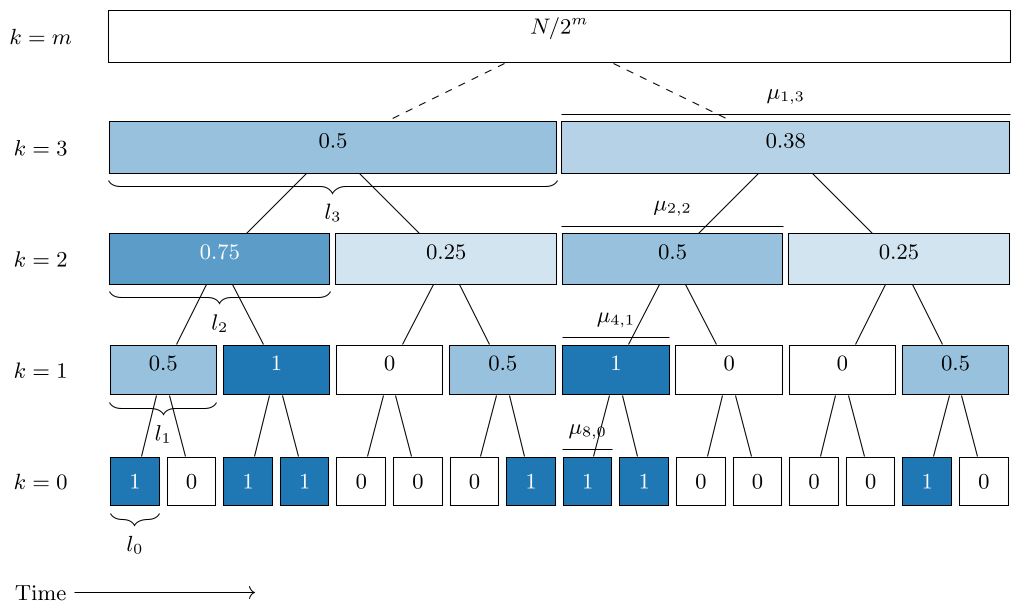 In the figure above, the tree structure shows how a discrete signal is aggregated. By analyzing the "partition function" (the sum of moments) of these densities, the researchers can calculate the Generalized Fractal Dimension .
The Statistical Fingerprint: Multi-fractality
In a simple (monofractal) system, a single scaling exponent describes the whole process. In a multi-fractal system, you need an entire spectrum of exponents because high-density "bursts" (large ) scale differently than low-density "voids" (small ).
Key Findings from the Data:
- Outbound vs. Inbound: Outbound flows (people leaving a train) are highly structured and "bursty" due to the train's arrival pulse. Their curves show steep declines, indicating rich multi-fractal structure. Inbound flows are more "spread out" and closer to the homogeneous Poisson ideal, though still non-random.
- Stairs vs. Escalators: Staircases exhibit stronger intermittency. The physical effort and varying speeds of walking on stairs create more "clumped" arrival patterns compared to the mechanical, steady "conveyor belt" delivery of an escalator.
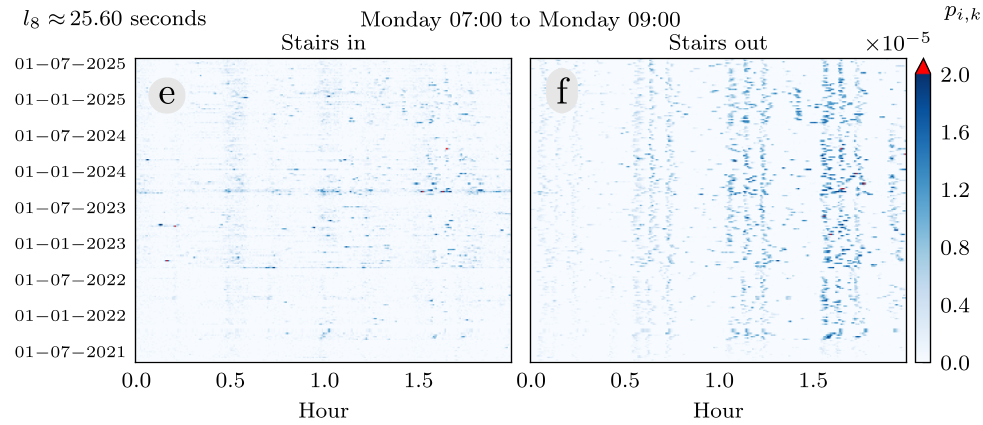 Heatmaps showing arrival probabilities across different scales (27 mins down to 26 seconds). The persistent "streaks" and clusters at every level are the visual signature of multi-fractality.
From Turbulence to Traffic: A New Modeling Frontier
The most striking takeaway is the methodological link to fluid turbulence. The authors suggest that since pedestrian arrivals behave like multi-affine fields (used to model the velocity of turbulent air), we can use the same mathematical generators to create "synthetic crowds."
Instead of feeding a simulation a steady stream of people, we should feed it a "cascading" signal that respects the multi-fractal dimensions found in the real world. This would allow urban planners to test infrastructure against "intermittent shocks"—the sudden, synchronized waves of people that actually cause system failures.
Conclusion & Future Outlook
This work highlights that the temporal "texture" of human behavior is far from random. By proving the multi-fractal nature of arrivals, the authors provide a bridge between social dynamics and statistical physics.
Limitations: The study focuses on a highly regulated environment (a train station with fixed schedules). Future work should investigate whether these multi-fractal signatures persist in "unforced" environments, such as shopping malls or public parks, where external schedules don't dictate the flow.
The Takeaway for Engineers: If you are designing for safety or capacity, the "average" is your enemy. The fractal "burst" is where the danger—and the real physics—lies.