
The paper investigates the breakdown of semiclassical geometry in 2D Jackiw-Teitelboim (JT) gravity. It proposes a new mechanism where non-perturbative quantum fluctuations, specifically the emergence of negative energy states in the dual random matrix ensemble, cause gravitational effective field theory to fail at a length scale of order $e^{S_0/3}$, much earlier than the previously assumed $e^{S_0}$.
TL;DR
In a striking challenge to the "conventional wisdom" of quantum gravity, John Preskill and his colleagues have revealed that the semiclassical description of spacetime in 2D JT gravity breaks down much sooner than we thought. While it was believed that the geometry of a black hole interior remains valid until its length reaches $e^{S_0}$, this paper proves that non-perturbative fluctuations—specifically rare negative energy states—cause a total breakdown at a mere $e^{S_0/3}$.
The "Counting" Fallacy: Why $e^{S_0}$ Was Only Half the Story
In the Holographic duality (AdS/CFT), we often view the bulk geometry as an effective description that should hold as long as the "complexity" or the "number of states" doesn't exceed the capacity of the boundary system ($N$ or $e^{S_0}$).
Previous benchmarks for this breakdown were:
- Discreteness: The boundary energy levels are discrete ($\Delta E \sim e^{-S_0}$), whereas the bulk is continuous.
- Null States: At lengths $\ell \sim e^{S_0}$, the bulk states must become overcomplete, leading to "null states."
However, the authors argue that the transition is not a sharp wall at $e^{S_0}$. Instead, quantum fluctuations allow the spacetime to "tunnel" into topologies that are highly sensitive to the tail of the energy distribution—including the mathematically valid but physically vexing negative energy region.
Methodology: Summoning the Genus Sum
The core of the paper lies in calculating the inner product $\langle \ell | V^\dagger V | \ell' \rangle$. In a semiclassical world, this is a delta function $\delta(\ell - \ell')$. In a quantum world, we must sum over all possible topologies (genus $g$).
 Figure 1: Diagrammatic representation of the sum over topologies (Wormholes). Each hole added suppresses the probability by $e^{-2S_0}$, but the "volume" of ways to add it grows with $\ell$.
The authors discovered that when $\ell \sim e^{S_0/3}$, the suppression from high genus is exactly offset by the growth in the "Weil-Petersson volumes" (essentially the number of ways to build a complex spacetime). By performing a full genus resummation in the "Airy limit," they found an exponential growth in corrections that was invisible to any single-order calculation.
The Intuition: The Power of Negative Thinking
Why does the breakdown happen so early? It comes down to the overlap between energy states and length states: $\langle E | \ell \rangle \sim e^{\ell \sqrt{|E|}}$ for $E < 0$.
Normally, we ignore negative energies. But in the Random Matrix Theory dual to JT gravity, the density of states $\rho(E)$ has a non-zero (though tiny) "tail" extending into the negative axis.
- The Rare Event: A member of the Hamiltonian ensemble might have a state with energy $E = -e^{-2S_0/3}$.
- The Amplification: Because of the $\sqrt{|E|}$ in the exponent, even a microscopic probability of having a negative energy state is amplified by the massive length $\ell$.
When $\ell$ hits $e^{S_0/3}$, this amplification factor wins. A single negative energy "ghost" in the spectrum can suddenly dominate the entire geometry.
Experimental (Numerical) Proof
The paper provides analytical results that match the "Airy Kernel" of matrix models. They show that not only does the average overlap explode, but the variance between different "universes" (ensemble members) is even larger.
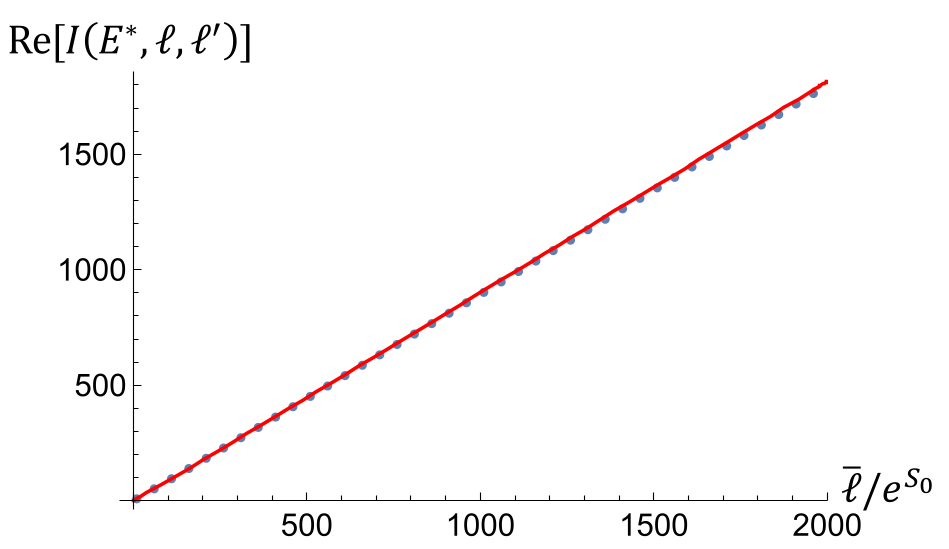 Figure 2: The real part of the overlap exponent. The blue dots (numerical) match the red line (analytic) perfectly, showing the transition into large, oscillating, and eventually divergent values at large $\ell$.
One of the most disturbing findings is that for a Thermofield Double state (a standard model for a two-sided black hole), the expected length becomes infinite at all times if these effects are included.
Critical Analysis: A Crisis in Effective Theory?
If the classical prediction for wormhole growth ($\ell = 2\pi t/\beta$) is destroyed by negative energies even at $t=0$, we have a problem. The authors suggest two exits:
- Microcanonical Constraints: Maybe the states we care about are "energy-filtered" to exclude the negative tail.
- Alternative Completions: Some versions of JT gravity (like Clifford Johnson’s non-perturbative model) are designed to have strictly positive spectra. The fact that Preskill’s result differs so much suggests that the choice of non-perturbative completion is not just a mathematical detail—it changes the very fabric of the interior geometry.
Takeaway
This work signals that the "Semiclassical Barrier" is much leakier than we imagined. If you are building a theory of the black hole interior, you cannot just count states; you must account for the extreme sensitivity of long geodesics to the non-perturbative "fuzz" of the quantum spectrum. Space isn't just discrete; it's precarious.