
GEM-Rec is a unified generative recommendation framework that integrates commercial monetization into sequence generation using Semantic IDs. It achieves state-of-the-art performance by co-optimizing organic relevance and ad revenue through a novel bid-aware decoding mechanism.
Executive Summary
The recommendation landscape is shifting from discriminative ranking to Generative Information Retrieval. While models like TIGER have set new benchmarks for organic relevance using Semantic IDs, they remain "economically blind"—unable to handle real-time auction bids or monetization targets.
GEM-Rec (Generative Marketplace Recommendation) is the first framework to unify organic content and sponsored ads within a single autoregressive sequence. By introducing a Bid-Aware Decoding mechanism, it allows platforms to steer recommendations toward high-value items in real-time, achieving a controllable balance between user satisfaction and platform revenue.
The "Economic Blindness" of Modern Recommenders
Current generative recommenders treat every item as an organic target. However, industrial systems must survive in a marketplace where:
- Objectives Diverge: Organic items maximize user preference; sponsored items must satisfy both relevance and auction revenue.
- Real-Time Volatility: Auction bids fluctuate constantly. A static model trained on historical logs cannot adapt to a sudden "Bid Shock" (e.g., a 10x spike in value for a specific category) without expensive retraining.
Methodology: One Model, Two Modes
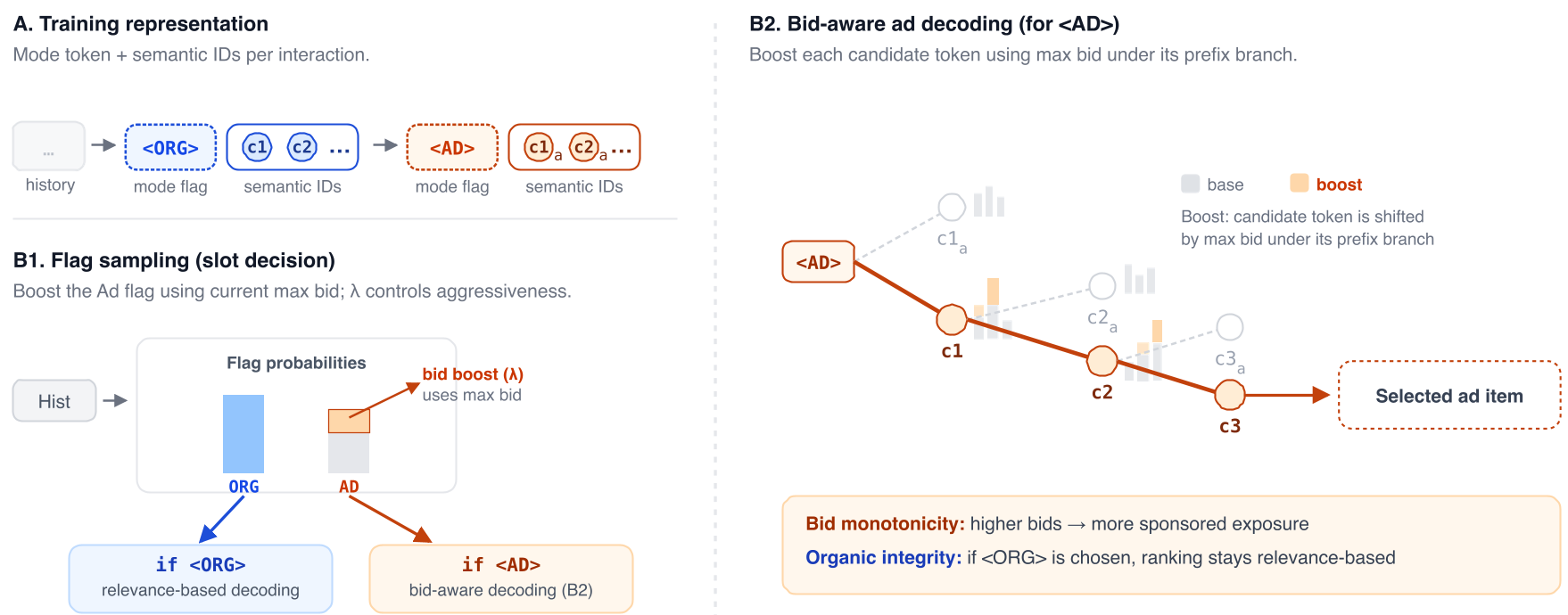
GEM-Rec addresses this by augmenting the hierarchical Semantic ID vocabulary with explicit control tokens: [<ORG>] and [<AD>].
1. Unified Sequence Architecture
The model factorizes the recommendation task into two steps:
- Step A (Slot Decision): The model predicts the mode token (
f_t). It learns from logs where ads were historically "feasible" without disrupting the user experience. - Step B (Mode-Conditional Retrieval): If
f_t = <AD>, the model shifts to "Monetization Mode," targeting inventory that is both semantically relevant and commercially viable.
2. Bid-Aware Decoding (The "How")
To avoid retraining when bids change, GEM-Rec uses Logit Modulation at inference time. The logits for the <AD> branch are "boosted" by the bid values ($\lambda \cdot \log(1 + b)$).
This mechanism satisfies Allocative Monotonicity: a higher bid will never decrease an ad's likelihood of being shown. Crucially, it also ensures Organic Integrity—the internal ranking of organic items remains untouched even when the system is aggressively pushing for revenue.
Experimental Insights
The authors validated GEM-Rec across four major datasets (Steam, Amazon Beauty/Sports/Toys).
The Pareto Frontier
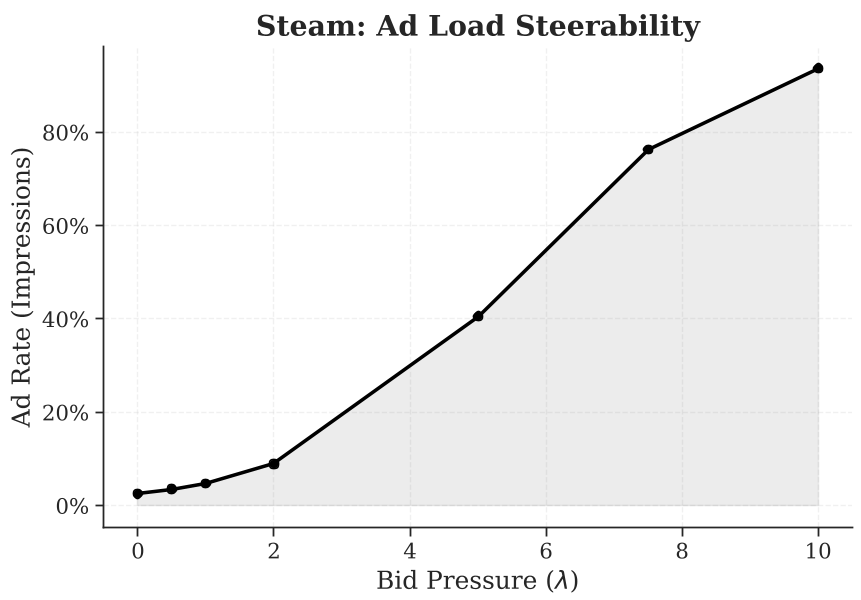
As the steering parameter $\lambda$ increases, the platform generates more revenue, but Total NDCG (policy fit) gradually declines. This creates a predictable Pareto Frontier, allowing engineers to choose the exact operating point for the business.
Rapid Adaptation to Bid Shocks
In a "Bid Shock" simulation (multiplying 5% of bids by 10x), GEM-Rec at $\lambda=0.5$ increased the high-value ad share from 21.8% to 81.5%, resulting in a 9x revenue uplift with only a minor increase in total ad load. This proves the system's "plasticity" in volatile markets.
Critical Analysis & Conclusion
GEM-Rec represents a significant step toward Mechanism Design in Generative AI.
- Strength: It provides a mathematical guarantee that increasing a bid increases exposure (monotonicity), which is vital for advertiser trust.
- Limitation: While it uses first-price auctions for simplicity, the authors note that full incentive compatibility (DSIC) is complex in sequential generation due to the need for counterfactual evaluation.
- Future Work: The "hallucination-free" nature of this model (100% validity rate) suggests that future iterations could scale to even larger vocabularies or more complex auction types like GSP or VCG.
Takeaway: Don't just model the user; model the marketplace. GEM-Rec proves that we can maintain high-quality organic recommendations while turning the generative decoder into a high-performance auction engine.