
This paper presents the first general relativistic magnetohydrodynamic (GRMHD) simulations of a recoiling supermassive black hole (SMBH) interacting with a magnetically arrested circumbinary disk (CBD). It identifies that the recoil geometry (vertical, horizontal, or oblique) is the primary determinant of the post-merger accretion dynamics and whether relativistic jets are sustained, quenched, or intermittent.
TL;DR
When supermassive black holes (SMBHs) merge, they often receive a "kick" or recoil from anisotropic gravitational wave emission. This paper reveals that the direction of this kick—whether it shoots the BH out of the galactic plane or slams it into the surrounding gas—dictates whether we see a steady relativistic jet, a sudden thermal flare, or a chaotic series of intermittent outbursts. By using the first GRMHD simulations of this process, the authors bridge the gap between gravitational wave detection and electromagnetic observations.
Problem & Motivation: Beyond Hydrodynamics
For decades, the "afterglow" of a black hole merger was modeled as a simple gas-refilling problem. However, real galaxies are messy and highly magnetized. Previous models missed a critical component: Magnetic Fields. Magnetic fields allow black holes to enter a "Magnetically Arrested Disk" (MAD) state, launching powerful relativistic jets.
The core question is: How does a sudden change in the black hole's velocity (the recoil) disrupt the magnetic "funnel" that powers these jets? Depending on the angle of the kick, the physics shifts from stable accretion to violent shock heating.
Methodology: The First Magnetized Recoil Model
The researchers used a sophisticated 3D GRMHD framework (AthenaK) to simulate a $10^8 M_\odot$ black hole remnant. They initialized the simulation using data from a realistic pre-merger circumbinary disk (CBD) that was already in a highly magnetized state.
Key Geometries Explored:
- Vertical Recoil (90°): The BH is kicked perpendicular to the disk.
- Horizontal Recoil (0°): The BH plows directly through the dense disk material.
- Oblique Recoil (45°): A middle-ground that introduces complex tilting and warping.
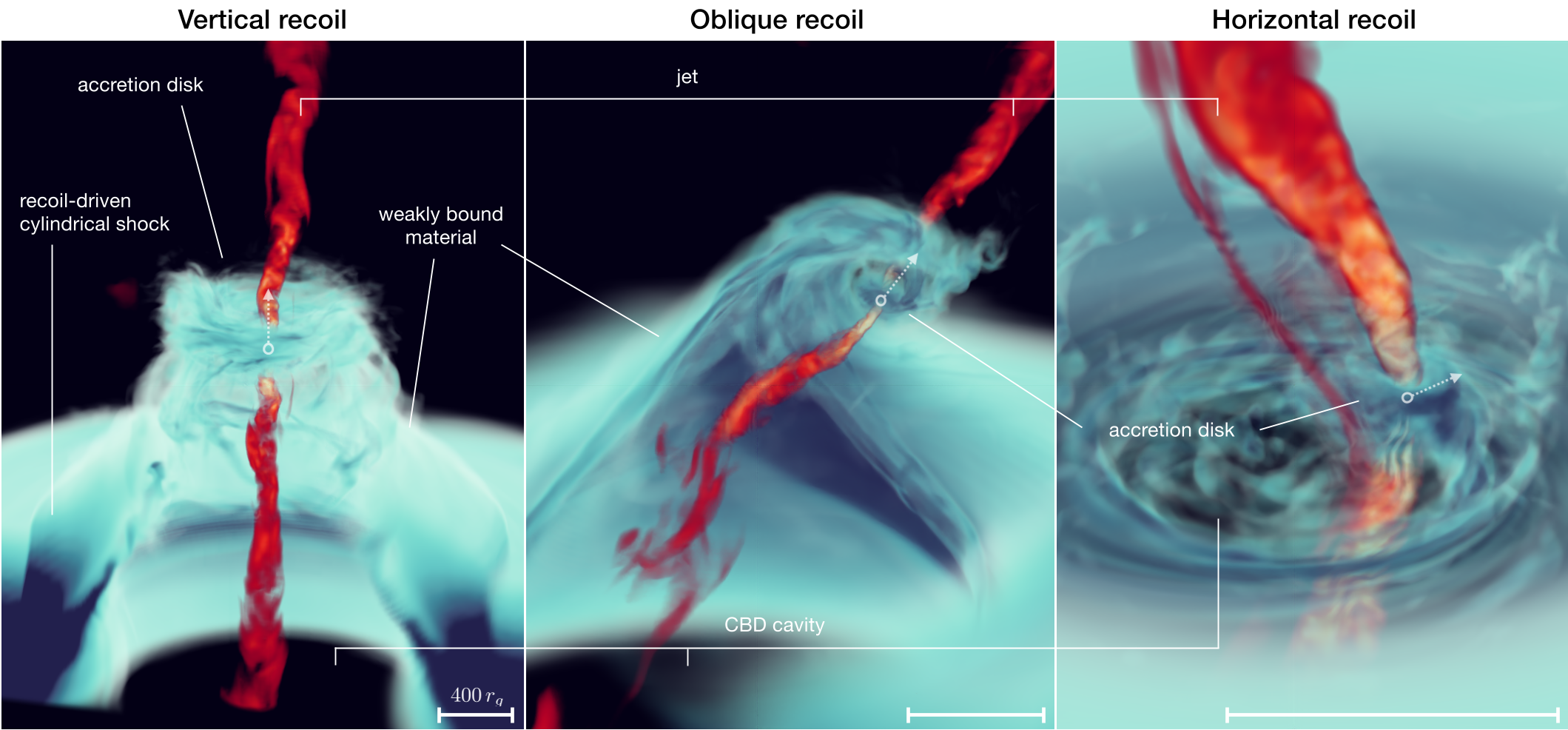 Figure 1: Comparison of global gas density and jet structures for Vertical (left), Oblique (center), and Horizontal (right) recoils.
Methodology Detail: The Jet-Disk Interaction
In the Vertical case, the black hole carries its own "mini-disk" of gas with it, acting like a portable AGN.
In the Oblique case, things get chaotic. The incoming gas is misaligned with the BH's spin, causing the accretion disk to warp. This results in a "tug-of-war":
- The jet tries to align the disk to its spin.
- The disk gas pressure tries to tilt the jet. This leads to intermittent jet outbursts, as shown in the sequence below:
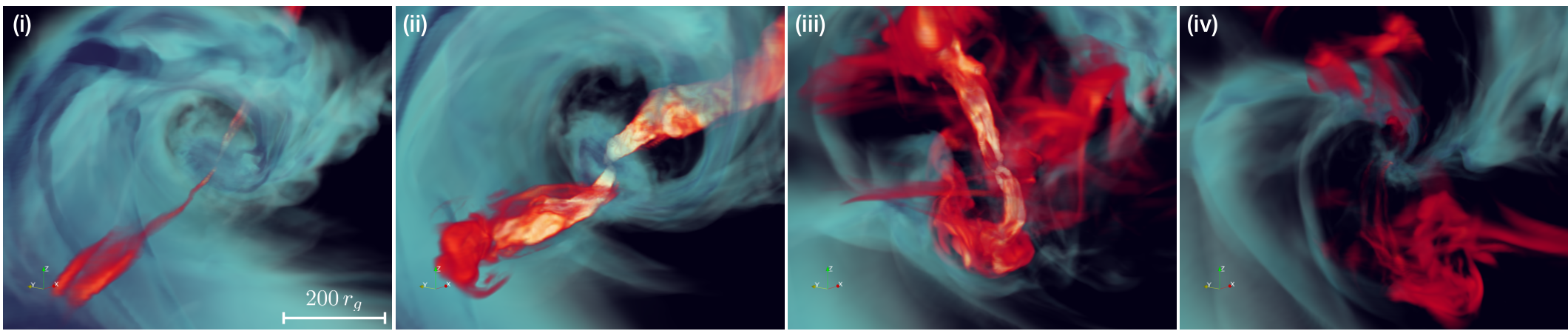 Figure 2: Time evolution of an oblique recoil showing the episodic destruction and reformation of the gas supply.
Experiments & Results: Quenching and Heating
The most dramatic results occurred in Horizontal recoils. As the BH moves through the disk at speeds near $0.05c$, it experiences massive ram pressure. This pressure actually quenches the jet, switching off the non-thermal radio/X-ray signature.
However, this kinetic energy is not lost—it is converted into heat. The simulation measured a massive spike in the total internal energy ($U$) of the gas, which would manifest as a bright thermal UV or Optical flare.
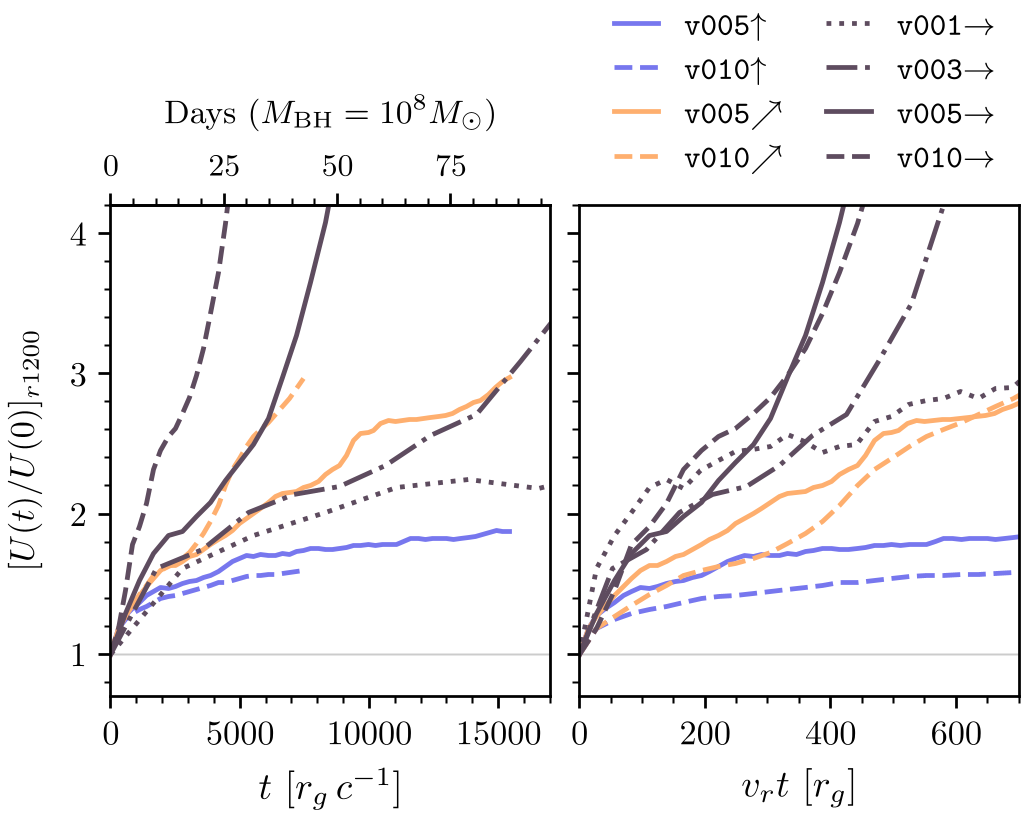 Figure 3: Internal energy evolution. Horizontal (v005→) and Oblique (v005/) recoils show significantly higher shock heating compared to Vertical (v005↑) kicks.
Critical Insight & Conclusion
This work provides a "Rosetta Stone" for future multi-messenger astronomy. When LISA (Laser Interferometer Space Antenna) detects a merger, it will tell us the mass and spin of the BHs. By observing the specific timing and spectrum of the electromagnetic afterglow (the "EM counterpart"), we can now work backward to determine the orientation of the galaxy's gas disk and the exact direction the black hole was kicked.
Limitations: The simulations currently ignore radiative cooling and the long-term impact of the galactic environment beyond $10^4$ gravitational radii. Future iterations incorporating radiative transport will be necessary to provide exact light curves for telescope observers.
The Takeaway: Post-merger signatures are not just "fading echoes"—they are dynamic, geometry-dependent events that reveal the invisible magnetic structure of the universe's most violent mergers.