
SpUDD is a novel framework for reconstructing high-quality polygonal meshes from discrete, unsigned distance functions (UDFs). It introduces the "superpower contour," a theoretical structure derived from power diagrams that serves as a robust surface proxy, achieving state-of-the-art performance in meshing non-orientable, open, and non-manifold geometries.
In the world of 3D geometry processing, Unsigned Distance Functions (UDFs) are the "wild west" of implicit representations. Unlike their well-behaved cousins, Signed Distance Functions (SDFs), UDFs don't care about "inside" or "outside." This indifference makes them incredibly flexible—capable of representing open surfaces like a piece of cloth or non-manifold intersections like a double-cross—but it also makes them a nightmare to turn into a usable mesh.
Traditionally, if you only had a discrete grid of UDF values, you were stuck. Most algorithms required gradients, continuous sampling, or heavy neural priors to guess where the surface actually lived. SpUDD (Superpower Contouring of Unsigned Distance Data) changes the game by introducing a new theoretical construct: the Superpower Contour.
TL;DR
SpUDD is the first robust method designed to reconstruct polygonal meshes from a finite set of discrete UDF samples. By leveraging the geometric properties of Power Diagrams, it identifies surface locations without needing signs or gradients, outperforming current state-of-the-art UDF meshing techniques by significant margins in both accuracy and topological consistency.
The Motivation: Why UDFs are Hard
The fundamental issue with UDFs is localization. In an SDF, a sign flip (positive to negative) tells you exactly which grid edge the surface crosses. In a UDF, everything is positive. At the surface, the value is zero, but if your grid samples don't land exactly on zero, you only see a local minimum.
Previous attempts to mesh UDFs usually tried to estimate gradients to "guess" a sign, but at the zero-level set, gradients are non-differentiable. This leads to the "catastrophic failures" seen in many current methods: holes, grid-aligned noise, or entirely empty meshes.
Methodology: Entering the Superpower Diagram
The core innovation of SpUDD is the Superpower Contour (). The authors treat every distance sample as a seed for a Power Diagram.
- The Power Distance: Instead of standard Euclidean distance, they use a power distance that treats each sample as a sphere of radius .
- Filtering Faces: They define the Superpower Contour as the subset of faces in this diagram that do not poke into the interior of any of these spheres.
- The Proof: Mathematically, the authors prove that as your sampling density increases, this filtered set of faces converges exactly to the true underlying surface.
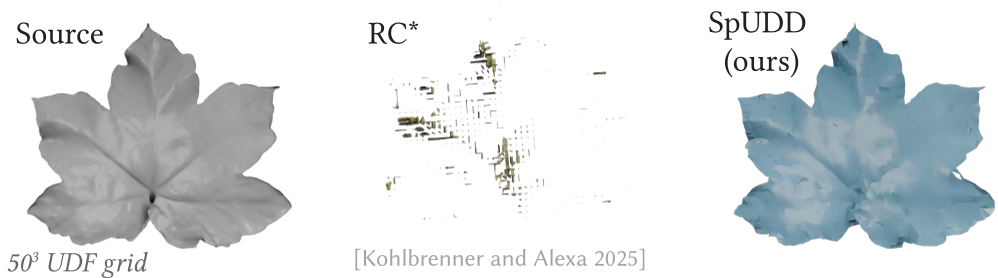 Figure: The SpUDD pipeline—from raw unsigned distance data to the Power Diagram, then filtering for the Superpower Contour, and finally optimizing for the quad mesh.
From Proxy to Mesh: Dual Optimization
Once the is found, it acts as a "proxy." The algorithm identifies "active" edges in the grid (edges that intersect the ). It then performs a local-global optimization:
- Local: Each grid cell optimizes a vertex position to be tangent to the distance spheres.
- Global: Vertices are connected into a quad mesh, and "Hermite data" (crossing points and normals) are updated iteratively.
Crucially, the authors use the Superpower Contour to solve the "data assignment" problem—mapping distance samples to specific grid cells—which prevents the optimization from getting stuck in bad local minima.
Experiments: SOTA Performance
The authors tested SpUDD against a gauntlet of competitors including MeshUDF, GeoUDF, and Neural Dual Contouring (NDC).
Across three distinct datasets—closed CAD shapes (ABC), open clothing (DeepFashion3D), and non-manifold intersections (SALS)—SpUDD consistently delivered cleaner topology.
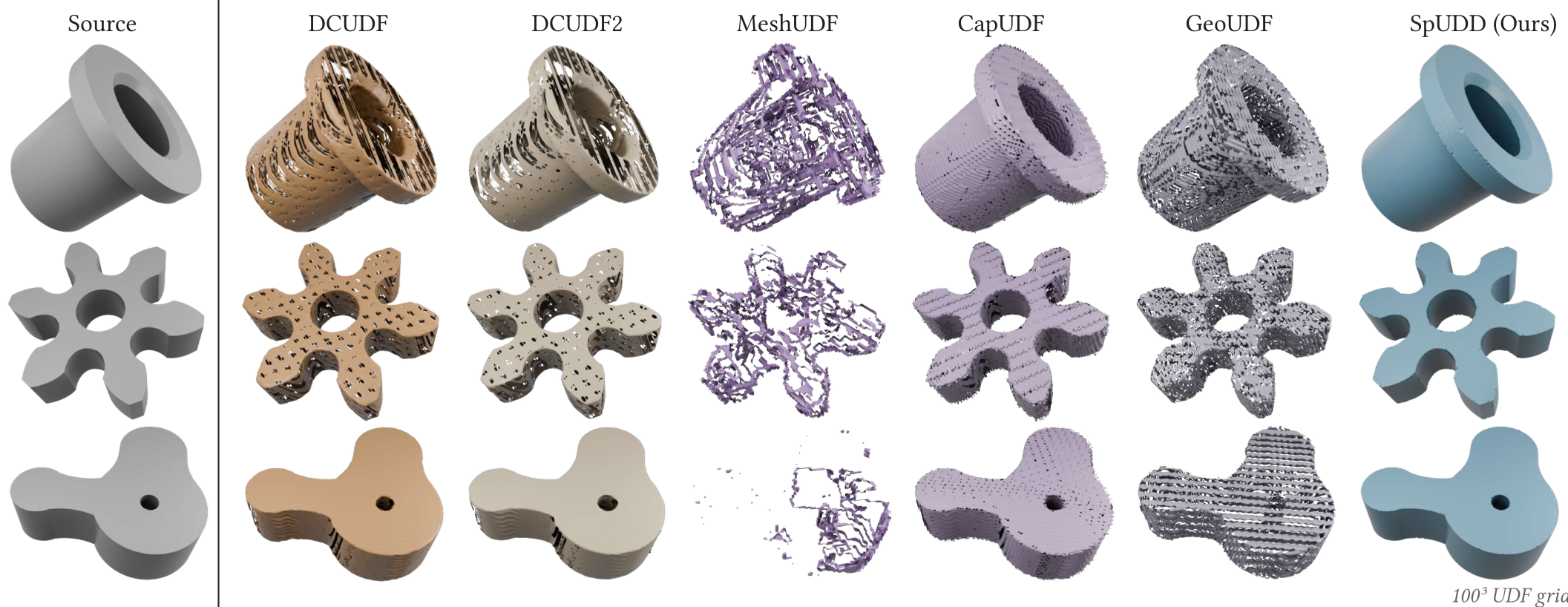 Table: Quantitative comparison showing SpUDD (Ours) achieving the lowest Chamfer and Hausdorff errors.
The visual results are even more striking. Where other methods produce "swiss cheese" meshes or grid artifacts, SpUDD produces smooth, contiguous surfaces that respect the true geometry of the UDF.
Deep Insights & Limitations
SpUDD's magic lies in its ability to handle non-orientable and non-manifold geometry. Because it never relies on a global "in/out" sign, it doesn't get confused by a surface that intersects itself or has no "inside."
Limitations:
- Exact Distance Requirement: The theory relies on the input being the exact distance. If the data is noisy or comes from a "quasi-distance" field, the Superpower Contour might miss faces or include noise.
- Computational Cost: Calculating the Power Diagram is . While efficient, it is slower than a simple single-pass Marching Cubes.
Conclusion
SpUDD is a significant theoretical and practical leap for geometry processing. It proves that we don't need signs to find surfaces. This opens the door for better mesh extraction from 3D GANs, diffusion models, and raw sensor data, where UDFs are often the most natural representation. As the authors put it, this "sets the stage for future work on this mathematically rich problem."