
The paper introduces STAR-magic mutation (SMM), a hybrid protocol for implementing high-fidelity logical analog rotation gates on early fault-tolerant quantum computers. By combining Transversal Multi-Rotation (TMR) and Magic State Cultivation (MSC), it achieves an error scaling of O(θ²(1-Θ(1/d))pph), reaching state-of-the-art performance for small-angle rotations within a single surface code patch.
TL;DR
Researchers from Fujitsu and Osaka University have unveiled STAR-magic mutation (SMM), a protocol that allows early fault-tolerant quantum computers (FTQC) to execute analog rotation gates with unprecedented fidelity. By intelligently "mutating" between analog transversal rotations and digital T-gate synthesis, this method reduces error rates by two orders of magnitude while maintaining a compact footprint, potentially enabling the simulation of complex molecules like [4Fe-4S] clusters with realistic hardware (pph = 10⁻³).
The Motivation: The "RUS" Bottleneck
In the quest for practical quantum advantage, the field is transitioning from NISQ to Early-FTQC. However, two major hurdles remain:
- Digital Synthesis Overhead: Standard Clifford+T synthesis for arbitrary rotations is incredibly "deep" and resource-heavy.
- The Analog Error Floor: Previous STAR architectures (using the Clifford+ϕ set) utilized a Repeat-Until-Success (RUS) mechanism. In RUS, if a rotation fails, you try again with double the angle. Eventually, you hit large angles where errors scale linearly with the physical error rate ($O(θ_L p_{ph})$), creating a precision ceiling.
The authors' key insight: Don't treat all rotation angles the same. Use cheap analog methods for tiny angles and save the "expensive" digital magic states for when the angles get dangerously large.
Methodology: The Architecture of SMM
SMM defines a new paradigm: the Clifford+T+ϕ gate set. The protocol operates in two stages:
1. The Analog Stage (Targeting Efficiency)
As long as the rotation angle $ heta_{RUS}$ is below a threshold $ heta_{th}$, the system uses the Transversal Multi-Rotation (TMR) protocol. This prepares the resource state $|m_{ heta_L}\rangle$ within a single surface code patch. To manage coherent errors, the authors developed Higher-order Probabilistic Coherent Error Cancellation (PCEC), which uses probabilistic sampling to "untwist" over-rotation errors.
2. The Digital Stage (Targeting Precision)
Once the RUS angle doubles past $ heta_{th}$, the protocol "mutates." It abandons the noisy analog approach and switches to deterministic T-gate synthesis using Magic State Cultivation (MSC). Because this switch happens rarely, the time penalty is negligible, but the precision benefit is massive.
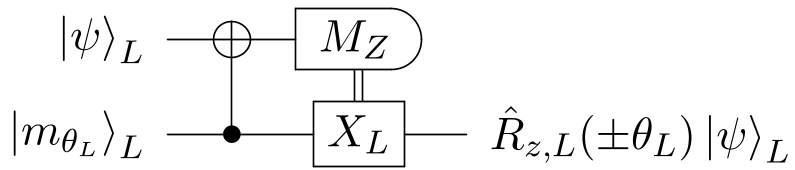 Figure 1: The Gate-Teleportation circuit used for SMM, utilizing both analog resource states and digital magic states.
Benchmarking Performance
The results are striking. Under a realistic physical error rate of $10^{-3}$:
- Precision: For small angles ($<10^{-5}$), SMM is 100x more accurate than standard T-gate synthesis.
- Speed: It is 100x faster than pure digital methods because it bypasses massive synthesis chains for the majority of the circuit.
- Scaling: While previous STAR versions required $p_{ph} = 10^{-4}$ to be useful, SMM works at $10^{-3}$, moving the goalposts closer to today's experimental realities.
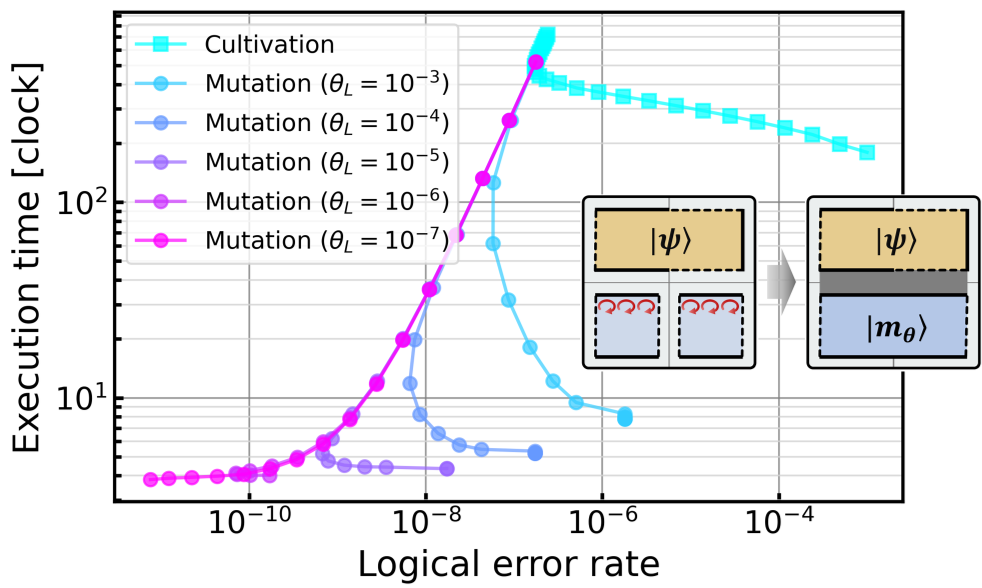 Figure 2: Logical error rate vs. Execution time. SMM (bottom-left) achieves both the lowest time and lowest error compared to traditional cultivation.
Practical Application: Simulating the [4Fe-4S] Cluster
To prove the architecture's worth, the authors analyzed the TE-PAI (Time Evolution by Probabilistic Angle Interpolation) algorithm for molecular dynamics. They estimated that a [4Fe-4S] cluster—a complex bio-molecule crucial for electron transfer—could be simulated with:
- Physical Qubits: ~190,000
- Runtime: Within one week
- Error Rate: $p_{ph} = 10^{-3}$
This is a landmark estimation. It suggests that we don't need millions of qubits or "perfect" $10^{-5}$ physical gates to start doing chemistry that is impossible for classical supercomputers.
Critical Insight & Conclusion
The real value of STAR ver. 3 lies in its locality. Because both TMR and MSC can be performed "in-place" on a single surface code patch, the architecture is horizontally scalable. You can parallelize rotations without building massive, centralized "Magic State Factories" that act as communication bottlenecks.
Limitations: The protocol is sensitive to control errors (calibration shifts). While the authors suggest QPE-based calibration, real-time drift in logical rotation angles remains an engineering challenge for future STAR implementations.
In summary, STAR-magic mutation is a sophisticated "best of both worlds" approach that likely defines the blueprint for the first generation of useful, compact, fault-tolerant quantum simulators.