
The paper introduces a theory for "topological-topological" ($top^2$) flat bands, which are electronic flat bands that possess both real-space localized zero modes (compact localized states) and well-defined, non-trivial topological invariants like Chern numbers or $Z_2$ indices. By imposing a new linear dependence condition on real-space loop states, the authors remove the common singularity at band-touching points, allowing for stable topological phases in dispersionless systems.
TL;DR
Researchers have unveiled a new class of electronic states called Topological-Topological ($top^2$) Flat Bands. While traditional flat bands (like those in the Kagome lattice) suffer from a "topological singularity" that prevents them from having well-defined invariants, this new theory introduces a symmetry-based "Second Topological Condition" that smooths out the singularity. This allows for flat bands that are both dispersionless and robustly topological (Chern or $Z_2$), providing a perfect playground for studying fractionalized phases and correlated insulators.
Problem & Motivation: The Curse of the Singularity
In condensed matter physics, flat bands are the "holy grail" for studying strong correlations because the kinetic energy is suppressed, making electron-electron interactions the dominant driver of physics. However, there has long been a "no-go" intuition: if a flat band is formed by local orbitals (Compact Localized States, CLSs) and has non-trivial topology, it usually hits a mathematical snag.
In models like the Lieb lattice, the CLSs satisfy a condition that forces a band touching point in momentum space. At this point, the wavefunction becomes singular—it depends on the direction from which you approach it. This "singularity" makes it impossible to define a Chern number for the band as a whole. The authors asked: Can we keep the flatness and the locality, but fix the singularity to define a real topological invariant?
Methodology: The Power of Linear Dependence
The core insight of the paper is the Second Topological Condition.
- The First Condition (Real Space): CLSs must be "total derivatives," meaning their sum over a region only leaves residues at the boundary (Loop States $\Theta_x, \Theta_y$).
- The Second Condition (The Innovation): The authors demand that these loop states $\Theta_x$ and $\Theta_y$ be linearly dependent ($\Theta_y = \lambda \Theta_x$).
Why does this work?
Physically, this ensures that as you approach the band-touching point $\mathbf{k}=0$ from any direction, the limit of the wavefunction is the same. Mathematically, it makes the Projector $P(\mathbf{k})$ continuous.
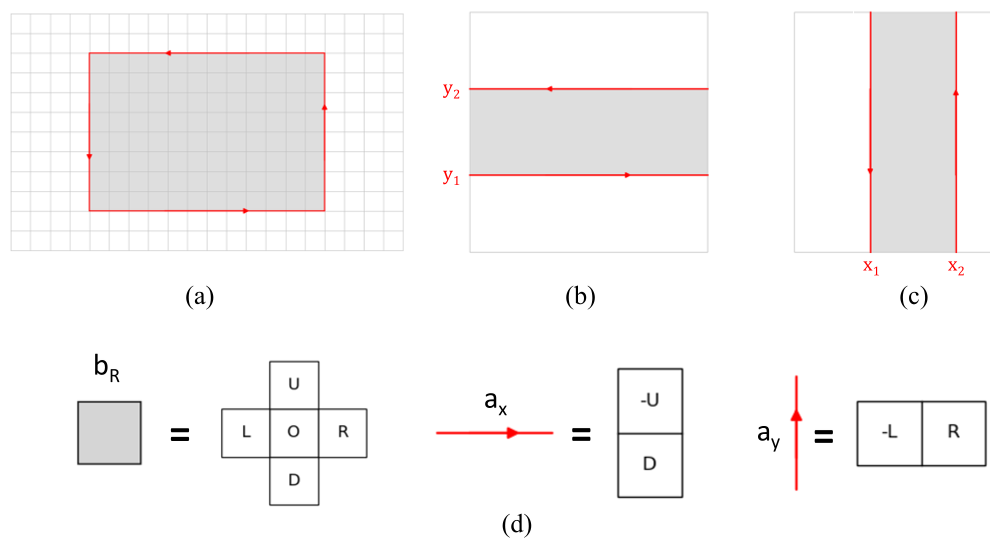 Fig 1. (a-c) Construction of loop states from CLSs. (d) A square lattice model satisfying the new $top^2$ conditions.
By tuning the coefficients of the CLS (as shown in the table below), the authors can "engineer" the phase winding of the wavefunction to produce a Chern number $C=1$ or a $Z_2=1$ invariant.
 Table 1. Explicit wavefunctions for 2D Square, Hexagonal, and 3D top2-flat bands.
Experiments & Results: From Theory to Correlation
The authors didn't just stop at non-interacting models. They asked: What happens when electrons start talking to each other?
1. Dynamic Mass Generation
Using Hartree-Fock analysis, they showed that even infinitesimal interactions (Hubbard repulsion or attraction) generate a "symmetric mass term." This mass term lifts the degeneracy at the touching point. Because the band already had a "latent" topological invariant, the resulting gapped state is a Correlated Topological Insulator.
2. Universal 3D Construction
By using "layer construction" and "topological crystal" methods, they proved that $top^2$-flat bands can be constructed for all topological crystalline states in 218 out of 230 space groups. This demonstrates the universal applicability of their framework.
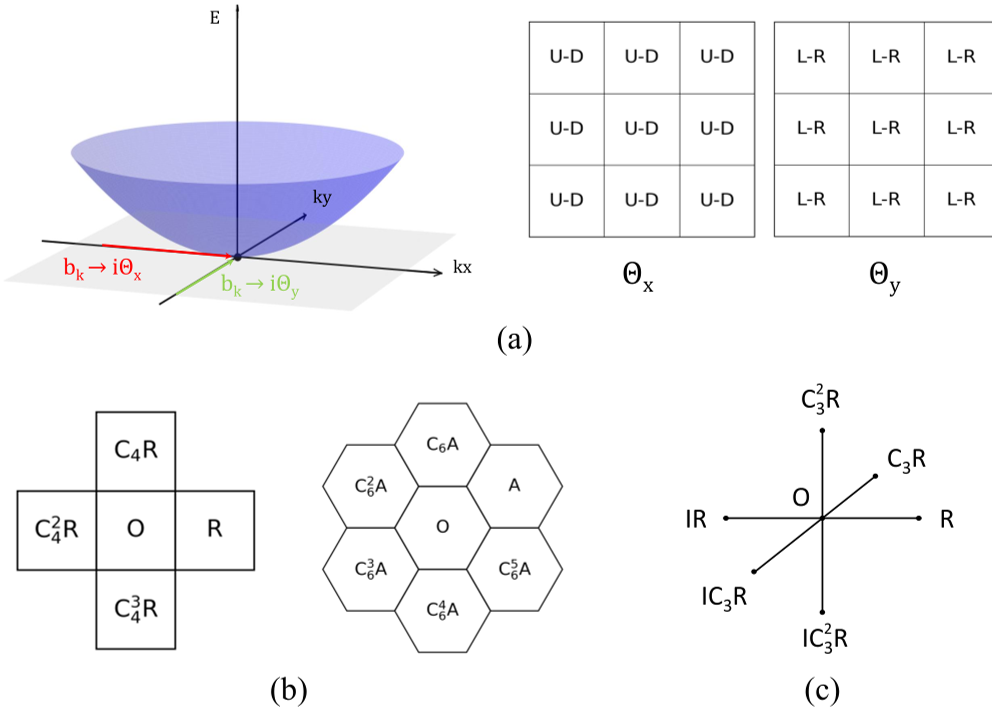 Fig 2. (a) Singular projector in standard flat bands vs (b) Smooth, winding projector in $top^2$ bands leading to $C=1$.
Critical Analysis & Takeaways
The beauty of this work lies in its "constructive" nature. Instead of just proving that such bands can exist, the authors provide the exact recipe (parent Hamiltonians) to build them.
- Value Strategy: The work bridges the gap between Real-Space CLS Theory and Momentum-Space Topology.
- Limitations: While the bands are "exactly flat" in the non-interacting limit, generic Hubbard interactions will introduce some dispersion (the "flatness" is not protected by a symmetry against all interactions).
- Future Impact: This provides a theoretical foundation for searching for Fractional Chern Insulators in Moiré systems or cold atom lattices without the need for external magnetic fields, using the inherent $top^2$ nature of the bands.
Conclusion
The theory of $top^2$-flat bands effectively "tames" the singularity of frustrated hopping models. It proves that we can have our cake (locality and flatness) and eat it too (robust topology), opening a new door for identifying exotic quantum materials in $(2+1)D$ and $(3+1)D$.