
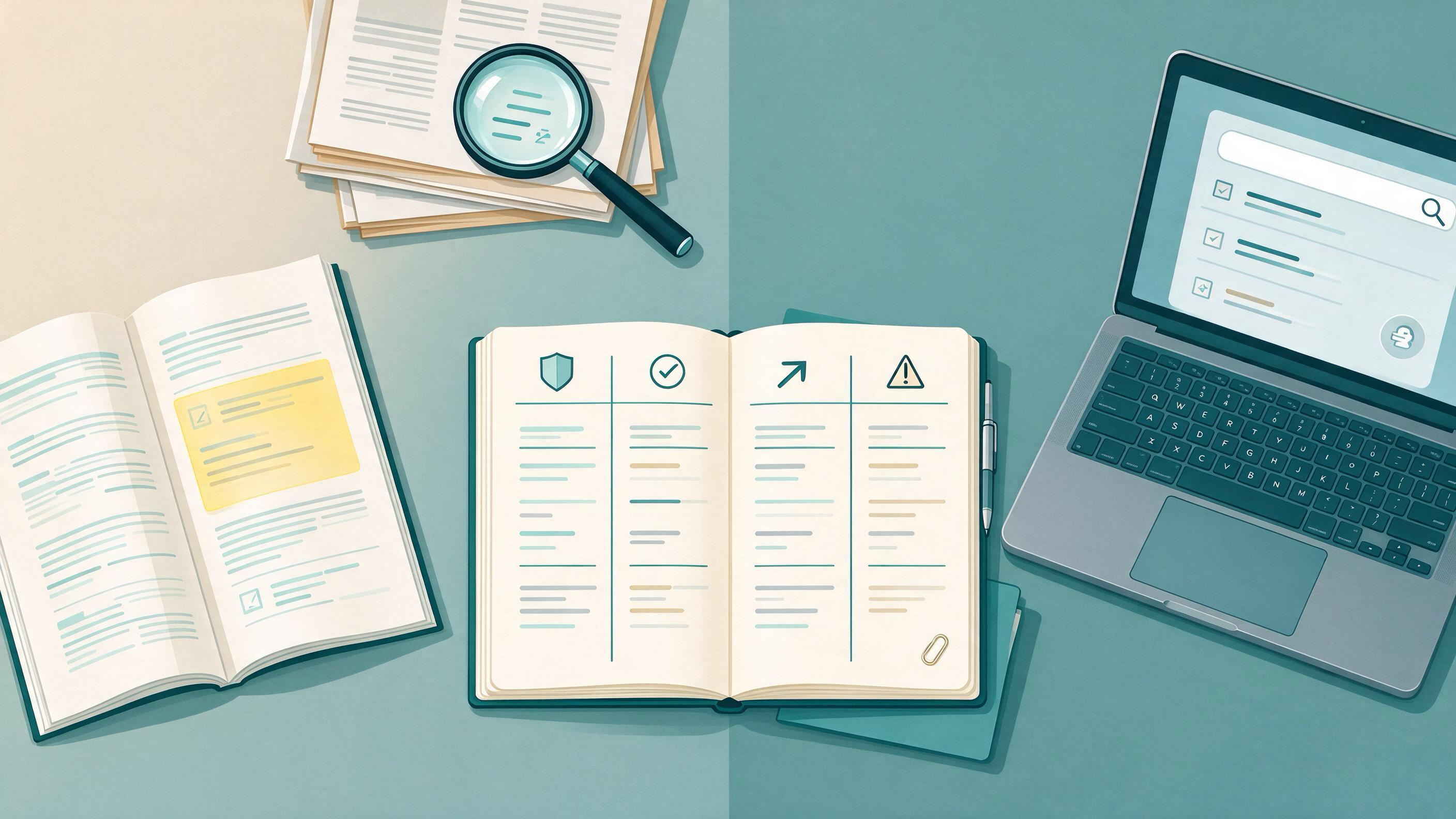
You are drafting an evidence brief for a journal club or a departmental update. The guideline you are summarizing makes a clean recommendation, and it points to a reference that should settle the question. You paste the citation into a database, and nothing comes back. Or you find a record, but it is a conference abstract with no numbers, or a secondary review that cites yet another paper you also cannot open. The recommendation now rests on a citation you cannot verify, and your brief has a hole in it.
This is a common and fixable situation. The task is not to defend the guideline or to quietly drop the reference. It is to reconstruct the citation trail, decide what the underlying evidence actually supports, and produce a brief that states clearly what is known, how strong the evidence is, and where it applies. This article walks through that repair process using a focused example, then shows where a research assistant such as WisPaper fits at each step.
What does it mean when a guideline citation cannot be located?
A citation that cannot be located is usually one of several distinct problems, and they call for different repairs. Before assuming the evidence does not exist, separate these possibilities:
- The record exists but is indexed differently. Titles change between preprint, conference, and journal versions; author names may be transliterated differently; the guideline may cite a report, chapter, or registry entry rather than a journal article.
- The citation is incomplete or garbled. A missing volume, a wrong year, or a truncated author list can defeat a naive lookup even when the paper is indexed.
- The cited item is a secondary source. The guideline may point to a review or a summary that itself cites the primary study. The trail continues one step back.
- The item is genuinely hard to retrieve. It may be behind a paywall, in a non-indexed journal, or available only as a supplement.
Cochrane guidance on searching for studies is useful here because it treats searching as a planned, documented process rather than a single query. It recommends planning searches from explicit eligibility criteria, using multiple sources, combining free-text terms with subject headings, documenting the process, deduplicating records, screening in stages, and linking multiple reports of one study. Those same habits apply when you are chasing one elusive citation.
A worked example: a screening recommendation with a missing primary study
To keep the decisions concrete, imagine a brief on a defined population and outcome. The guideline recommends a particular screening approach for a specified adult population, and the stated outcome of interest is detection of a named condition at an earlier stage. The guideline grades the recommendation and attaches a citation.
When you try to verify it, the trail breaks. The cited record turns out to be a summary that references a primary trial, and the trial's report is not where the summary says it is. Your job is to answer four separate questions, and it helps to keep them apart:
- What is the evidence level? Is the underlying source a randomized trial, an observational study, a diagnostic accuracy study, or a synthesis of several studies?
- Does it apply to your population? Does the study enroll people like those in the guideline's recommendation, with the same baseline risk and care setting?
- Is the evidence direct or indirect? Does it measure the outcome you care about, in the comparison you care about, or does it measure a surrogate or a different comparison?
- What are its limitations? Sample size, follow-up duration, risk of bias, and consistency with other studies all shape how much weight the finding can carry.
These are not the same question asked four ways. A study can be high-level evidence and still be indirect for your brief; a study can be directly applicable and still have serious limitations. Keeping the four judgments separate is what turns a missing citation into a defensible statement.
How do you rebuild the search from eligibility criteria?
The first repair is to stop searching for the citation and start searching for the evidence. Write down, in plain terms, what would count as a relevant study: the population, the intervention or exposure, the comparison, and the outcome. That short list is your eligibility criteria, and it is what Cochrane guidance means by planning a search before running it.
With criteria in hand, search for the study the guideline probably relied on, not the exact string the guideline printed. Try the intervention and outcome terms together, then broaden. If the guideline's summary cites a primary trial, search for that trial by its distinguishing features rather than by the citation as printed.
This is where a scholarly search interface earns its place. Using WisPaper search lets you run topic-level queries and pull candidate papers into one working space, which is faster than repeating the same broken citation lookup across several databases. For readers who want a general orientation to what the tool does before starting, the WisPaper homepage describes it as an AI research assistant for finding, screening, organizing, and working with academic papers.
How do field tags, MeSH, and search details sharpen a failed lookup?
When a topic search returns too much noise, the fix is usually vocabulary control. PubMed supports field tags, phrase searching, filters, Advanced Search, saved searches, Similar Articles, citation lookup, and links to full text when available, and its search details show how your terms were translated and combined. That translation view is often the fastest way to see why a lookup failed: a phrase may have been split, a term mapped somewhere unexpected, or a filter silently excluded the record you wanted.
MeSH, the National Library of Medicine's controlled and hierarchical vocabulary, adds another lever. Preferred headings, entry terms, scope notes, qualifiers, and tree positions let you expand or focus a strategy deliberately. If your population term is too narrow, moving up the tree broadens it; if your outcome term is ambiguous, a qualifier or scope note tells you which sense the indexer used.
A practical sequence for a stubborn citation:
- Run the citation lookup as printed and note the exact failure.
- Check the search details to see how the terms were interpreted.
- Rebuild the query from your eligibility criteria using free-text terms plus the relevant subject headings.
- Use Similar Articles on any near-miss record to surface the study the guideline likely meant.
- Save the working query so the search can be rerun later.
Cochrane guidance also recommends rerunning searches before publication. For a brief, that means rechecking your rebuilt strategy shortly before you finalize, so a newly indexed version of the study does not slip past you.
Which source should you trust when the trail splits?
Once you have candidates, you face a decision: which source carries the claim? A guideline summary, a systematic review, and a primary trial are not interchangeable, and the trail often splits into several reports of the same study.
Cochrane guidance explicitly recommends linking multiple reports of one study. That matters here because a single trial may appear as a protocol, a conference abstract, a main results paper, and a long-term follow-up. If you treat these as separate studies, you will overcount the evidence; if you treat only the abstract as the study, you will undercount what is known.
A workable rule for the brief:
- Cite the primary study for the effect, and cite the guideline for the recommendation.
- Note when several reports describe one study, and say so rather than listing them as independent findings.
- Prefer the most complete report for numbers, and flag when you are relying on an abstract because the full report is unavailable.
When you need to screen a reference list at scale, TrueCite checks BibTeX against real academic databases to flag hallucinated references. That is useful when a draft bibliography has grown faster than your verification, and it complements rather than replaces the manual trail you are rebuilding.
How do you judge applicability and indirectness for your population?
Applicability and indirectness are where most briefs go wrong, because they are easy to assert and hard to demonstrate. Work through them explicitly.
Applicability asks whether the study population resembles the population in your brief. Consider the care setting, baseline risk, age range, and how participants were selected. A trial in a highly selected group may support a narrower statement than the guideline's broad recommendation.
Indirectness asks whether the study measured the comparison and outcome you care about. If the trial reported a surrogate marker rather than the clinical outcome in your brief, the evidence is indirect for that outcome even if the study is otherwise strong.
Limitations asks how much confidence the study's own design and conduct support: sample size, follow-up, risk of bias, and consistency with related studies.
Keep these as three separate sentences in your notes, not one blended judgment. A statement like "the evidence is limited" hides which of the three problems you actually found, and your readers cannot act on it.
Where should the retrieved papers live while you work?
A repair like this generates a small pile of material: candidate records, near-miss citations, the primary report, and the guideline itself. Losing track of which version you screened is a common cause of errors later.
Save the papers you are actually using in My Library, where you can save or upload papers and organize them. Keeping the guideline, the primary study, and any linked reports together makes the trail auditable when a colleague asks why a citation changed.
If your brief is part of a larger team effort, Research Projects gives you a place to create a project and keep the work associated with it. And when you need to ask questions across the papers you have already collected, Library QA lets you ask questions based on papers uploaded to My Library or added from search results, which is useful for checking what a specific retrieved paper actually reports before you cite it.
What should the corrected brief actually say?
A repaired brief does not pretend the original citation was fine, and it does not overcorrect into vagueness. It states the recommendation, identifies the evidence behind it, and characterizes that evidence on the four dimensions you assessed.
A useful structure for each claim:
- The recommendation, attributed to the guideline.
- The underlying study or studies, with linked reports noted as one study.
- The evidence level, named plainly.
- Applicability, stated in terms of the population and setting actually studied.
- Indirectness, stated in terms of the outcome actually measured.
- Limitations, stated as specific features rather than a general caveat.
This structure keeps every sentence traceable. If a reader challenges the brief, you can point to the study, the report you used, and the reason you judged it applicable or indirect.
How do you know the repair is finished?
The brief is ready when you can answer yes to each of these:
- Every cited claim resolves to a source you have actually opened, or to a clearly labeled abstract when the full report was unavailable.
- Multiple reports of the same study are linked, not counted as separate evidence.
- Evidence level, applicability, indirectness, and limitations each appear as distinct statements.
- The search strategy is documented well enough that a colleague could rerun it.
- The search was rerun close to finalization, consistent with Cochrane's recommendation to rerun before publication.
If any item is a no, the repair is incomplete, even if the prose reads smoothly.
What carries over to the next evidence brief?
The specific missing citation is a one-off, but the habits are transferable. Plan searches from eligibility criteria rather than from a printed citation. Use controlled vocabulary and check how your terms were translated. Document the strategy and deduplicate records. Link multiple reports of one study. Separate evidence level from applicability, indirectness, and limitations. Rerun the search before you finalize.
For longer briefs or literature reviews, Scholar Agent supports longer research tasks in its literature review, inspiration, and reproduction use cases, which can carry the same documented-search discipline across a larger body of work. The point is not to automate judgment but to keep the trail intact as the project grows.
FAQs
Keep Reading

A Key Paper Was Retracted After You Finished the Draft: A Repair Plan for Students and Early-Career Researchers
You finished the draft in December. In January, while tidying your reference list before sending the chapter to your supervisor, you open the landing page for the paper your argument leans on and see a retraction notice.

A Reviewer Says Your Literature Review Is Out of Date: A Repair Plan for Clinicians and Researchers
You submitted a focused review on a clinical question, and the reviewer's comment is blunt: the evidence base is out of date. The instinct is to add a handful of recent papers and resubmit. That usually produces a second
Abstract Screening vs. Full-Text Screening: A Practical Workflow for Your Next Paper
You have a folder of search results, a rough idea of your topic, and a deadline. The real question behind "abstract screening vs. full-text screening" is not which one is better. It is which one you should be doing right