
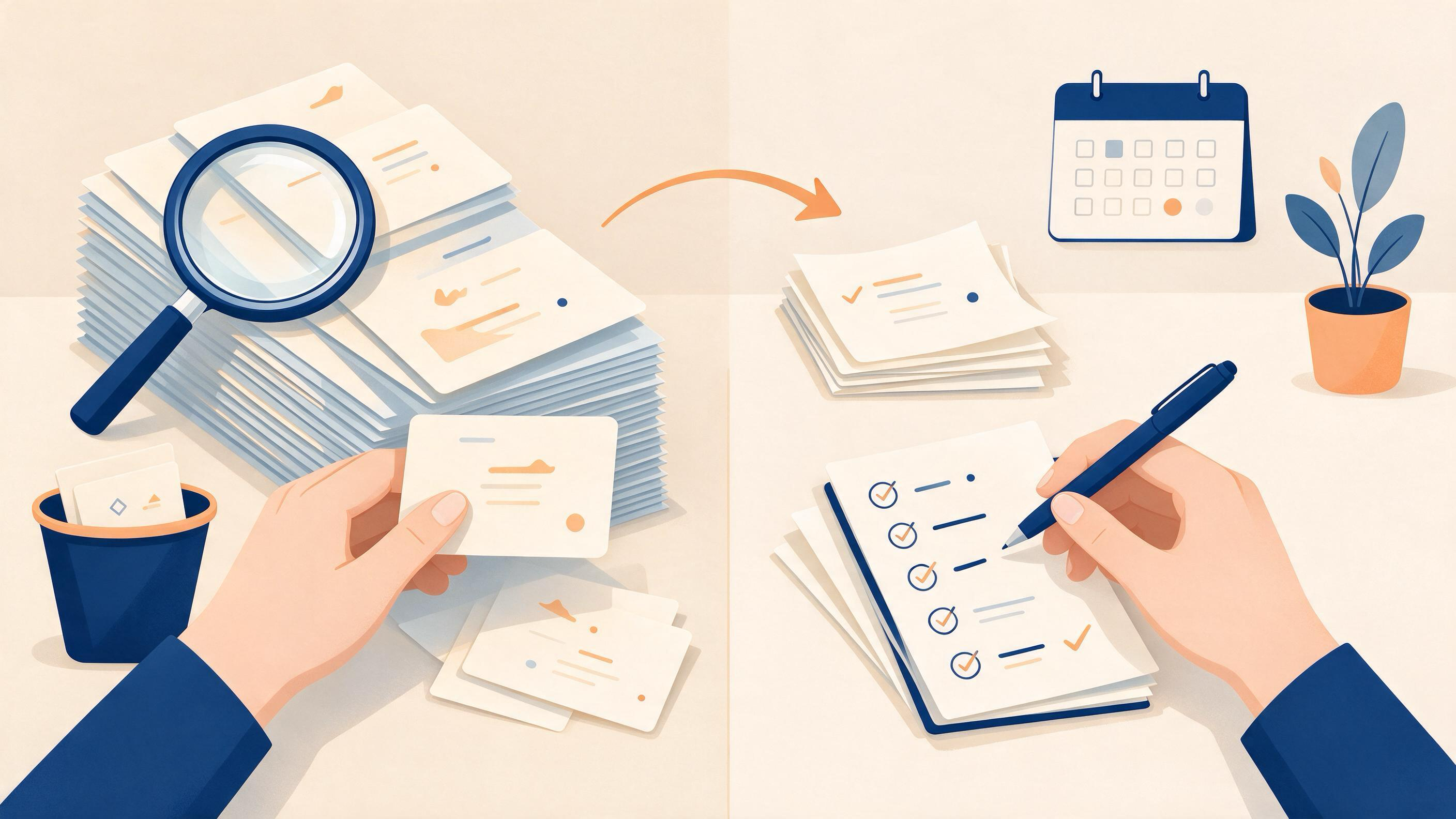
You have a folder of search results, a rough idea of your topic, and a deadline. The real question behind "abstract screening vs. full-text screening" is not which one is better. It is which one you should be doing right now, what you need to have written down before you start, and how you will know the pile is actually finished.
Abstract screening is a fast, broad pass: you read titles and abstracts and decide whether a record is worth a closer look. Full-text screening is a slower, narrow pass: you read the whole paper and decide whether it belongs in your final set. They answer different questions, fail in different ways, and work best as two stages of one documented process. This article walks through the decisions and artifacts each stage requires, compares them on the same task, and ends with a concrete next action for a thesis chapter, a course paper, or a January project start.
What problem are you actually solving?
Most people searching this comparison are mid-project. You may have run a search, exported a few dozen records, and started reading. Or a supervisor has returned a draft with a note that your selection process is unclear. Or you are cleaning up a literature folder over winter break before a new project begins in January.
In all of these cases, the underlying task is the same: move from a large, messy set of candidate records to a smaller, defensible set of studies you will actually use. Screening is the decision process that gets you there. The two stages differ in cost, in what you can judge, and in what you must record.
Cochrane's guidance on searching and selecting studies frames this as a planned process: searches should be built from eligibility criteria, use multiple sources, combine free-text terms with subject headings, document the process, deduplicate records, and screen in stages. That framing is useful because it tells you that screening is not an afterthought. It is a designed step with inputs and outputs.
What must exist before either stage begins?
Both stages depend on the same two artifacts. If either is missing, you will end up re-reading papers and second-guessing decisions.
Eligibility criteria. Write down, in plain sentences, what makes a study in or out. Think about population, intervention or topic, study design, date range, language, and publication type. Cochrane recommends planning searches from these criteria, which means the criteria come first and the search follows, not the reverse.
A documented search. Record which sources you used, the terms you combined, and when you ran the search. Cochrane also recommends rerunning searches before publication, so a dated record matters later.
A third artifact helps at the boundary: a screening log. Even a simple spreadsheet with columns for record ID, decision, reason, and stage will save you time when a supervisor asks why a paper was excluded.
If you are still assembling the candidate set, start with a scholarly search interface such as WisPaper search to find academic papers, and keep your criteria visible while you scan results. The point is not to collect everything. The point is to collect against a written standard.
How does abstract screening work in practice?
Abstract screening is triage. You read the title and abstract and ask one question: is there any chance this record meets my criteria? If yes, it moves forward. If clearly not, it is excluded with a reason.
The stage is designed for volume. You can process many records quickly because you are not trying to understand the full method or the nuance of the results. You are looking for signals: does the population match, is the design plausible, is the topic close enough to warrant a full read?
Two habits make this stage reliable. First, screen against the written criteria, not against your memory of them. Second, record exclusion reasons at the level of the criterion, so the log stays useful later. Cochrane's staged screening recommendation exists precisely because this broad pass is cheaper than reading everything in full.
Abstract screening fails in predictable ways. Abstracts are compressed and sometimes omit the population or design detail you need. A record that looks irrelevant may be a relevant study reported under different terminology. A record that looks perfect may turn out, in full text, to be a different design entirely. These failures are acceptable at this stage because the cost of a wrong "maybe" is one full-text read, while the cost of a wrong "no" is a missed study. When in doubt, advance the record.
How does full-text screening work in practice?
Full-text screening is confirmation. You read the whole paper and ask: does this study, as actually conducted and reported, meet my criteria? Now you can check the method, the sample, the outcomes, and the limitations directly.
This stage is slower and should be. You are making the decision that determines what enters your synthesis, so the criteria need to be applied to what the paper actually says rather than to what the abstract promised. Record the decision and the reason, and note where a paper only partially fits.
Cochrane's guidance adds an important detail: multiple reports of one study should be linked. A single study may appear as a conference abstract, a journal article, and a follow-up paper. Full-text screening is where you notice these overlaps and treat them as one study rather than three.
Full-text screening fails differently from abstract screening. It is expensive, so it tempts shortcuts: skimming the introduction and conclusion, trusting the abstract you already read, or stopping at the first mismatch. It also surfaces ambiguity that the abstract hid, which can stall decisions if your criteria were vague. A clear criterion resolves most of these stalls; a vague one turns every borderline paper into a debate.
Where does each stage break down?
The comparison is easiest to see as a table applied to the same research task.
| Dimension | Abstract screening | Full-text screening |
|---|---|---|
| Question asked | Is this worth a closer look? | Does this study meet my criteria? |
| Volume handled | High | Low |
| Information available | Title and abstract | Complete paper |
| Typical failure | Missing detail leads to wrong exclusion | Cost leads to skimming and inconsistent decisions |
| Main risk if rushed | Missed relevant studies | Unstable inclusion set and unclear reasons |
| Artifact produced | Advance or exclude, with reason | Include or exclude, with reason and linked reports |
Read the table as a division of labor, not a contest. Abstract screening protects your time; full-text screening protects your final set. Skipping the first makes the second unaffordable. Skipping the second makes the first meaningless.
What does a combined workflow look like?
A workable sequence has five steps, and each one produces something the next step uses.
- Write the criteria and the search record. Criteria first, then the documented search, following the logic Cochrane describes.
- Deduplicate the records. Cochrane recommends deduplicating before screening so you do not screen the same paper twice.
- Run abstract screening. Advance anything plausible; exclude clear mismatches with a criterion-level reason.
- Run full-text screening. Apply the criteria to the full paper, link multiple reports of the same study, and record reasons.
- Rerun the search before you finalize. Cochrane recommends rerunning searches before publication, and the same habit serves a thesis chapter or course paper.
If your project is a systematic review or you are reporting one, PRISMA 2020 provides a reporting checklist, expanded explanations, an abstract checklist, and flow-diagram templates. The flow diagram is a natural home for the counts your screening log produces at each stage.
For a lighter project, the same five steps still apply. You simply keep the log smaller and the criteria shorter.
How do you keep the process organized across a term?
Screening generates artifacts: criteria documents, search records, logs, and the papers themselves. Keeping them in one place is what makes the process repeatable when you return to it after a break.
This is where a library helps. You can save or upload papers and organize them in My Library, so the records you advanced from abstract screening stay together with the ones you later include. When you want to ask questions based on papers you have uploaded or added from search results, Library QA lets you query that collection directly.
For a project that spans a term or a thesis chapter, Research Projects gives you an area to create and manage the work. That matters most at the January project-start moment, when the criteria, the search record, and the screening log all need a home before the reading begins.
How do you know the screening result is ready?
Readiness is not a feeling. It is a set of checks you can run against your own artifacts.
- Criteria are written and were applied consistently. Every exclusion in your log points to a criterion.
- The search is documented and dated. You can say which sources and terms produced the candidate set.
- Duplicates were removed before screening. Cochrane's deduplication step is done, not deferred.
- Multiple reports of one study are linked. Your final set counts studies, not PDFs.
- The search was rerun before finalizing. New records from the rerun went through the same stages.
- Counts reconcile. The number of records at each stage matches your log, which is exactly what a PRISMA-style flow diagram needs.
If any check fails, the fix is usually small: add the missing criterion, rerun the search, or link the duplicate reports. None of these require restarting the project.
How does this play out in a real project?
Imagine a student finishing a thesis chapter over winter break, with a January project start waiting on the other side. The search produced a few hundred records. The supervisor's feedback was that the selection process was unclear.
The fix is not more reading. It is the two-stage process with artifacts. Over a few days, the student writes the criteria, documents the search, deduplicates, and runs abstract screening to cut the set down. Full-text screening then confirms the smaller set, links duplicate reports, and records reasons. The log becomes the basis for a short methods paragraph and, if the project is a systematic review, the counts for a PRISMA flow diagram.
At the January start, the same artifacts carry forward. The criteria become the starting point for the new project's search, and the library holds the papers already screened. If the new project needs a longer literature task, Scholar Agent fits literature review and related use cases. If the new project needs to generate directions from a topic, background, references, and experimental constraints, Idea Discovery supports that step.
One more check belongs at the end of any writing stage: citation integrity. TrueCite checks BibTeX against real academic databases to flag hallucinated references, which is a useful final pass once your included set is stable.
What should you do next?
Pick the stage you are actually in and produce its artifact today. If you have no written criteria, write them now, in plain sentences, before you open another paper. If you have criteria but no log, create one with columns for record ID, stage, decision, and reason. If your log is complete, rerun the search and reconcile the counts.
Then move to the next concrete step: open WisPaper search with your criteria beside you, advance the plausible records, and save them to My Library so full-text screening starts from an organized set rather than a scattered folder.
FAQs
Keep Reading
AI-Assisted Literature Review: Search, Synthesis, and Verification
A literature review stalls for a specific reason: you have a pile of PDFs and no defensible answer to "what did I search, what did I keep, and why?" The fix is not a better prompt. It is a short sequence of decisions, ea

AI Literature Search vs. Traditional Database Search: Choosing a Method You Can Defend
You are revising a manuscript, closing a grant, or handing a review to a coauthor, and someone asks how you found the papers you cite. The honest answer is often "a bit of everything." That answer is fine for a first pas

AI Paper Summary vs. Full-Text Evidence Check: Choosing the Right Tool for a Clinical Evidence Brief
You have a clinical question, a stack of candidate papers, and a deadline. An AI summary promises to compress the reading; a full-text check promises to catch what the summary missed. The practical answer is that these a