
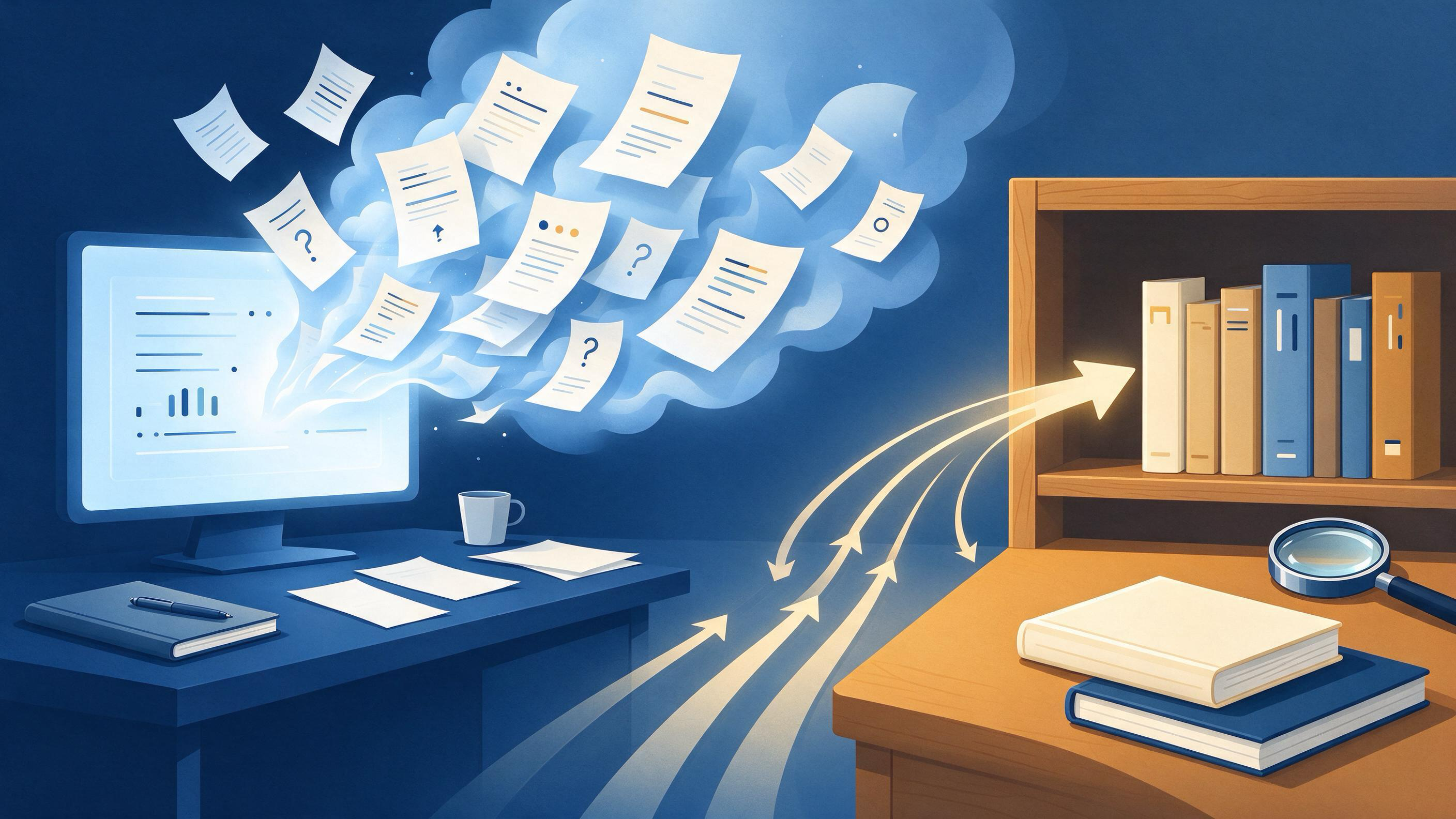
You have a topic, a deadline, and a blank reference list. The question is how to fill it: let an AI tool generate a reading list from your topic description, or start from a curated seed library of papers you already trust and grow outward from there. The short answer is that these two approaches solve different problems. An AI-generated list is fast at breadth and weak at provenance; a curated seed library is slow to build but strong at relevance and traceability. Most finished papers need both, in a specific order.
This article compares the two options on the same task, shows where each one fails, gives you a decision table, and lays out a combined workflow you can run this week.
What each option actually is
An AI-generated reading list starts from a description of your topic and returns a set of candidate papers. You supply the topic, the tool proposes the reading. The value is speed and coverage of vocabulary you did not know to search for.
A curated seed library is a small set of papers you have already chosen because they define your problem, your method, or your closest prior work. You build it deliberately, then expand from it. The value is that every item has a reason to be there.
The distinction matters because the two produce different artifacts. The AI list produces candidates. The seed library produces commitments.
Diagnose your starting state before you choose
Before picking a method, answer three questions honestly.
Do you already have anchor papers? If your supervisor handed you three papers, or your course reading list named the canonical study, you already have a seed library. Your job is expansion, not generation.
Do you know the vocabulary of the field? If you can name the standard terms and the main research groups, an AI list mostly confirms what you know. If you cannot, an AI list is genuinely useful for surfacing terms you would not have typed.
What is the artifact you must produce? A coursework essay needs a defensible set of sources. A thesis chapter needs a documented search you can describe in a methods section. A first manuscript needs both, plus a reference list that survives checking.
Write your answers down. They determine the workflow below.
Compare both options on the same task
Take one concrete task: build a reference base for a thesis chapter on a defined topic, in two weeks.
| Criterion | AI-generated reading list | Curated seed library |
|---|---|---|
| Time to first candidates | Minutes | Hours to days |
| Coverage of unfamiliar vocabulary | Strong | Weak until you search |
| Provenance of each item | Often unclear | Known by construction |
| Fit to your specific argument | Variable | High |
| Risk of fabricated or mismatched references | Present; must be checked | Low; you selected them |
| Documentable as a search method | Hard to describe | Easy to describe |
| Scales to a large field | Yes | Only through expansion |
Neither column wins outright. The AI list wins on discovery; the seed library wins on defensibility.
Where the AI-generated list fails
The failure mode is not that the list is empty. It is that the list looks complete. A generated list can include references that do not exist, or that exist but do not say what the list implies. Because the output is formatted like a bibliography, it invites trust it has not earned.
A second failure is drift. A generated list responds to your prompt, and your prompt is a summary of your topic. If your summary is vague, the list will be broad and shallow. If your summary is narrow, the list will miss adjacent work.
A third failure is that the list is not a method. If a reviewer asks how you found your sources, "the tool gave me a list" is not an answer. You need a process you can describe.
Where the curated seed library fails
The failure mode here is the opposite: the library is too small and too familiar. You seed it with the papers you already cite, and you expand along citation chains that lead back to the same cluster. The result is a well-defended but narrow base.
A second failure is staleness. A seed library built from a reading list two years old will miss recent work unless you deliberately search for it.
A third failure is the blank-page problem. If you have no anchor papers at all, you cannot start a seed library. You need a discovery step first.
The decision table
| Your situation | Start with | Then |
|---|---|---|
| No anchor papers, unfamiliar field | AI-generated list | Verify each candidate, then seed |
| Anchor papers from supervisor or syllabus | Curated seed library | Expand with search |
| Thesis chapter needing a documented method | Curated seed library | Document expansion searches |
| Coursework essay, tight deadline | AI-generated list | Verify before citing |
| First manuscript, mixed familiarity | Both, in sequence | See combined workflow |
| Winter-break cleanup of an old project | Curated seed library | Deduplicate and re-search |
A combined workflow you can run this week
Use the AI list for discovery and the seed library for commitment. The order matters.
Step 1: Generate candidates broadly
Describe your topic in a few sentences and generate a candidate list. Treat every item as a lead, not a source. The goal at this stage is vocabulary and coverage, not citation.
You can run this discovery step through WisPaper search, which gives you a scholarly search interface for finding academic papers. For a longer, multi-step literature task, Scholar Agent fits literature review and inspiration work.
Step 2: Verify before you commit
Every candidate must be checked against a real record before it enters your library. This is the step that separates a usable list from a liability. TrueCite checks BibTeX against real academic databases to flag hallucinated references, which is the right check to run on a generated list before you build on it.
Step 3: Seed the library deliberately
From the verified candidates, choose a small set that defines your problem, your method, and your closest prior work. Save them. My Library lets you save or upload papers and organize them there, which gives you a stable base to expand from.
Step 4: Expand from the seeds
Now search outward from your seeds: cited-by lists, shared methods, adjacent problems. This is where the curated library earns its keep, because every new item can be checked against a seed you already trust.
Step 5: Document the process
Record what you searched, where, and when. Cochrane guidance on searching for studies recommends planning searches from eligibility criteria, using multiple sources, combining free-text terms with subject headings, documenting the process, deduplicating records, and screening in stages. PRISMA 2020 provides reporting checklists and flow-diagram templates for reviews. Even a course paper benefits from a short written record of how sources were found.
Step 6: Ask questions of your own library
Once the library exists, you can interrogate it. Library QA lets you ask questions based on papers uploaded to My Library or added from search results, which is useful when you need to compare what two seeds actually claim.
Worked example: a January project start
Suppose you return in January to a thesis chapter you outlined in December. You have a topic sentence and two papers your supervisor mentioned.
Your starting state: two anchor papers, weak vocabulary in the adjacent literature, and a methods section that must describe your search.
Run the combined workflow. Generate candidates from your topic sentence to surface vocabulary you did not have. Verify the candidates before trusting any of them. Seed your library with the two supervisor papers plus the strongest verified candidates. Expand from those seeds with documented searches. Keep a short log of terms, sources, and dates.
By the end of the week you have a library you can defend and a search record you can write up. If you want to keep the chapter's sources and notes together, Research Projects is the area for creating and working inside a project.
How to know the result is ready
Your reference base is ready when four conditions hold.
Every item is verified. Each reference resolves to a real record, and you have checked that the record says what you think it says.
Every item has a reason. You can state in one sentence why each paper is in the library: it defines the problem, supplies the method, or represents the closest prior work.
The search is describable. You can write a paragraph explaining what you searched, which sources you used, and how you screened. This is the standard Cochrane and PRISMA point toward, and it is what a supervisor or reviewer will ask for.
The library is deduplicated. Multiple reports of one study are linked rather than counted twice. Zotero's Duplicate Items collection supports review and merging, and its collections can hold one item in multiple project groupings without duplication.
If any condition fails, you are not finished. The most common gap is the second one: a large library where several items have no stated reason to be there.
Organizing the result so it stays usable
A verified library still needs structure. Zotero collections can organize one item in multiple project groupings without duplicating it, and tags can describe topic, method, status, or workflow. Use tags for the reason each paper is present, not just its subject. That way, when you return to the chapter in March, you can filter to the papers that define your method without re-reading everything.
Saved searches update automatically, which helps when you add new items during expansion. Review duplicates as you go rather than at the end.
FAQs
Keep Reading

An AI-Written Background Section Sounds Convincing but Has No Evidence Map
A background section can read smoothly and still leave you unable to answer the one question a supervisor or examiner will ask: *which claim rests on which study, and how do you know?* That is the gap this article addres
Broad Topic Search vs. Feasibility Search for a New Project
You have a topic, a deadline, and a vague sense that the literature is either too large to enter or too thin to support a project. The practical question is not which search is "better" but which one you should run first

Building a Reusable Research Knowledge Base
A reusable research knowledge base is a set of records, files, and decisions you can carry from one project into the next without rebuilding your reading from scratch. It answers four questions at any moment: what have I