
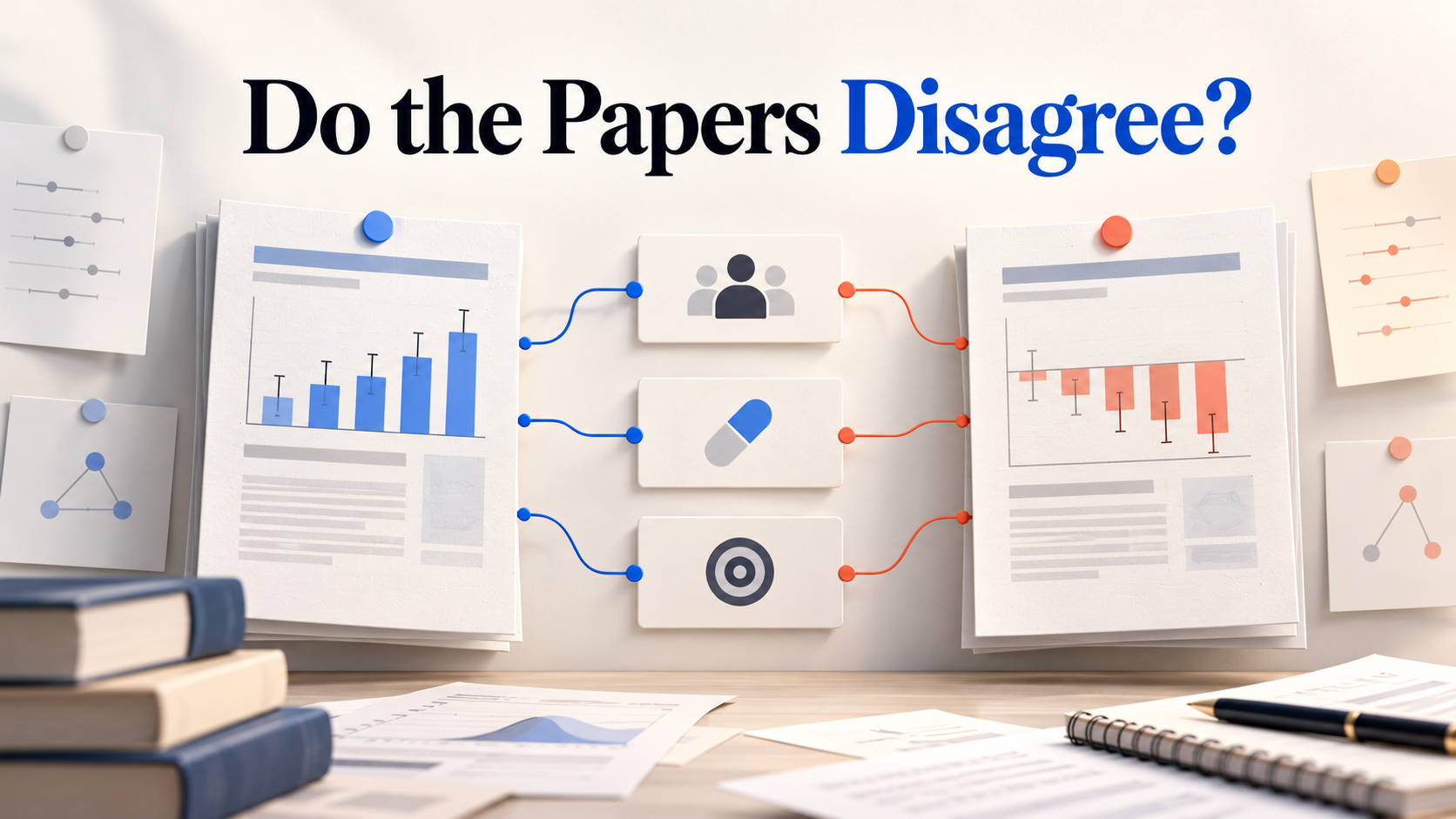
Paper A reports a benefit. Paper B finds no clear effect. It is tempting to write “the literature is mixed,” but the papers may have asked different questions.
Put the results on the same coordinates before calling them contradictory.
Align the question behind each result
Compare population, intervention or exposure, comparator, outcome, and time point. Then add study design, sample size, measurement, and analysis.
A short laboratory task and a year-long field study do not estimate the same effect. Neither do self-reported well-being and clinical symptoms, even if both are labeled “mental health.”
Compare estimates, not significance labels
“Significant” versus “not significant” does not prove two findings differ. Look at effect direction, magnitude, and uncertainty. The estimates may be similar while one study has a wider confidence interval.
Ask whether a formal interaction or heterogeneity test exists before claiming subgroup differences. Absence of evidence in one paper is not automatically evidence of the opposite result.
Find the source of the difference
Classify it as:
- population or context
- intervention dose or implementation
- outcome definition
- follow-up time
- study design or bias
- statistical precision
- genuine theoretical conflict
Now the synthesis can explain the condition: “Benefits appeared in short-term supervised studies but not in longer unsupervised settings.” That is more informative than “results were mixed.”
Compare the papers in WisPaper
Save both papers and close follow-ups to My Library. Ask Library QA for the aligned fields and exact numerical result. Use WisPaper Search to find reviews or studies that directly test the suspected moderator.
Return to the original tables before deciding. An AI comparison can expose candidate explanations; the reported data decide whether they hold.
FAQs
Keep Reading

Does Giving AI a Seed Paper Improve Its Literature Search?
Learn how a seed paper improves AI literature search through vocabulary and citations while avoiding anchor bias and narrow coverage.

How to Find Recent Papers That Challenge a Classic Study
Find recent papers that test, revise, or challenge a classic study using citation chasing, new terminology, and status checks.
How to Ask AI to Explain a Research Paper’s Methods Section
Learn how to ask AI about a paper's sample, procedure, variables, and analysis without letting it invent missing methods.