
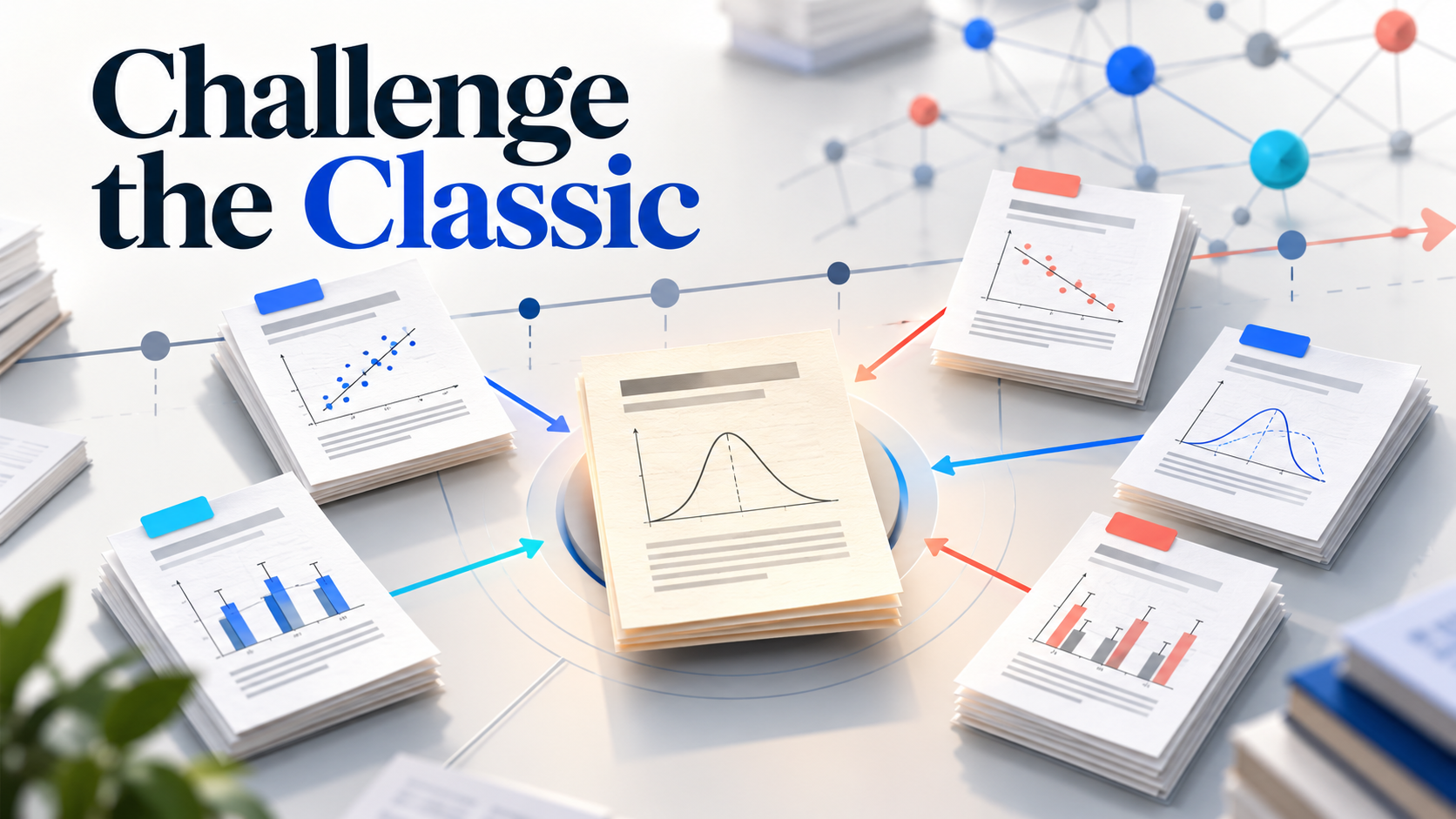
A classic paper may define the question your field still asks, but citation count does not tell you whether its result survived. The useful search is not simply “new papers on this topic.” It is “what happened to this specific claim after publication?”
Start from the exact paper and exact claim
Confirm the title, authors, year, DOI, and version of the classic study. Then write the claim you want to test. A paper may contain one famous result and several less important findings; later research may challenge only one of them.
For example: “The original study claims that brief exposure to X improves Y.” This is searchable. “Is this classic paper still true?” is not.
Follow the paper forward
Open Cited by in Google Scholar or a citation index and focus on recent years. Search within citing papers for terms such as replication, reanalysis, boundary condition, failed to replicate, robustness, meta-analysis, correction, and critique.
Also search the paper title or first author together with the measured outcome. Later studies may not use the word “challenge,” especially when they test a different population or improved method.
Know the different ways a paper can be challenged
A challenge may be:
- a direct replication with a different result
- a conceptual replication testing the same idea differently
- a reanalysis of the original data
- a larger study with tighter uncertainty
- a meta-analysis showing a smaller or context-dependent effect
- evidence that the measurement or mechanism was wrong
- a correction, expression of concern, or retraction
These do not all have the same meaning. One failed replication does not automatically erase the original study; a consistent body of stronger evidence may substantially change how it should be cited.
Read the response, not just the challenger
Look for author replies, subsequent replications, and reviews that discuss both sides. Check whether the newer paper actually used comparable materials, populations, and outcomes.
Write a timeline: original claim, first challenge, response, later evidence, and current synthesis. This prevents the newest paper from automatically becoming the final word.
Build the citation trail in WisPaper
Search the classic paper and its main claim in WisPaper Search. Save the original, strongest challenge, strongest supporting follow-up, and a recent review to My Library. Ask Library QA how their populations, methods, outcomes, and conclusions differ.
Your final sentence may be more precise than “the classic study was debunked”: perhaps the effect appears smaller, depends on context, or has not replicated with the original measure.
FAQs
Keep Reading
How to Ask AI to Explain a Research Paper’s Methods Section
Learn how to ask AI about a paper's sample, procedure, variables, and analysis without letting it invent missing methods.
How to Find the Original Source Behind an AI-Generated Answer
Follow an AI-generated claim through blogs and news pages to the original study, dataset, or official report—and check whether it supports the exact sentence.

How to Turn Research PDFs into a Comparison Table with NotebookLM
Turn research PDFs into a useful comparison table with NotebookLM. Choose better columns, expose missing data, verify key cells, and use the table to synthesize studies.