
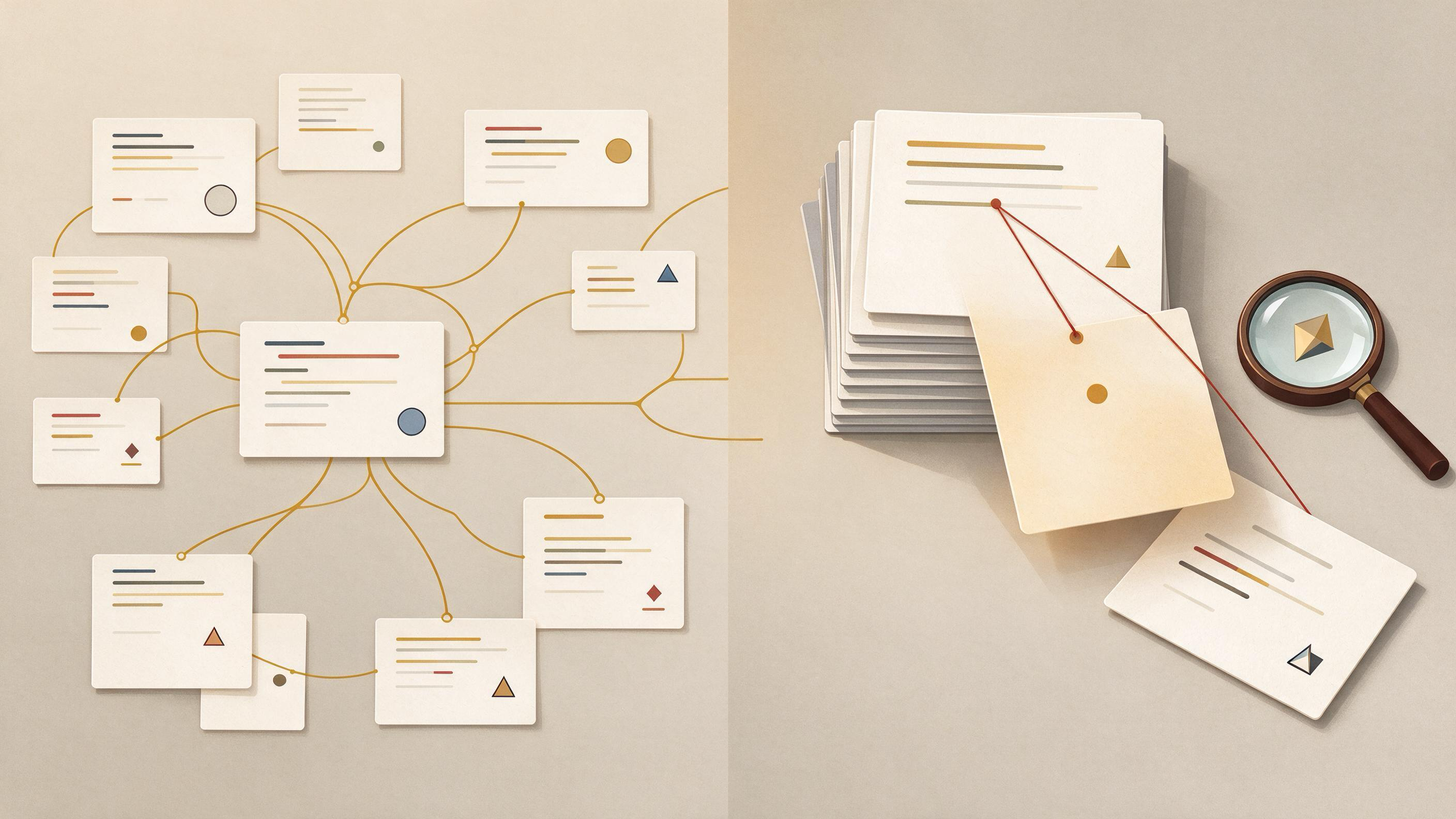
You are revising a manuscript, and the reference list has a gap you cannot name. Or a coauthor has asked for "the paper that reported that effect" and you know it exists but not what it is called. These are two different search problems, and treating them the same way wastes time. Exploratory search is for when you are mapping a topic and do not yet know what you need; known-item search is for when you can already describe the target precisely enough to recognize it. The switch point is not a feeling — it is a change in what you can specify. Once you can name an author, a title fragment, a field, or a citation, you have crossed from exploration into retrieval, and your method should change with you.
This article compares both modes on the same manuscript task, shows where each fails, gives a decision table, and lays out a combined workflow that leaves an auditable trail for coauthors, peer review, or a lab handoff.
Start by diagnosing which search problem you actually have
Before choosing a tool or a query, write down what you can already specify. The Cochrane Handbook's guidance on planning searches begins from eligibility criteria — what counts as a study worth including — rather than from a keyword list. That is an exploratory posture: you define the boundary of the question first, then search inside it.
A quick diagnostic:
- Can you write the target's title, author, or citation? If yes, you have a known item.
- Can you only describe the topic, population, or phenomenon? If yes, you are exploring.
- Do you need to know what exists, or do you need to retrieve something you already know exists? The first is exploration; the second is retrieval.
- Would a wrong result be obviously wrong? Known-item searches have a recognizable target, so errors surface fast. Exploratory searches have no single right answer, so you need a stopping rule instead.
Write the answer down. That sentence becomes the first line of your method trail.
What exploratory search is good for — and where it stops helping
Exploratory search is the right mode when the shape of the literature is still unknown: scoping a new review, checking whether a claimed gap is real, or finding the vocabulary a field uses before you commit to terms.
Cochrane's recommendation to combine free-text terms with subject headings is directly relevant here. Exploration is where you discover which subject headings and synonyms exist; a purely free-text pass will miss records indexed under different vocabulary. Using multiple sources is also part of the recommended method, because no single index covers everything.
Where exploration fails:
- It has no natural end. Without a stopping rule, you keep finding adjacent papers and never close the search.
- It produces volume, not a reference list. You accumulate candidates but cannot yet say which are eligible.
- It is hard to reproduce. An undocumented exploratory session cannot be rerun by a coauthor or defended at peer review.
If you are exploring and need a scholarly search interface to move from vague topic to concrete candidate set, WisPaper search is a place to run that pass. The point of the pass is to convert description into specification — author names, title fragments, index terms — that you can carry into retrieval.
What known-item search is good for — and where it fails
Known-item search is the right mode when you can already describe the target. PubMed's field tags, phrase searching, citation lookup, and Advanced Search are built for exactly this: you supply an author, a title, a journal, or a citation, and the system retrieves it. PubMed's search details also show how your terms were translated and combined, which is useful when a known-item query returns nothing and you need to see why.
Google Scholar's documented features support the same mode: searching by author and title, date limits and sorting, Cited by and Related articles, citation export, and locating alternative versions of a work. When you have a citation but not the full text, those are the levers.
Where known-item search fails:
- It cannot find what you cannot describe. If you only remember the finding, not the author or title, a precise query returns nothing useful.
- It assumes the item exists in the index you are searching. A known item held only in a source you have not searched will not appear.
- It gives false confidence. A near-match with a similar title can look like the target; you still have to verify it is the same work.
The same task, both ways: a manuscript reference gap
Take a concrete case. You are revising a manuscript and a reviewer says a claim needs a citation to the study that first reported a specific effect. You do not have the citation.
Exploratory pass. You search the phenomenon, its synonyms, and likely subject headings across more than one source. You collect candidates and note which ones report the effect. You are not trying to find one paper; you are trying to learn who works on this and what the field calls it.
Switch trigger. Somewhere in that pass you find an author name, a distinctive title phrase, or a citation in a review's reference list. Now you can specify the target.
Known-item pass. You search by author and title fragment, use citation lookup, and check alternative versions. You confirm the retrieved record matches the claim.
Artifact. You record the final citation, the query that found it, and the date. That record is what a coauthor or reviewer can check.
Cochrane's guidance to link multiple reports of one study matters here: the paper you retrieve may be one of several reports, and your citation should point to the right one.
Where each mode breaks down on this task
| Failure | Exploratory mode | Known-item mode |
|---|---|---|
| No stopping rule | Keeps expanding, never closes | Not applicable — target defines the end |
| Cannot specify target | Not a problem; that is the point | Query returns nothing |
| Reproducibility | Hard unless documented | Easier; the query is the record |
| False match risk | Low; you are surveying | Higher; similar titles look alike |
| Vocabulary gaps | Addressed by subject headings | Not addressed; you must already know the term |
The practical lesson: exploration without documentation is not reproducible, and retrieval without verification is not safe. Both need an artifact.
A decision table for switching
| Signal | Stay exploratory | Switch to known-item |
|---|---|---|
| You can name an author | No | Yes |
| You have a title fragment | No | Yes |
| You have a citation from a reference list | No | Yes |
| You only have a phenomenon or population | Yes | No |
| You are defining eligibility criteria | Yes | No |
| You are filling a specific gap in a reference list | No | Yes |
| You need to know whether a gap is real | Yes | No |
| A reviewer asked for "the study that reported X" | Briefly, to identify it | Yes, to retrieve it |
Use the table as a checkpoint, not a rule. The switch is justified when your specification is concrete enough that a wrong result would be visibly wrong.
A combined workflow that leaves an auditable trail
Cochrane's method is a useful skeleton: plan from eligibility criteria, use multiple sources, combine free text with subject headings, document the process, deduplicate, screen in stages, link multiple reports, and rerun before publication. Map the two search modes onto that skeleton.
- Plan. Write eligibility criteria and the question boundary. This is exploratory framing.
- Explore. Run a broad pass across more than one source, combining free text and subject headings. Capture the vocabulary you discover.
- Specify. Convert what you learned into named targets: authors, titles, citations, index terms.
- Retrieve. Run known-item queries for each target. Use field tags, citation lookup, and alternative-version tools.
- Verify. Confirm each retrieved record matches the claim it will support.
- Document. Record queries, sources, dates, and decisions.
- Deduplicate and screen in stages. Cochrane recommends staged screening and deduplication; do this after retrieval, not during exploration.
- Rerun before publication. Cochrane recommends rerunning searches before publication, so your trail should be rerunnable.
For a lab handoff, the trail is the deliverable: a coauthor should be able to rerun your queries and reach the same candidate set.
Turning the trail into a shared, checkable record
A method trail is only useful if someone else can act on it. Two practical moves:
Organize the candidate set. Save or upload the papers you have retrieved so the set is stable and shareable. My Library is where that collection lives, which matters when a coauthor needs the same set you screened.
Ask questions of the collected set. Once papers are in the library, you can query them directly rather than re-searching the open web. Library QA supports asking questions based on papers uploaded to My Library or added from search results — useful when you need to check whether a retrieved paper actually supports the claim before you cite it.
For longer tasks that span exploration and retrieval — a literature review, for instance — Scholar Agent is the area for extended research work. If the project needs a home for the whole effort, Research Projects is where a new project can be created.
Checking citations before they go into the manuscript
Known-item search has a specific failure mode at the citation stage: a reference that looks right but does not correspond to a real record. Before a reference list goes to a coauthor or into a submission, screen the BibTeX. TrueCite checks BibTeX against real academic databases to flag hallucinated references. That is a verification step, not a search step — run it after retrieval, when the list is assembled.
How to know the search is finished
The result is ready when three conditions hold:
- The specification is closed. Every gap in the reference list has a named target, and every target has a verified record.
- The trail is rerunnable. Queries, sources, and dates are recorded well enough that a coauthor could repeat the pass.
- The screening is staged and deduplicated. Cochrane's staged screening and deduplication have been applied, and multiple reports of the same study are linked to the right citation.
- The search has been rerun. Cochrane recommends rerunning before publication; a final rerun confirms nothing new has appeared since your last pass.
If any condition fails, you are still in exploration — and that is fine, as long as you know it.
FAQs
Keep Reading

Full-Text Annotation vs. Structured Data Extraction: Choosing the Right Evidence Trail
You have a folder of PDFs, a manuscript deadline, and a coauthor asking why a particular number appears in your results table. The question behind "full-text annotation vs. structured data extraction" is practical: which

How to Annotate Papers So Your Future Self Can Reuse Them
Annotation usually fails for a simple reason: it is written for the person you are today, not the person who will reopen the file in six months. You highlight a sentence because it matters now, but you do not record why
How to Archive a Literature Search After Submission
A submitted manuscript is not the end of your search record; it is the moment the record becomes something other people may need to inspect. Coauthors may ask which terms you used, a reviewer may request a search update,