
An AI answer tells you that students who sleep less than six hours are “twice as likely” to fail an exam. It sounds specific enough to use. There is even a citation beside it.
You open the citation and land on a blog post. The blog links to a university news story. The news story mentions a study but never gives the number you were shown.
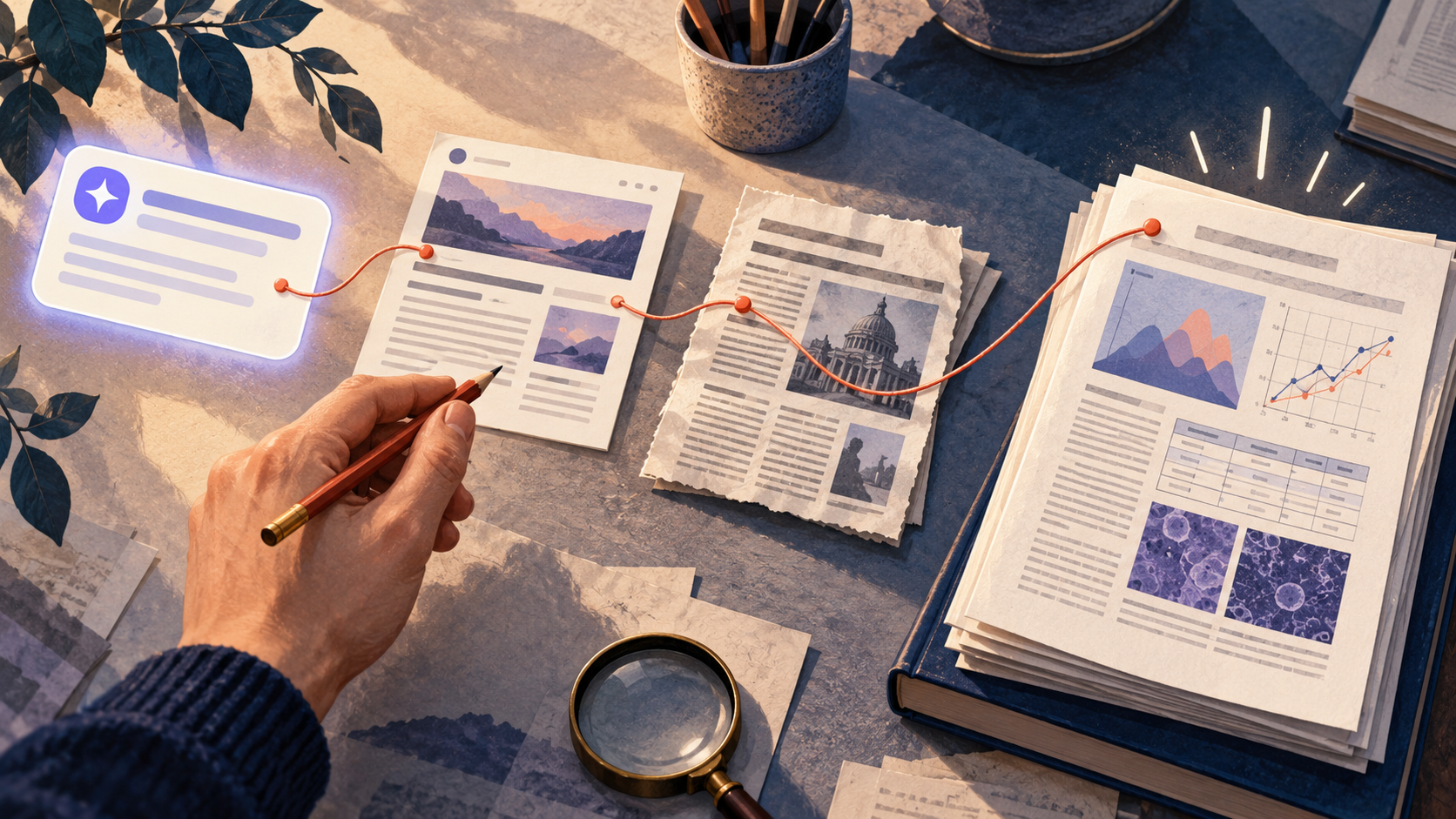
This is where source checking often stops too early. Finding a page related to a claim is not the same as finding the evidence behind it. Your job is to follow the chain until you reach the study, dataset, report, or official document that actually supports the sentence.
Where should I start when an AI answer has citations?
Open the citation attached to the exact sentence you care about. In ChatGPT Search, cited statements have inline links, and the Sources panel shows the pages used for the answer. OpenAI's search guide recommends opening those sources and checking whether they support the response.
Then ask three quick questions:
- Does this page contain the claim?
- Is the page reporting its own evidence or repeating someone else?
- Can I identify the original study or dataset from it?
A government statistics table may already be the original source. A news article, company blog, or literature review usually is not. Those pages can still be useful because they give you names, dates, phrases, or links that lead further back.
How do I follow a secondary page back to the original study?
Look for the trail the page leaves behind. The original source may appear as a linked study title, an author name, a journal, a report number, a DOI, or a reference at the bottom of the page.
Suppose the blog says, “A 2024 study from Northbridge University found that students sleeping under six hours were twice as likely to fail.” Search the quoted phrase first. If that goes nowhere, combine the distinctive parts:
Northbridge University students sleep six hours exam failure 2024 study
Once you find a likely paper, compare its title, authors, population, year, and result with the claim. A study about medical residents working overnight is not evidence about university students, even if the news story used the word “students.”
For academic papers, an exact title search often works. If the page gives a DOI, paste it into doi.org. If you have partial citation details, Crossref Metadata Search lets you search by title, author, DOI, or full citation. Biomedical papers can also be checked in PubMed.
How do I know the original source supports the exact claim?
Do not stop when the paper title looks right. Find the result itself.
For a numerical claim, check:
- who was included in the analysis
- what was measured
- which groups were compared
- the unit and time period
- whether the number is absolute or relative
- what uncertainty or adjustment accompanies it
“Twice as likely” may refer to an adjusted odds ratio rather than twice the raw failure rate. “Students” may mean first-year nursing students at one institution. “Less than six hours” may be a single self-reported night rather than a person's usual sleep.
Read the result in context, then see how the authors describe it in the discussion. If you cannot find the number or an equivalent statement anywhere in the source, the citation does not support the claim just because it is on the same topic.
You can ask the AI to help with this narrower task:
In this source, show the passage or table that supports the claim that students sleeping under six hours were twice as likely to fail. Explain the population, comparison, and type of statistic. If the source does not contain that result, say so.
That question gives you a location to inspect. It does not replace the inspection.
What if the citation leads to a review instead of an original study?
A review can be the right source when your sentence describes the state of a field: “Across 18 studies, shorter sleep was associated with poorer academic performance.” If your sentence describes one experiment or gives one study's number, follow the review's references to that study.
Use the claim to decide how far back to go:
- A broad conclusion may be best supported by a systematic review or official synthesis.
- A result from one sample should point to the original study.
- A statistic from a public dataset should point to the agency or dataset record.
- A definition or rule should point to the organization responsible for it.
“Original” does not always mean “journal article.” It means the closest authoritative source for the claim you are making.
What if I know it should be a paper, but I still cannot identify it?
Take the useful pieces from the page—topic, population, result, author, and approximate year—and search them as a research question.
In WisPaper Search, for example, you could ask: “Find studies on sleep duration and exam performance among university students, especially studies reporting failure risk.” The paper results give you titles, authors, dates, and summaries to compare with the claim. Save the plausible matches to My Library, then ask Library QA which paper reports the population and statistic you are trying to verify.
This works best when you are tracing an incomplete reference, not trying to prove that the AI's wording must be correct. The original evidence may use different language, or the claim may combine details from several sources. If none of the candidate papers contains the result, write the sentence from evidence you can actually locate—or leave it out.
What should I save once I find the source?
Save enough information to avoid repeating the chase:
- the claim you checked
- the original source and stable link or DOI
- the page, section, or table containing the evidence
- the population and measurement details that limit the claim
- your final wording
That small note is more useful than a bookmark alone. Three weeks later, it tells you both where the number came from and why you phrased the sentence carefully.
FAQs
Keep Reading

How to Turn Research PDFs into a Comparison Table with NotebookLM
Turn research PDFs into a useful comparison table with NotebookLM. Choose better columns, expose missing data, verify key cells, and use the table to synthesize studies.
How to Prepare for a Journal Club with AI—Without Skipping the Paper
Use AI to prepare for journal club while still reading the paper: map the argument, inspect figures, and build better discussion questions.
NotebookLM vs. ChatGPT for Comparing Research Papers: One Task, Two Results
Compare NotebookLM and ChatGPT for multi-paper research, from source grounding and tables to flexible analysis and verification.