
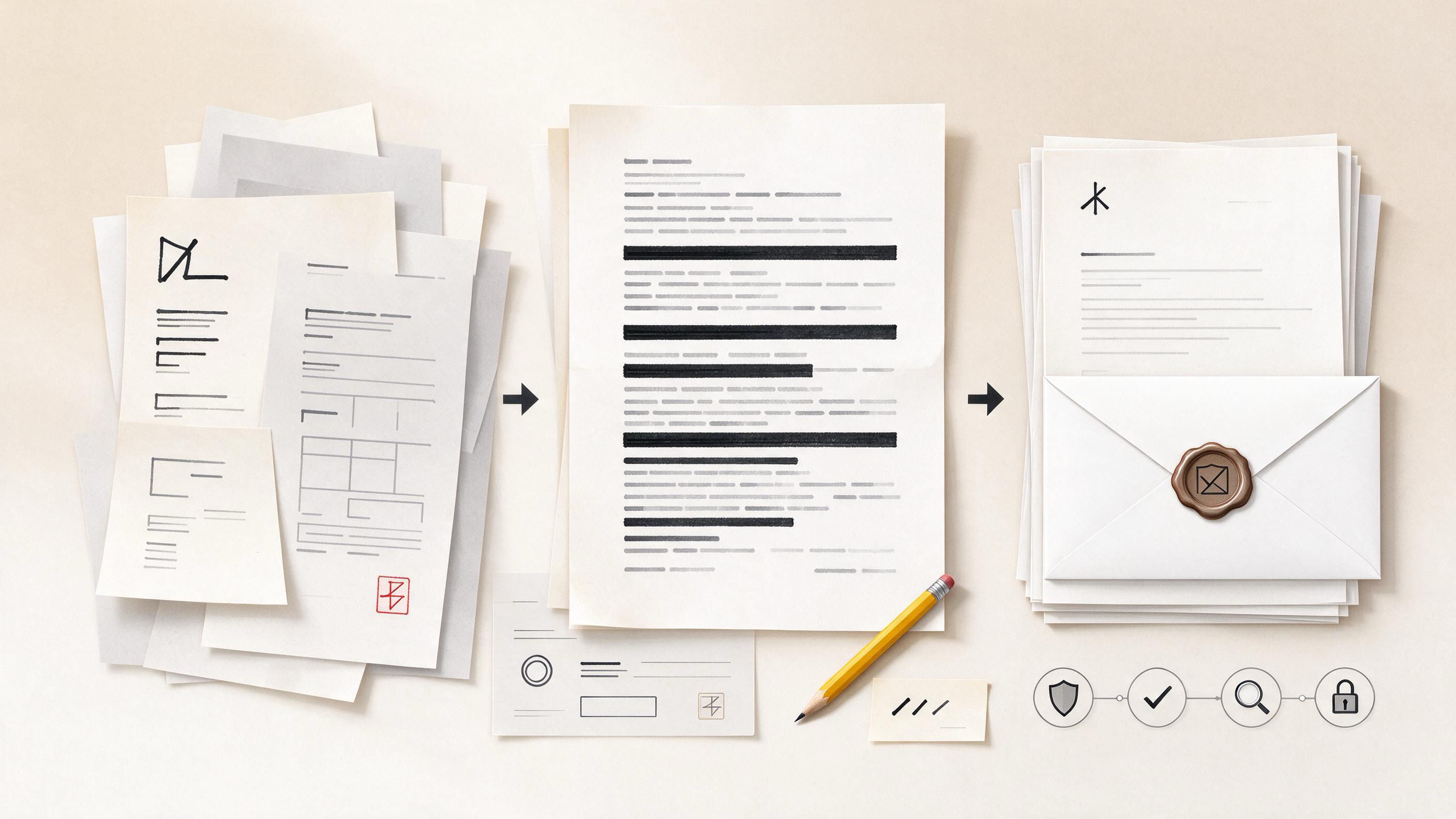
Double-blind review fails quietly. A manuscript can pass a journal's technical check yet still expose the author team through a project name in the methods section, a grant number in the acknowledgments, file metadata, or a self-citation that a reviewer spots in seconds. The search task behind this guide is therefore not just "what do I redact" but "how do I run a repeatable anonymization pass on a manuscript that will actually be read by skeptical reviewers?"
This article treats anonymization as a submission-readiness workflow rather than a find-and-replace exercise. It shows a complete sequence with checkpoints, a worked example using a decision memo as the submitted artifact, a reusable checklist, and explicit completion criteria. The focus is on producing an anonymized version you can defend, not on guessing what a particular editor might tolerate.
What Does Double-Blind Anonymization Actually Require?
Double-blind review asks that reviewers cannot identify the authors from the manuscript itself or from materials that accompany the submission. The governing principle is narrower than it sounds: it concerns identifiable evidence, not rhetorical style. A reviewer may recognize a laboratory's measurement protocol as familiar; that is generally acceptable. A reviewer who sees "as reported in our earlier trial (Chen et al., 2022)" has been handed the answer.
Anonymization therefore operates on categories of evidence. The manuscript must be checked for author names, institutional affiliations, funding identifiers, trial or project identifiers, acknowledgments, self-citations that reveal authorship, and any file properties that carry author information. ICMJE guidance on preparing manuscripts emphasizes that authors should follow the selected journal's current instructions for article type, format, required statements, and submission materials. Many journals publish a separate anonymization checklist, and that journal-specific checklist should sit above any general one.
A useful mental model is that anonymization has two layers. The first is the visible text: title page elements, headers, footers, and body content. The second is hidden metadata: document properties, tracked changes, comments, and embedded identifying strings. Pass both layers, and the manuscript is ready for review. Pass one, and the editorial office may return the file before review begins.
When in the Submission Process Should You Remove Identifying Details?
Anonymize only on a copy, and do it after the scientific content is final. The reason is practical: removing identifying details early causes rework because every coauthor edit, comment resolution, and version merge can reintroduce author names into tracked changes or document properties.
The safer order is:
- Finalize the manuscript content in the normal, identifiable working file.
- Resolve all comments and reject all tracked changes.
- Create an anonymized derivative file from the clean working version.
- Run the anonymization checks and checksums described below on the derivative.
- Submit only the derivative.
If the manuscript depends on a larger source set, search for and collect the supporting papers in WisPaper search before the redaction pass. Doing this early keeps the source set stable, so the anonymized derivative can be checked against the actual references rather than a half-remembered version.
The submission-readiness threshold is not "looks anonymous." It is that a named reviewer, given the file and the journal's anonymization instructions, cannot reconstruct an author name, an institution, a funding source, or a project identity from anything the submission contains. That is the acceptance test for every step that follows.
What Usually Exposes Authors in the Body Text?
Author exposure in the body text tends to cluster in a small number of conventional manuscript zones, which makes the check scriptable.
Methods and materials. Equipment is rarely identifying, but bespoke software, named datasets, or a link to a laboratory repository can be. Replace "our institute's REDCap instance" with a neutral description unless the journal's policy on repositories says otherwise. When in doubt, the submission materials carry the authority; the manuscript should not name a repository if the repository landing page lists the authors.
Self-citations. References to earlier work by the same team are legitimate scholarship and also the most common vector for reviewer inference. A self-citation is not automatically disallowed, but it must not use first-person ownership language such as "our previous work" or "in earlier work by these authors." Replace such phrases with neutral third-person phrasing and consider removing self-citations that are peripheral to the argument when the journal permits it.
Trial and project identifiers. Registration numbers, ethics approvals, and project acronyms can be uniquely traceable to an institution or investigator team. The journal's instructions govern which identifiers must be present, but a manuscript should carry only the identifiers the journal requires. A decision memo or internal report submitted as the reviewed artifact is a prime place where an internal project code survives the redaction pass.
Acknowledgments and funding statements. These sections often appear before the main text and are easy to miss because reviewers skim them. Remove names, institutions, grant numbers, and funder names unless the journal instructs otherwise. Some journals use a separate title page or a submission-system field for these details, which keeps them out of the reviewer file entirely.
How Do You Remove Embedding and File Metadata?
Metadata anonymization is the step most teams skip because the visible file looks clean. Document properties, author fields, revision log entries, and embedded thumbnail images can all carry names and affiliations.
The procedure below assumes the manuscript was written in a word processor, which covers the majority of submissions. The same principles apply to PDFs, but for PDF the cleanest route is usually to export a fresh file from the anonymized source document after the checks below have run.
For a word-processor file, work through at least these properties:
- Author and last-modified-by fields in document properties.
- Company and manager fields in document properties.
- Comments, including resolved comments that remain in the comment pane.
- Hidden revisions or tracked changes that were not rejected.
- Headers, footers, and page-setup elements that carry names, logos, or institution styling.
- Embedded objects such as charts linked from spreadsheets that carry the spreadsheet's author metadata.
A practical checkpoint is to save the anonymized derivative, export it to PDF, and inspect the PDF metadata separately. If the PDF's producer or author fields show an individual's name, the source document still carries metadata that must be removed before final export. This is a completion criterion, not a nice-to-have.
How Do You Keep the Evidence Base Organized Across Revisions?
Anonymization is usually not a one-pass task: a coauthor revises, a supplementary file changes, or a journal asks for a revised submission. Keeping the evidence base organized makes each pass cheaper and reduces the chance that an earlier redaction decision is lost.
A useful structure is to treat the anonymization pass as a small project with three artifacts: the working manuscript, the anonymization decisions log, and the final derivative. The decisions log records what was changed, where, and why, such as "methods paragraph 3: removed institute name from software description; replaced with 'a university research laboratory'" or "acknowledgments: removed grant number; journal permits funding statement in submission system only." That log is for the author team and the editorial office if a question arises; it is not submitted.
If the manuscript draws on a large set of references, maintaining a clean reference library also helps. You can save or upload the papers that support the manuscript into My Library so that the source set for a revision is separate from the working set used during earlier drafts. When a coauthor asks which version of a source was used in a particular redaction pass, the library becomes the retrieval point rather than an email thread.
Which Reporting Standard Should the Anonymized Manuscript Still Follow?
Anonymization changes identifying content, not scientific reporting. The anonymized version must still satisfy whatever reporting guideline the study design requires, and the journal's instructions are the controlling reference for the final format. ICMJE directs authors to follow the selected journal's current instructions for article type, format, required statements, and submission materials. That means the anonymized manuscript is not a reduced manuscript; it is the full manuscript with identifying details removed.
For structured reporting, the EQUATOR Network groups reporting guidelines by study type and specialty so authors can select a checklist that matches the design they are reporting. APA JARS provides reporting standards and design-specific modules for quantitative, qualitative, and mixed-methods research. The relevant checklist belongs to the anonymized file's content just as much as to the working file. A useful checkpoint is to re-run the applicable reporting checklist against the anonymized derivative after redaction. Removing identifying prose can accidentally delete a required methods element, and the checklist catches that before submission.
Worked Example: Anonymizing a Decision Memo with Source Provenance
This worked example uses a team decision memo as the artifact being prepared for double-blind review. The team has produced a report recommending a change to a research data pipeline, and the memo cites internal experiment logs alongside published sources. The anonymization task is to make the memo reviewable without revealing the team, the institution, or the pipeline's project name.
Starting state: the memo contains the team name in the header, the project codename in the executive summary, a reference to "our earlier pipeline migration report," two grant numbers in the funding statement, and an embedded chart linked from a spreadsheet whose document properties name the analyst.
Pass one, visible text:
- Header: replaced the team name with a neutral label and removed the logo.
- Executive summary: replaced the project codename with "the evaluated pipeline" throughout.
- Self-reference: changed "our earlier pipeline migration report" to "a prior internal evaluation" and removed the specific citation that pointed to internal documentation.
- Funding: removed grant numbers and funder names; retained only the statement the journal requires, which for this example permits a neutral sentence with no identifiers.
Pass two, metadata:
- Document properties: cleared author, last-modified-by, company, and manager fields.
- Chart: replaced the linked chart with a static image and removed the source spreadsheet reference.
- Revisions: rejected all tracked changes and confirmed the comment pane was empty.
Pass three, citation check for provenance:
- Verified every remaining external citation against the source set in the library.
- Confirmed no citation had been added from memory during revision by running the BibTeX entries through TrueCite, which checks BibTeX against academic databases to flag hallucinated references.
Completion state after three passes:
- The memo contains no author names, institution names, project identifiers, grant identifiers, or first-person ownership self-citations.
- The file metadata shows no individual author.
- The exported PDF metadata is clean.
- The remaining references resolve to real published sources, and no internal report is cited.
The memo can now be submitted because a reviewer working only from the file cannot connect it to the originating team.
Reusable Anonymization Checklist
Run this checklist on the anonymized derivative, not on the working file.
| Zone | Check | Evidence of completion |
|---|---|---|
| Title and header | No author names, affiliation, logo, or team identifier | Header reads as neutral or is absent |
| Executive summary or abstract | No project name, trial ID, or "our earlier work" language | Abstract makes sense without author context |
| Methods | No institution-specific software, repository, or dataset names unless journal requires and permits | Methods stay reproducible in neutral terms |
| References | No self-citation phrased with ownership; self-citations neutralized or removed per journal policy | Each self-citation reworded or deleted and logged |
| Identifiers | No registration numbers, ethics IDs, or internal codes beyond journal requirements | Only journal-required identifiers remain |
| Acknowledgments and funding | No names, institutions, grant numbers, or funder names in the reviewed file | Statements moved to permitted channels only |
| Document properties | Author, last-modified-by, company, and manager fields cleared | Properties dialog shows no individual identity |
| Comments and revisions | All comments resolved; all tracked changes accepted or rejected | Comment pane empty; no revision marks remain |
| Embedded objects | Linked charts or spreadsheets replaced with static content | No external links to source workbooks |
| Reporting checklist | Relevant EQUATOR or APA JARS checklist re-run on the anonymized file | All required reporting elements still present |
| Reference integrity | Every remaining citation resolves to a real source | BibTeX checked with TrueCite where citations were part of the revision |
| Test read | A colleague outside the author team reads the file and cannot name the authors | Test reader reports no identifying inference |
How Do You Know the Anonymized Manuscript Is Ready?
The completion criteria are explicit and testable:
- The file contains no author name, institution name, project identifier, grant number, or self-identifying first-person ownership phrase.
- Document properties and PDF metadata are empty of individual identity.
- All comments and tracked changes are resolved, not merely hidden.
- The manuscript still meets the journal's required format and the applicable reporting standard.
- A test reader outside the author team, reviewing only the submitted file, cannot name the authors, the institution, or the funding source.
- Every citation in the final derivative resolves to a real source, and the author team can retrieve each source if asked.
If any one of these fails, the manuscript is not ready. The check is deliberately narrow because double-blind review is a binary judgment: either the file supports identification or it does not.
When a revised manuscript arrives after peer review, the entire checklist restarts on the revised derivative. Revisions are the most common point where a coauthor's name reappears in document properties or a newly added reference carries an ownership phrase. Treat each revision as a new anonymization pass, not as a continuation of the first one.
When the reference set is large or the revision cycle is long, use Library QA to ask questions based on papers uploaded to My Library or added from search results. Asking "which sources in the library contain author-affiliated project identifiers?" keeps the revision-time check tied to the actual source set rather than a mental list.
FAQs
Keep Reading

How to Archive Decision Letters and Revision Files for Your Next Paper
Your folder of decision letters, reviewer comments, and revision files is not a graveyard of past submissions. It is the raw material for the next project: evidence of what reviewers in your field actually ask for, a rec
How to Archive Searches You No Longer Need
Most researchers do not lose a literature search because the database stopped working. They lose the *why*. Six months after a screening pass, the folder is still there, but the connection between the eligibility criteri

How to Build a January Reading Plan from Your Research Backlog
A research backlog rarely fails because you stopped caring. It fails because it has no shape: forty open tabs, a folder called “to read eventually,” three supervisor comments you half-remember, and a stack of PDFs that n