
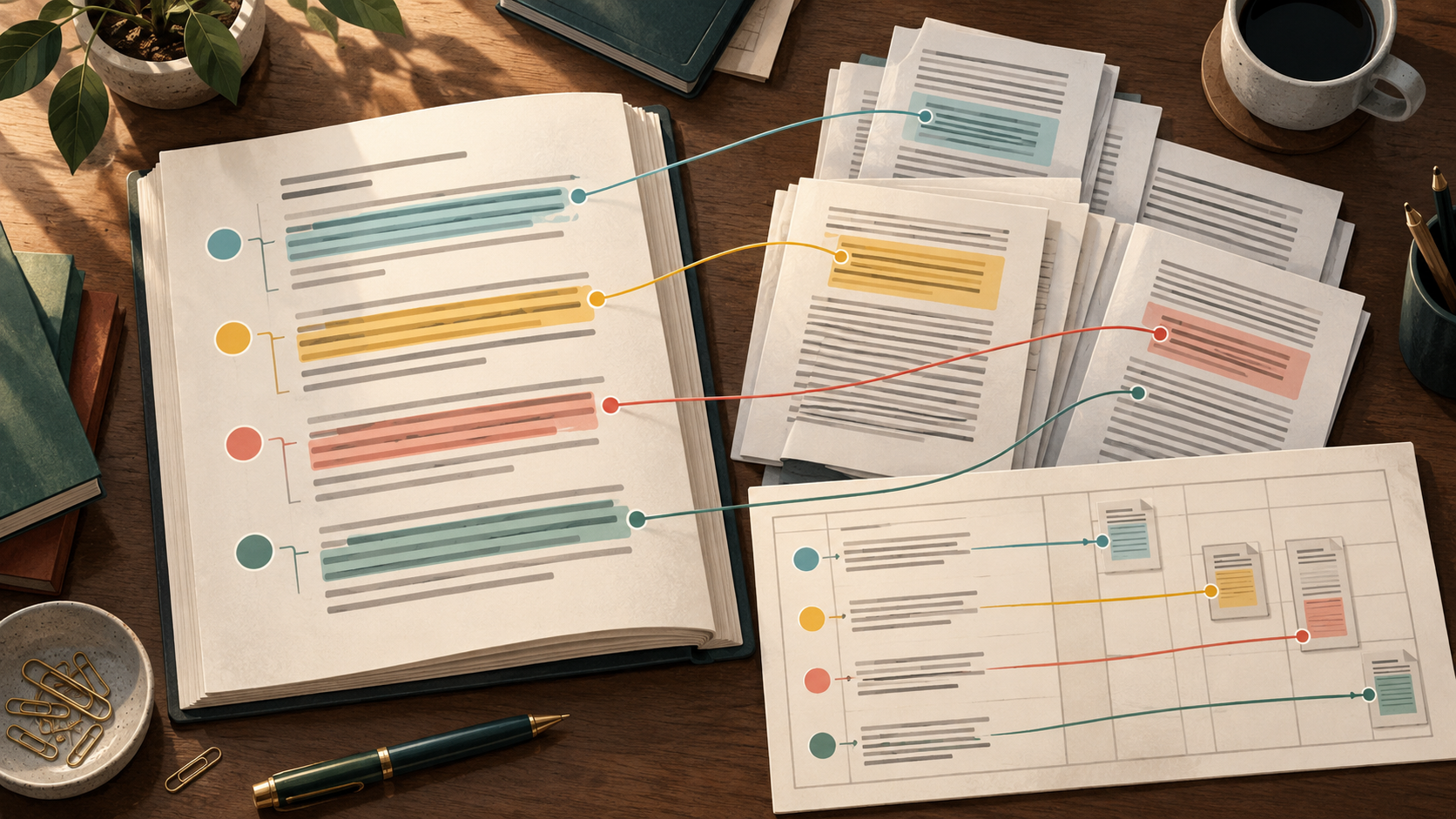
A claim audit is a sentence-by-sentence pass through a draft in which you record what each sentence asserts, classify it as factual or interpretive, attach the exact source passage that supports it, and then revise or remove anything the evidence cannot carry. It is the step between "the draft reads well" and "the draft can be defended in review."
The audit works best as a ledger: one row per claim, with a status you can act on. This guide gives you the full sequence, the checkpoints where you decide whether to continue, a worked example, a reusable table, and rules for when to stop and escalate.
Why a claim ledger beats a read-through
A normal read-through checks flow and tone. It does not reliably separate a factual statement from an interpretive one, and it does not force you to open the cited paper. A ledger does both, because every row must end in one of a small number of states: supported, needs a narrower wording, needs a different source, or unsupported.
The method also leaves a trail. NIH guidance on scientific rigor and reproducibility treats careful assessment of prior knowledge, strengths, weaknesses, and knowledge gaps as core to rigorous practice, and it emphasizes transparent methods and reproducibility. A ledger is a transparent method applied to your own prose: it shows which prior work you relied on and where the gaps are.
If your draft is a systematic review, the trail matters even more. PRISMA 2020 provides a reporting checklist, expanded explanations, an abstract checklist, and flow-diagram templates for original and updated systematic reviews, including transparent reporting of search, selection, and synthesis methods. Your ledger should be consistent with whatever you report there.
Step 1: Freeze the draft and number the sentences
Before you change a word, save a copy and number the sentences in the sections you plan to audit. Work section by section rather than across the whole manuscript at once; a results section and an introduction need different scrutiny.
Checkpoint: you have a frozen file, a numbered list of sentences, and a scope decision (which sections are in this pass). If the draft is still moving, stop and freeze it first — auditing a changing text produces a ledger that no longer matches the manuscript.
Step 2: Extract claims, one per row
Read each sentence and ask what it asks the reader to believe. Some sentences carry one claim; some carry two or three and should be split. A sentence that says a treatment reduced an outcome and that the effect was largest in older adults contains two claims and needs two rows.
Write the claim in your own words, shorter than the original sentence. This forces you to see what the sentence actually commits to.
Checkpoint: every sentence in scope appears in at least one row, and multi-part sentences are split. If a sentence is pure transition or signposting, mark it as such rather than leaving it blank.
Step 3: Classify each claim as factual or interpretive
This is the decision that determines how much evidence the claim needs.
- Factual claims report something specific: a measured result, a stated method, a reported sample size, a defined term. They need a source passage that says that thing.
- Interpretive claims draw a conclusion, assign importance, generalize, or explain a mechanism. They need support too, but the support is usually a combination of factual claims already in your ledger plus an explicit reasoning step you can state.
A useful test: could a reader disagree with the sentence on the basis of the cited paper alone? If yes, it is probably interpretive and needs either a narrower wording or an added reasoning sentence.
Checkpoint: every row has a classification. If you cannot decide, treat it as interpretive — that is the safer default because it forces you to show the reasoning.
Step 4: Trace each citation to the exact passage
For every factual claim, open the cited work and locate the passage that supports it. Record the location — section, page, table, or figure — and copy the supporting sentence or the relevant numbers into the ledger. Do not accept an abstract as support for a specific result if the result appears only in the full text, and do not accept a secondary mention as support for a primary finding.
This is where most audits find their problems: a citation that supports a related but different claim, a number that appears in a different population, or a reference that does not exist in the form cited.
If you need to locate or re-locate the underlying papers, use WisPaper search to find academic papers through the scholarly search interface, and keep the ones you rely on in My Library so the audit trail and the sources sit in one place. When you need to ask questions grounded in the papers you have already saved or added from search results, Library QA lets you query that collection directly.
Checkpoint: every factual row has a quoted passage and a location. Rows without a located passage move to the unresolved list — they are not allowed to stay marked "supported."
Step 5: Screen the reference list itself
A claim audit assumes the reference exists and points where you think it does. Check that separately. For BibTeX-based reference lists, TrueCite checks BibTeX against real academic databases to flag hallucinated references. Run this before or alongside the passage tracing so you are not hunting for a passage in a paper that cannot be found.
Checkpoint: every reference in scope resolves to a real record. Any reference that does not resolve is removed or replaced before you continue, because a claim resting on it cannot be traced.
Step 6: Resolve each row to a status
Give every row one of four statuses and a matching action:
| Status | Meaning | Action |
|---|---|---|
| Supported | The passage states what the claim states | Keep; record location |
| Narrow | The passage supports a weaker or smaller version | Rewrite the sentence to match the passage |
| Re-source | The claim is reasonable but the cited work does not support it | Find a passage that does, or cut the claim |
| Unsupported | No passage in your sources supports it | Cut, or mark as your own interpretation with explicit reasoning |
Checkpoint: no row is left blank. A blank row is an unresolved claim, and unresolved claims do not go into the next draft.
Worked example: a single paragraph
Suppose a draft paragraph reads: "Prior work shows that the intervention improves retention across settings, and our results confirm this in a larger sample."
Row 1. Claim: the intervention improves retention across settings. Classification: factual, but broad. Trace the citation: the cited study reports improvement in one setting with a small sample. Status: Narrow. Rewrite: "The intervention improved retention in the one setting where it has been tested."
Row 2. Claim: our results confirm this in a larger sample. Classification: factual about your own study. Trace to your results table: check the sample size and the direction of the effect. If your sample is not larger, the comparison is unsupported and the clause is cut. If it is larger but the effect differs, the status is Re-source — the sentence needs to describe what you actually found.
Row 3. The implied claim that the finding generalizes. Classification: interpretive. Status: Unsupported unless you add a sentence stating the reasoning and its limits.
The paragraph that survives is shorter and narrower, and every remaining clause has a location in the ledger.
A reusable ledger table
Keep one table per manuscript, with these columns:
- ID — section and sentence number.
- Claim (short) — your paraphrase.
- Type — factual or interpretive.
- Citation as written — the reference key in the draft.
- Passage and location — the quoted support and where it sits.
- Status — supported, narrow, re-source, unsupported.
- Revised wording — the sentence you will actually use.
- Owner and date — who resolved it and when.
Columns 5 and 7 are what make the ledger auditable: they show the evidence and the resulting text side by side.
Keep the method trail reproducible
If your audit involves searching for additional sources, treat the search as part of the record. Cochrane guidance on searching for and selecting studies recommends planning searches from eligibility criteria, using multiple sources, combining free-text terms with subject headings, documenting the process, deduplicating records, screening in stages, linking multiple reports of one study, and rerunning searches before publication.
Those practices map directly onto an audit trail: record the criteria you used to accept a replacement source, note which databases you searched, keep the deduplicated set, and rerun the search before you submit so a newer paper does not undercut a claim you just fixed.
For longer or multi-part audits, Scholar Agent supports longer research tasks in the areas of literature review, inspiration, and reproduction. If the audit is one workstream inside a larger study, keep the ledger and its sources together in Research Projects.
Stop and escalation rules
Use these rules so the audit ends deliberately rather than trailing off.
Stop the pass when: every in-scope sentence has a row, every row has a status, and every factual row has a located passage. At that point the ledger is complete for this draft.
Escalate to a co-author when: a claim is central to the paper's argument and its status is unsupported or re-source; the only supporting passage is in a language no one on the team reads; or resolving the claim would change the study's stated contribution.
Escalate to a methods or statistics reviewer when: the claim depends on a comparison, a sample-size statement, or an effect direction that you cannot verify from the reported tables.
Stop and re-scope when: more than a small share of rows in a section come back unsupported. That pattern usually means the section was written ahead of the evidence, and the fix is a rewrite, not a sentence-by-sentence patch.
Do not close the audit while any row is blank or while a reference in scope has not resolved to a real record.
Running the audit across a revision
On a revision, you do not need to rebuild the ledger from scratch. Re-audit only the rows whose sentences changed, plus any row whose citation changed, plus any new claim added in response to reviewers. Keep the previous version of the ledger so you can show what changed and why.
If a reviewer asks for a new comparison, add the rows before you write the response letter, so the letter describes claims you have already traced.
FAQs
Keep Reading

How to Build a Claim-to-Evidence Table Before Submission
A claim-to-evidence table is a working document that lists every major claim in your draft and, for each one, records the source, the exact passage, the type of evidence, your confidence level, and the next action. Build

How to Build a Last-Minute Evidence Matrix That Is Actually Useful
A last-minute evidence matrix is a single table that turns a pile of papers into a defensible argument. Each row is one claim-bearing finding; each column records the claim, the population, the method, the result, the li

How to Build a Source-Provenance Trail for a Research Report
A source-provenance trail is the record that lets a reader—or a reviewer six months later—move from a sentence in your report back to the exact source, version, and search that produced it. For a time-sensitive decision