
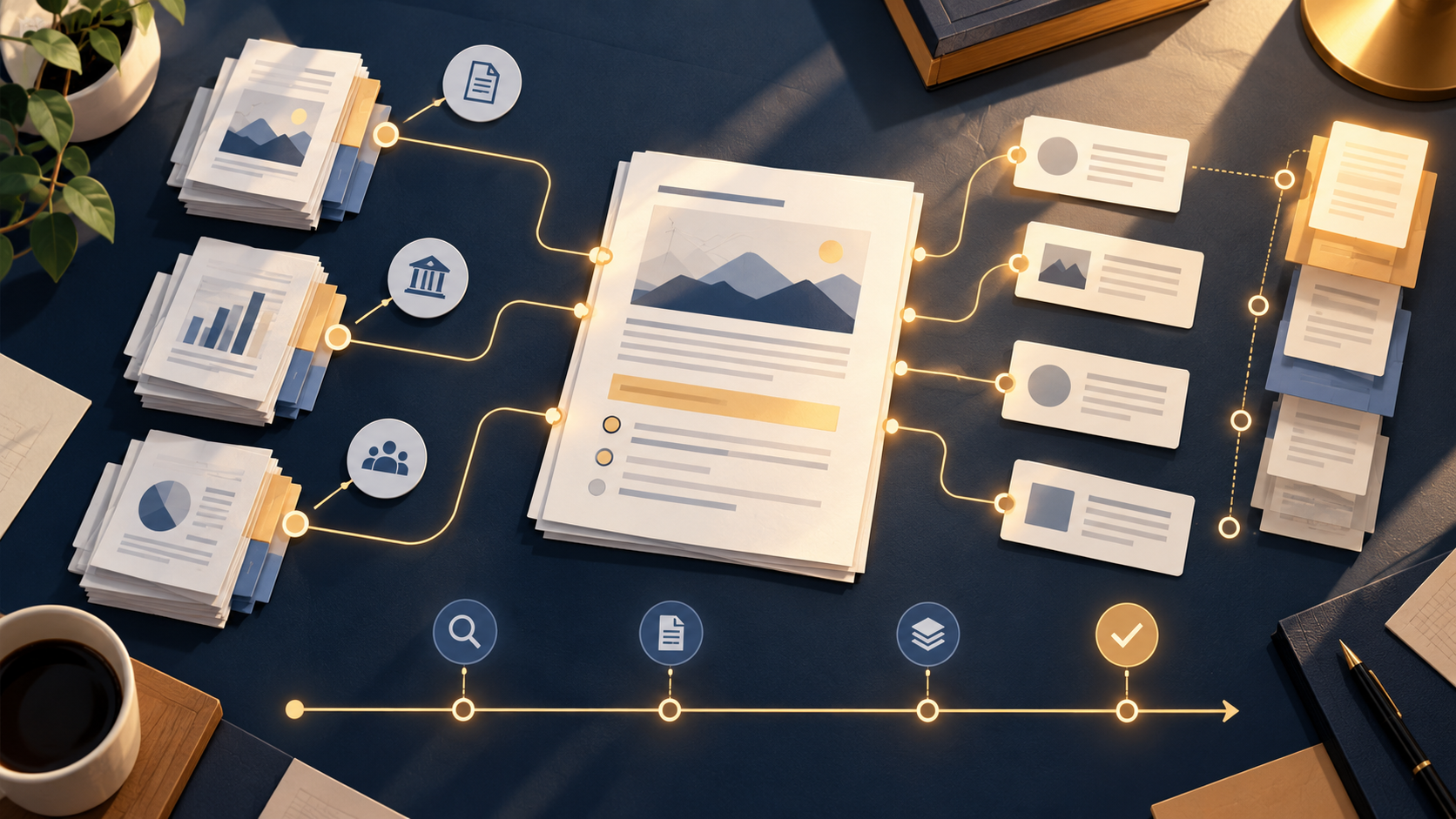
A source-provenance trail is the record that lets a reader—or a reviewer six months later—move from a sentence in your report back to the exact source, version, and search that produced it. For a time-sensitive decision memo, due-diligence file, or client briefing, that trail is what separates a defensible claim from an assertion.
This guide gives a complete sequence: plan the search, capture each record, log the version, attach claims to sources, assign confidence, and propagate changes when a source moves. It ends with a reusable table, stop rules, and a worked example.
Start with the decision, not the sources
Before you collect anything, write the question the report must answer and the decisions it will inform. Cochrane's guidance on searching for studies begins with eligibility criteria: define what counts as a relevant source before you search, so the search plan follows from the question rather than from whatever turns up.
For a provenance trail, translate eligibility criteria into a short source charter:
- Question: what the report must resolve.
- Inclusion rules: source types, date windows, languages, and study or document designs you will accept.
- Exclusion rules: what you will drop and why.
- Claim register: the specific claims the report will make, each with an owner.
- Confidence scale: what "high," "medium," and "low" mean for your team.
This charter is the first artifact in the trail. Every later record points back to it.
Run a documented, multi-source search
Cochrane recommends planning searches from eligibility criteria, using multiple sources, and combining free-text terms with subject headings. It also recommends documenting the process and deduplicating records. Those four habits map directly onto provenance.
- Use more than one source. A single database is a single point of failure. Record which sources you searched and on what date.
- Combine free-text and controlled vocabulary. PubMed supports field tags, phrase searching, filters, and Advanced Search, and its search details reveal how terms were translated and combined. Capture that translation—it is the difference between "we searched X" and a reproducible query.
- Document the process as you go. Record the query string, filters, date run, and result count for each source.
- Deduplicate before screening. Keep a record of which duplicate was retained and which was merged.
If you are finding papers through a scholarly search interface, WisPaper search is the entry point for locating academic papers; treat each result as a candidate record to be logged, not as a finished citation.
Capture the source record at first contact
Provenance fails most often at the moment of capture: a PDF is downloaded, a link is pasted, and the context is lost. Build a capture template and fill it the first time you touch a source.
At minimum, record:
- Identifier: DOI, PMID, ISBN, or report number.
- Full citation: authors, title, venue, year.
- Version: preprint, accepted manuscript, published version, or report revision, plus the date you accessed it.
- Location: where the file or link lives in your library.
- Search origin: which query and which source surfaced it.
- Screening decision: included, excluded, or pending, with the reason.
Cochrane's guidance on linking multiple reports of one study matters here: one study may appear as several reports, and your trail should connect them rather than treat them as independent evidence. Give each study a parent record and attach its reports beneath it.
Google Scholar's help documentation describes searching by author and title, date sorting and limits, Cited by and Related articles, citation export, library access links, and ways to locate alternative versions of a work. Alternative-version lookup is a provenance tool: when you find a second version, log it against the parent record instead of silently replacing the first.
Log the version you actually used
A citation without a version is ambiguous. Record the version you read, the date you read it, and whether a newer version exists. When a source has a preprint and a published version, note both and state which one supports each claim.
A practical version log has four columns: parent record, version label, date accessed, and status (current, superseded, or under review). When you cite a claim, point to the version row, not just the parent record.
Attach every claim to a source and a confidence level
A traceable claim has four parts: the claim text, the source record, the exact location within the source (page, section, table, or figure), and a confidence level with a one-line rationale.
Use a simple, explicit scale:
- High: the claim is stated directly in a current, peer-reviewed or authoritative source, and a second independent source agrees.
- Medium: the claim is stated directly in one current source, or supported by converging but indirect evidence.
- Low: the claim rests on a single source, an older version, or inference across sources.
Write the rationale next to the level. "Medium—single source, published version, no corroboration yet" tells a reviewer what to check. A bare "medium" does not.
When you need to check that a bibliography is real before it enters the trail, TrueCite screens BibTeX against academic databases to flag hallucinated references—a useful gate before citation records are finalized.
Propagate changes when a source moves
Sources change: a preprint is published, a report is revised, a retraction appears, or a database updates. Propagation is the discipline of pushing that change through every claim that depends on it.
Run a change sweep at three points: before the first draft circulates, before the final review, and immediately before publication. Cochrane recommends rerunning searches before publication; treat that as the trigger for a full propagation pass.
For each changed source:
- Update the version log and mark the old version superseded.
- List every claim linked to that source.
- Re-read each claim against the new version and revise or retire it.
- Reassign confidence where the evidence changed.
- Note the change in a propagation log with date and owner.
A worked example: a due-diligence memo
Suppose your team is preparing a client briefing on a technology's clinical evidence. The memo will make three claims: the intervention has published trial evidence, the effect size is consistent across studies, and no major safety signal appears in the literature.
Step 1—Charter. The team sets inclusion rules (peer-reviewed trials and systematic reviews, last ten years), a claim register with the three claims, and a confidence scale.
Step 2—Search. The team searches two databases plus a scholarly search interface, records each query string and date, and deduplicates. One trial appears as a conference abstract and a full paper; the team links both under one parent study record.
Step 3—Capture. Each included source gets an identifier, full citation, version, location, and search origin. A preprint of one trial is logged alongside its published version.
Step 4—Claim mapping. Claim one (published evidence exists) is rated high: multiple current sources state it directly. Claim two (consistent effect size) is rated medium: two trials agree, but a third reports a different measure. Claim three (no major safety signal) is rated low: absence of reports in the searched sources is not the same as confirmed safety, so the memo phrases it as "no major safety signal identified in the sources reviewed" and flags the limitation.
Step 5—Propagation. Before the briefing, the team reruns searches. The preprint is now published with a revised effect estimate. The team updates the version log, revises claim two's wording, downgrades its confidence, and records the change. The client sees a memo whose every sentence can be traced to a dated, versioned source.
Use a library and Q&A layer without losing the trail
A shared library keeps records in one place. My Library lets you save or upload papers and organize them, which is where captured records and their versions can live. Library QA lets you ask questions based on papers uploaded to My Library or added from search results—useful for checking what a set of captured sources says, with the answers then verified against the underlying records.
For longer research tasks, Scholar Agent supports literature review, inspiration, and reproduction use cases. Keep the provenance discipline intact: whatever the agent surfaces becomes a candidate record that you log, version, and map to claims.
Reusable provenance table and checklist
| Field | What to record | Example |
|---|---|---|
| Record ID | Stable identifier | SRC-014 |
| Citation | Authors, title, venue, year | — |
| Identifier | DOI, PMID, or report number | — |
| Version | Preprint, published, revision | Published v2 |
| Date accessed | When you read it | — |
| Search origin | Query and source | Query Q3, database B |
| Screening decision | Include/exclude + reason | Include—meets criteria |
| Linked claims | Claim IDs | C1, C2 |
| Confidence | Level + rationale | Medium—single source |
| Status | Current/superseded | Current |
Checklist before circulation:
- Every claim has a source record and a location.
- Every source has a version and access date.
- Duplicates are merged and multi-report studies are linked.
- Confidence levels carry rationales.
- Searches were rerun and changes propagated.
- The propagation log is current.
Stop and escalation rules
Define these before drafting so the team acts consistently:
- Stop when a claim has no source record; do not draft around it.
- Stop when a source's version cannot be determined; resolve it before citing.
- Escalate when a source changes after the claim was rated high; a reviewer must re-rate it.
- Escalate when two current sources conflict and neither can be excluded on eligibility grounds.
- Escalate when a claim depends on absence of evidence; a senior reviewer decides how to phrase it.
- Stop when a citation cannot be verified against a database; remove or replace it before publication.
FAQs
Keep Reading

How to Build an Evidence Hierarchy for a Focused Clinical Question
A focused clinical question is not answered by finding the highest-ranked study type and stopping there. The practical task is to define the question precisely, retrieve the relevant evidence types, rank them by design a
How to Build Better Search Terms from One Strong Seed Paper
A single strong paper is often the most reliable starting point for a reproducible literature search. It already sits inside your eligibility criteria, it carries the vocabulary your field actually uses, and it points to
How to Capture Study Limitations Without Copying the Discussion Section
Most readers meet study limitations in the discussion section, where authors narrate what went wrong. That paragraph is useful, but it is not a limitation appraisal. Authors select, frame, and sometimes soften what they