
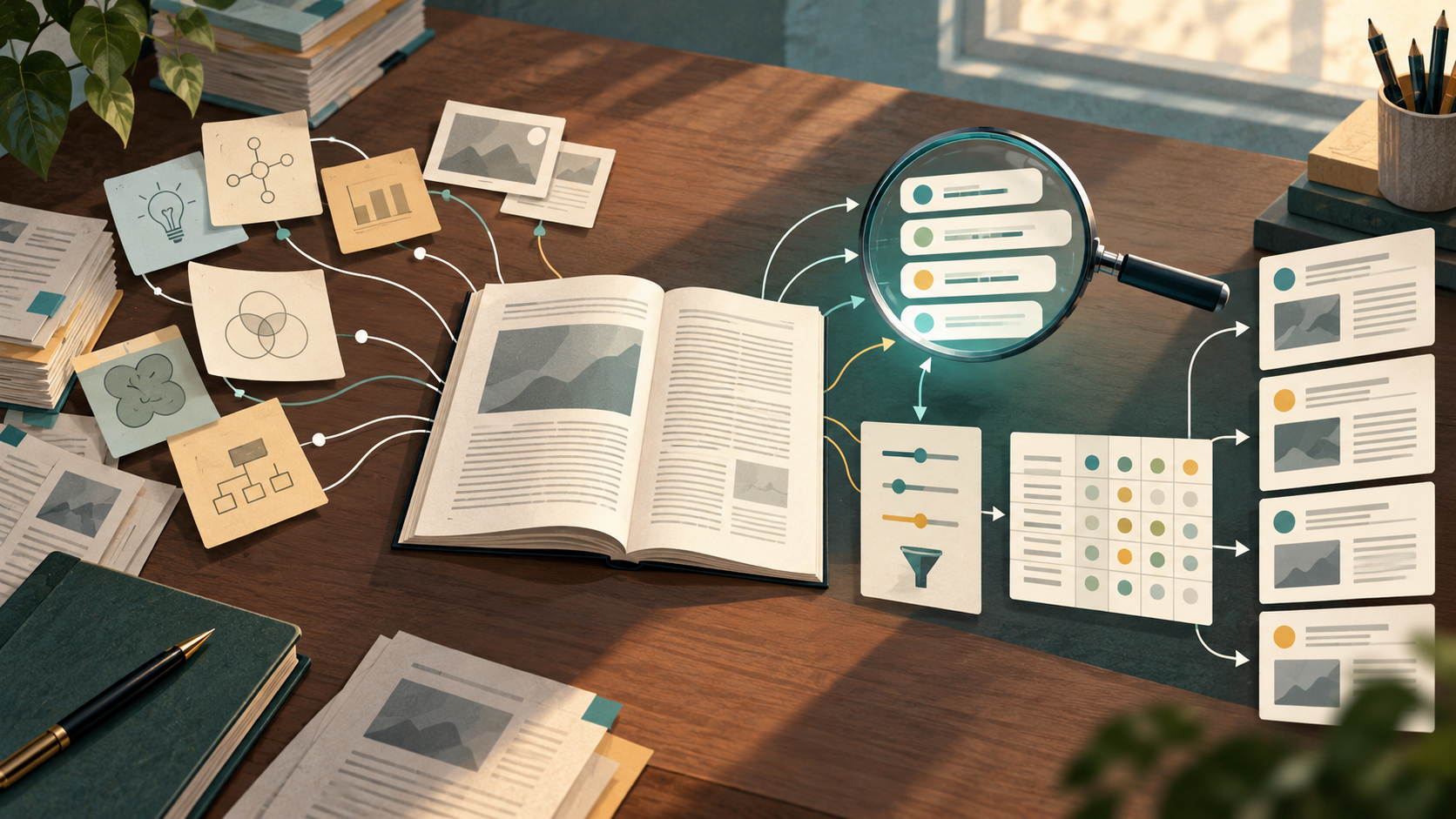
A single strong paper is often the most reliable starting point for a reproducible literature search. It already sits inside your eligibility criteria, it carries the vocabulary your field actually uses, and it points to the terms indexers and citing authors are likely to reuse. The task is to mine that paper systematically — author keywords, indexing terms, recurring concepts, cited terminology, and alternative labels — then test a compact query set before you commit to a full search.
This guide gives a complete sequence with diagnostic checkpoints, a worked example, a reusable checklist, and clear stop or escalation rules. It is written for researchers preparing a manuscript, a review, a revision, or a grant-related evidence summary where the search trail needs to be auditable.
Why start from a seed paper rather than a keyword brainstorm
Cochrane's guidance on searching for studies begins with eligibility criteria, not with a list of words. Building terms from a seed paper keeps you anchored to those criteria: every term you extract can be traced back to a document you have already judged relevant. That traceability is what makes the method auditable later.
Cochrane also recommends combining free-text terms with subject headings, using multiple sources, documenting the process, and deduplicating records. A seed-paper workflow supports each of these: the paper supplies free-text vocabulary, its indexing record supplies subject headings, and your extraction sheet becomes the documentation.
Step 1: Fix the seed paper and record why it qualifies
Before extracting anything, write one sentence stating why this paper meets your eligibility criteria. Note the database record you used, the date you accessed it, and the identifier (DOI or PMID). This is the first entry in your method trail.
Checkpoint: If you cannot state the eligibility reason in one sentence, the paper is not yet a reliable seed. Choose another.
Step 2: Extract author keywords and indexing terms separately
Author keywords and indexer-assigned terms are different evidence and should be captured in different columns.
- Author keywords come from the paper itself and reflect how the authors frame their contribution.
- Indexing terms come from the database record. PubMed's search details, for example, reveal how your terms were translated and combined, which helps you see the controlled vocabulary behind a record.
Record both verbatim. Do not merge them yet — you will want to see which concepts appear in both places.
Step 3: Map recurring concepts and cited terminology
Read the abstract, the introduction's framing sentences, and the reference titles. You are looking for:
- Recurring concepts — ideas that appear in the abstract, the keywords, and the cited work.
- Cited terminology — how the papers this seed cites name the same phenomenon. Reference titles are a compact source of alternative labels.
- Alternative labels — synonyms, spelling variants, and adjacent framings used by different research communities.
Keep a column for the source of each term (author keyword, index term, abstract, reference title). A term with no source is a guess, and guesses belong in a separate "to test" list, not in your extraction sheet.
Step 4: Build the concept table
Organize terms into concept blocks. A typical structure for a review has two or three blocks: the phenomenon, the population or context, and the study design if your criteria require one.
| Concept block | Author keywords | Indexing terms | Alternative labels from citations |
|---|---|---|---|
| Phenomenon | from seed | from record | from reference titles |
| Population / context | from seed | from record | from reference titles |
| Design (if required) | from seed | from record | from reference titles |
Checkpoint: Every block should have at least one term from each of the three sources. A block with only author keywords is under-supported and needs more reading before you search.
Step 5: Test a compact query set
Do not start with the full search. Build three to five test queries that vary one thing at a time:
- Free-text only — all alternative labels combined with OR within each block, blocks combined with AND.
- Subject headings only — the index terms from your record.
- Combined — free-text plus headings, as Cochrane recommends.
- Narrow variant — add a design or context term to see how much the set shrinks.
- Broad variant — drop the least-supported block.
Run each query and record the number of results and whether the seed paper appears. The seed appearing is your positive control.
You can run these test queries through WisPaper search to find academic papers through its scholarly search interface, and compare the result sets side by side.
Checkpoint: If the seed paper does not appear in the combined query, a term is wrong or a block is too narrow. Fix the query before expanding.
Step 6: Use citation tools to find alternative labels you missed
Google Scholar documents Cited by and Related articles, which surface papers that share vocabulary with your seed. PubMed offers Similar Articles. Use these to harvest additional alternative labels, then add them to your concept table with their source noted.
This is where a seed paper earns its keep: the citing literature often uses the newer label for the same concept, and that label may be missing from your original extraction.
Step 7: Save, organize, and keep the trail
Cochrane recommends documenting the process and deduplicating records. PubMed supports saved searches, and Google Scholar supports email alerts — both are useful for rerunning searches before publication, which Cochrane also recommends.
Save the papers you retrieve into an organized library so the trail stays intact. My Library lets you save or upload papers and organize them in the WisPaper library, which keeps your seed paper and test-query results in one place.
Checkpoint: Before moving to screening, confirm that your saved set includes the seed paper, the test-query results, and a dated note of each query string.
Worked example: a review on a specific intervention
Suppose your seed paper is a trial of a behavioral intervention in a clinical population, and your review asks whether the intervention improves a defined outcome.
Eligibility sentence: The paper reports a randomized trial of the intervention in the target population with the defined outcome.
Extraction:
- Author keywords: the intervention name, the population label, the outcome label.
- Indexing terms: the controlled vocabulary for the intervention and the population.
- Reference titles: two older labels for the intervention and one broader framing of the outcome.
Concept table: three blocks — intervention, population, outcome.
Test queries: free-text only, headings only, combined, narrow (adds randomized trial), broad (drops outcome).
Diagnostic result: the combined query retrieves the seed paper; the headings-only query misses it because the record uses a newer heading. You add the newer heading to the table and rerun.
Trail: a dated sheet listing each query string, the database, the result count, and whether the seed appeared.
This example is deliberately generic — the point is the sequence, not the specific terms.
Reusable checklist
- Eligibility sentence written for the seed paper
- Database record and access date noted
- Author keywords extracted verbatim
- Indexing terms extracted verbatim
- Recurring concepts mapped across abstract and references
- Alternative labels captured with source
- Concept table built with at least two blocks
- Three to five test queries written, varying one element at a time
- Seed paper confirmed in the combined query
- Query strings, databases, and result counts dated and saved
- Records deduplicated
- Search scheduled for rerun before submission
When to escalate beyond a single seed paper
A single seed paper is a starting point, not a complete search. Escalate when:
- The combined query retrieves too few records to screen meaningfully.
- The seed paper's vocabulary is clearly narrower than the field's.
- Your eligibility criteria span more than one literature.
- A reviewer or editor asks for a multi-database search.
Cochrane's recommendation to use multiple sources applies here: a seed-paper query set should be run across more than one database before it is reported as a search strategy.
For longer research tasks that fit WisPaper's Scholar Agent area and its literature review, inspiration, or reproduction use cases, Scholar Agent can carry the work forward once your term set is stable. If you need to ask questions based on papers you have already uploaded to My Library or added from search results, Library QA supports that step.
Stop rules
Stop extracting and start testing when:
- Every concept block has terms from all three sources.
- Two consecutive reference titles add no new alternative labels.
- Your test queries retrieve the seed paper in the combined variant.
Stop testing and move to screening when the combined query's result count is manageable and the seed paper appears. If the count is unmanageable, tighten the least-supported block rather than adding more synonyms.
FAQs
Keep Reading

How to Capture Study Limitations Without Copying the Discussion Section
Most readers meet study limitations in the discussion section, where authors narrate what went wrong. That paragraph is useful, but it is not a limitation appraisal. Authors select, frame, and sometimes soften what they

How to Check AI-Generated Research Notes Against the Papers
AI notes are most useful when you treat them as a list of claims to verify, not as finished prose. The fastest reliable method is to sample the highest-risk claims first, trace each one to a specific location in a specif

How to Check Whether a Paper Was Corrected, Updated, or Retracted
A correction, an update, and a retraction are three different events, and they change what you can responsibly claim from a paper in three different ways. If you are writing a decision memo, a due-diligence note, or a cl