
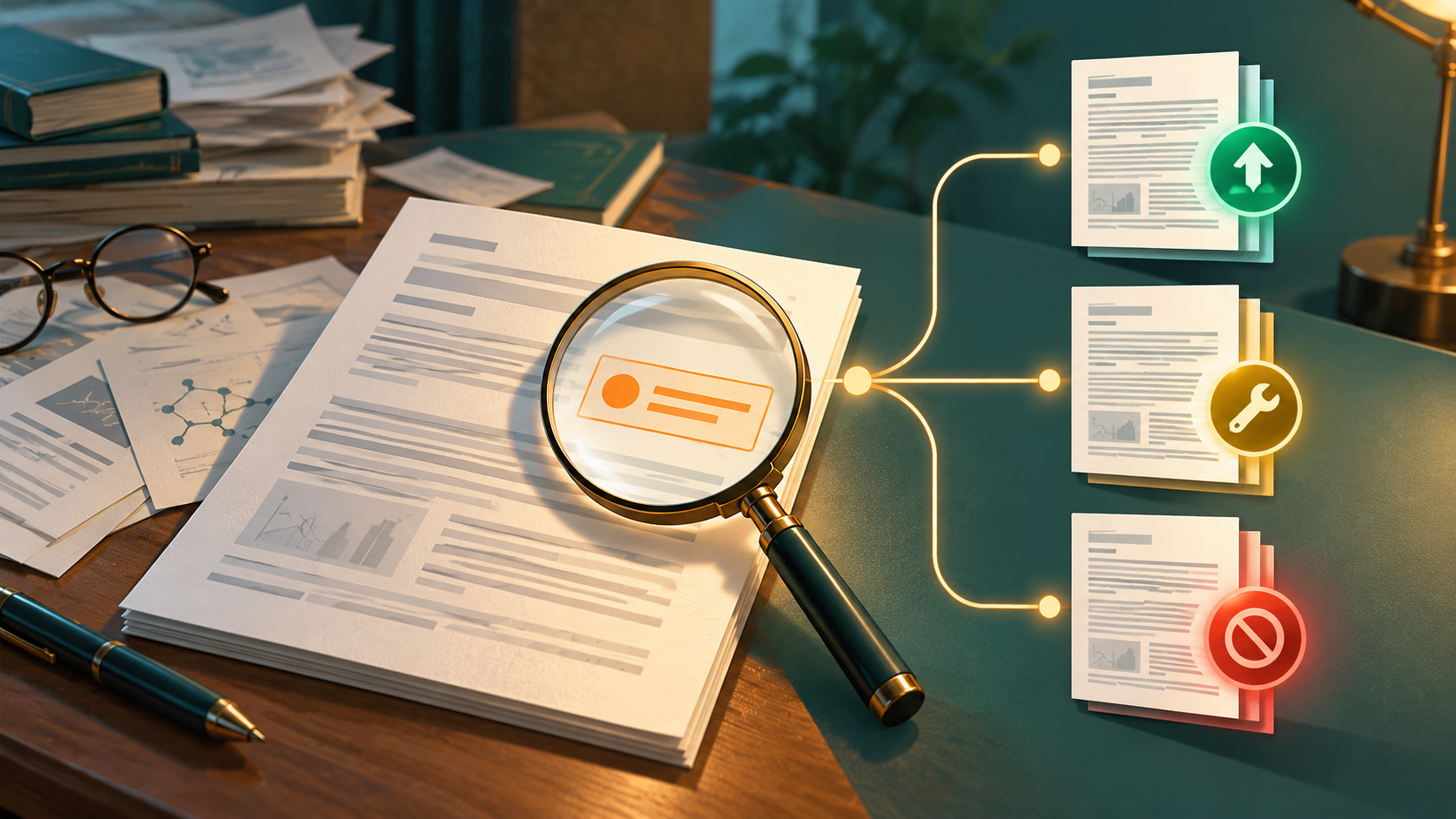
A correction, an update, and a retraction are three different events, and they change what you can responsibly claim from a paper in three different ways. If you are writing a decision memo, a due-diligence note, or a client briefing on a deadline, the practical question is not only "is this paper still valid?" but "what exactly changed, and which sentences in my draft does that change touch?"
This guide gives you a repeatable sequence: resolve the identifier, read the publisher notice, check the metadata relations, classify the event, then decide whether your claim survives, needs a qualifier, or must be withdrawn. It closes with a worked example, a reusable checklist, and stop rules for when to escalate.
Start with the identifier, not the PDF
Begin from the DOI rather than a downloaded file. A DOI can be resolved through doi.org to the current destination registered for that identifier. That resolution helps you locate the work, but the bibliographic fields and the source text still need to be checked for identity and claim support.
This matters because the PDF in your files may predate a notice. Treat the resolved record as the anchor and the PDF as one version of the work. Record the DOI, the resolved landing page, and the date you checked. If you are assembling a fresh set of candidates, WisPaper search lets you find academic papers through a scholarly search interface before you begin the status check on each one.
Checkpoint 1: You have a DOI, a resolved landing page, and a check date written down. If any of the three is missing, stop and complete them before reading further.
Read the publisher notice before the abstract
Publisher-deposited metadata is where post-publication updates surface. Crossref exposes publisher-deposited scholarly metadata through its REST API, including titles, authors, venues, dates, identifiers, licenses, funding, ORCID and ROR identifiers, abstracts when deposited, and post-publication updates from trusted sources.
So the notice is not an afterthought to the abstract — it is part of the record. Read the notice type, the date, the stated reason, and which element of the paper it affects. A notice that corrects a figure caption and a notice that withdraws the central finding are both "updates" in a metadata feed, but they are not the same event for your claim.
Checkpoint 2: You can state the notice type, its date, and the specific element it touches in one sentence. If you cannot, you have not read the notice closely enough to classify it.
Distinguish corrections from retractions by what they touch
Use the notice's own scope to classify the event, not the headline of the paper or the reputation of the venue.
- Correction: the notice identifies a specific error and its replacement. Your job is to check whether your claim depends on the corrected element.
- Update or new version: the record points to a later version of the work. Your job is to check whether the fields and text you relied on changed between versions.
- Retraction: the notice withdraws the work. Your job is to check whether any claim in your draft rests on it.
A single paper can carry more than one of these across its history. Read the relations in order of date so you understand the sequence rather than only the latest entry.
Checkpoint 3: You have written the classification and the affected element side by side. If the classification is ambiguous, treat it as unresolved and escalate rather than guessing.
Trace metadata relations to confirm the chain
Metadata relations are how you confirm that the notice you found actually belongs to the work you are citing, and how you find notices you did not expect. Use the deposited relations to link the original record, the notice, and any later version.
When you need to keep the original, the notice, and your notes together, My Library lets you save or upload papers and organize them in the WisPaper library. Keeping the notice alongside the paper prevents the common failure where the notice is read once and then lost when the draft is revised.
Checkpoint 4: The original record, the notice, and any later version are linked in your working set, with dates. If the chain has a gap, mark the claim as unverified.
Decide what the status does to your claim
This is the step most teams skip. The status of a paper does not automatically invalidate every sentence that cites it. Map the notice to the specific claim.
| Notice type | Ask this about your claim | Decision |
|---|---|---|
| Correction, unrelated element | Does my claim depend on the corrected figure, table, or passage? | Keep the claim; note the correction in provenance |
| Correction, related element | Does the corrected value change the direction or size of my claim? | Revise the claim to the corrected value |
| Update or new version | Did the fields or text I relied on change between versions? | Re-check the claim against the later version |
| Retraction | Does any part of my claim rest on this work? | Remove or replace the claim; do not cite the retracted work as support |
| Unresolved or ambiguous | Can I confirm the notice belongs to this work? | Hold the claim and escalate |
Assign an explicit confidence level to each affected claim — for example high, medium, or low — and write the reason next to it. A claim supported by a corrected-but-unrelated paper can stay high. A claim resting on a retracted paper drops out entirely. A claim whose notice you could not confirm stays low until resolved.
Checkpoint 5: Every claim that cites a paper with a notice has a decision and a confidence level written next to it.
Worked example: a due-diligence memo on a cited effect
Imagine a due-diligence memo that cites one paper for a specific quantitative effect. The analyst resolves the DOI, lands on the publisher page, and finds a notice deposited against the record.
- Resolve. The DOI resolves to the publisher landing page. The analyst records the DOI and the check date.
- Read the notice. The notice is a correction dated after publication and names a specific table.
- Trace relations. The analyst links the original record, the correction, and the current version in the working set.
- Map to the claim. The memo's sentence quotes the corrected table. The correction therefore touches the claim directly.
- Decide. The analyst revises the sentence to the corrected value and marks the claim medium confidence pending a second source.
- Record provenance. The memo's source note lists the DOI, the notice type, the notice date, and the check date.
Now change one variable: suppose the notice had been a retraction instead. The same mapping step would have removed the claim rather than revised it, and the memo would need a replacement source before the section could stand.
For longer memos that draw on many papers at once, Scholar Agent supports longer research tasks in the literature review, inspiration, and reproduction use cases. Use it to assemble the evidence base, then run the status check on each cited paper yourself so the notice mapping stays explicit.
Keep provenance and confidence visible in the memo
A status check is only useful if the reader of your memo can see it. For each cited paper, record:
- the DOI and the resolved landing page;
- the notice type and date;
- the element the notice affects;
- the claim it supports and that claim's confidence level;
- the date you checked.
When a claim has been revised, say so in the source note rather than silently swapping the number. When a claim has been removed, say why. This is what makes the memo traceable when someone re-checks it a month later.
If your team asks questions across a set of saved papers, Library QA lets you ask questions based on papers uploaded to My Library or added from search results. Pair those answers with the notice record for each paper so the status stays attached to the claim.
Checkpoint 6: A colleague who has not seen your working files can reconstruct, from the memo alone, which papers had notices and how each claim was decided.
Reusable checklist
Run this checklist for every paper that carries a claim in a time-sensitive deliverable.
- Record the DOI and resolve it through doi.org.
- Record the check date.
- Read the publisher notice: type, date, reason, affected element.
- Trace metadata relations to link original, notice, and any later version.
- Classify the event as correction, update, or retraction.
- Map the notice to each specific claim that cites the paper.
- Assign a confidence level and a reason to each affected claim.
- Revise, keep, or remove the claim according to the mapping table.
- Write the provenance note into the memo.
- Re-check before the deliverable ships if the check date is old.
Stop and escalation rules
Use these rules to decide when to keep working and when to hand the decision to someone else.
- Stop if you cannot resolve the DOI to a landing page. Do not cite the paper until you can.
- Stop if the notice type is ambiguous or the relations do not clearly connect the notice to the work. Mark the claim unverified and escalate.
- Escalate if a retraction touches a claim that anchors a recommendation in the memo. The decision owner needs to know before the memo ships.
- Escalate if a correction changes a number that appears in an executive summary or a client-facing figure.
- Re-check if the check date predates the latest notice date in the record.
These rules keep the status check from becoming a one-time ritual. The point is to make the decision visible and to route the consequential ones to the person who owns the recommendation.
FAQs
Keep Reading

How to Check Whether Study Results Apply to Your Population
You have a promising paper in front of you, a deadline on the calendar, and one nagging question: do these results actually apply to the people, setting, or problem you are writing about? Applicability is a judgment you

How to Check Whether Your Literature Review Missed Recent Studies
A literature review can be thorough on the day you run it and incomplete on the day you submit. The practical fix is not to redo the whole search from scratch. It is to define a cutoff, rerun date-bounded searches, track
How to Clean a Messy Reference Library Before Final Writing
A reference library that has grown across drafts, projects, and collaborators usually fails in predictable ways: the same paper appears three times, metadata is inconsistent, attachments point nowhere, and you cannot tel