

Statistical reporting errors are among the most common reasons a manuscript stalls in review. A reviewer cannot reproduce your logic if the numbers do not line up across the abstract, methods, results, tables, and figures. The practical question at submission time is not "is my analysis right?" but "can a careful reader verify what I did and where each number came from?" This guide gives you a submission-readiness sequence that works whether you are revising after peer review, closing a project before a lab handoff, or doing a final pass with coauthors.
You are ready to submit when three things are true: every reported statistic traces to a named analysis in your methods, every table and figure value matches the text and the analysis output, and your reporting choices follow the standard relevant to your design. The steps below turn that broad goal into checkpoints you can complete in a working session.
What state is your manuscript in right now?
Start by diagnosing where you are, because the right check is different for each state.
- Draft complete, no external review yet. Your main risk is internal inconsistency between text, tables, and analysis output. You need a traceability pass rather than a methods rewrite.
- Resubmitting after peer review. Your main risk is a changed analysis that was not propagated everywhere. You need a change-propagation pass.
- Handing off to a lab member or coauthor. Your main risk is that the trail exists only in your head. You need an artifact pack that lets someone else verify the work without asking you.
- Preserving a closed project. Your main risk is losing the link between final numbers and the files that produced them. You need a compact evidence trail.
Write down your state in one sentence. It will determine the order of the checkpoints below. If you have not kept a method trail until now, the first checkpoint becomes reconstruction rather than verification.
Which reporting standard applies to your design?
The reporting standard is your external checklist. It tells you which items a reviewer will expect to see for your study type, and it gives you a concrete list to check against your manuscript.
- Experimental and most quantitative psychology and social science work: APA Journal Article Reporting Standards (APA JARS) provide general reporting standards plus design-specific modules for quantitative, qualitative, and mixed-methods research. The modules exist so readers can evaluate how the study was conducted and analyzed, not just what the authors concluded.
- Observational epidemiology and clinical research: STROBE provides checklists for cohort, case-control, and cross-sectional studies. Items cover methods, results, discussion, and other information, including how variables were defined, how participants were selected, and how quantitative results are presented.
- Grant-funded biomedical or behavioral work: NIH expects a transparent account of design, methods, analysis, interpretation, and reporting as part of scientific rigor and reproducibility. This is a useful frame even when the funder is different.
Pick one primary standard and keep its checklist open beside your manuscript. If you are submitting to a journal with its own statistical reporting guide, use the journal guide as the primary standard and the general standard as a cross-check.
How do you build the number-to-analysis map?
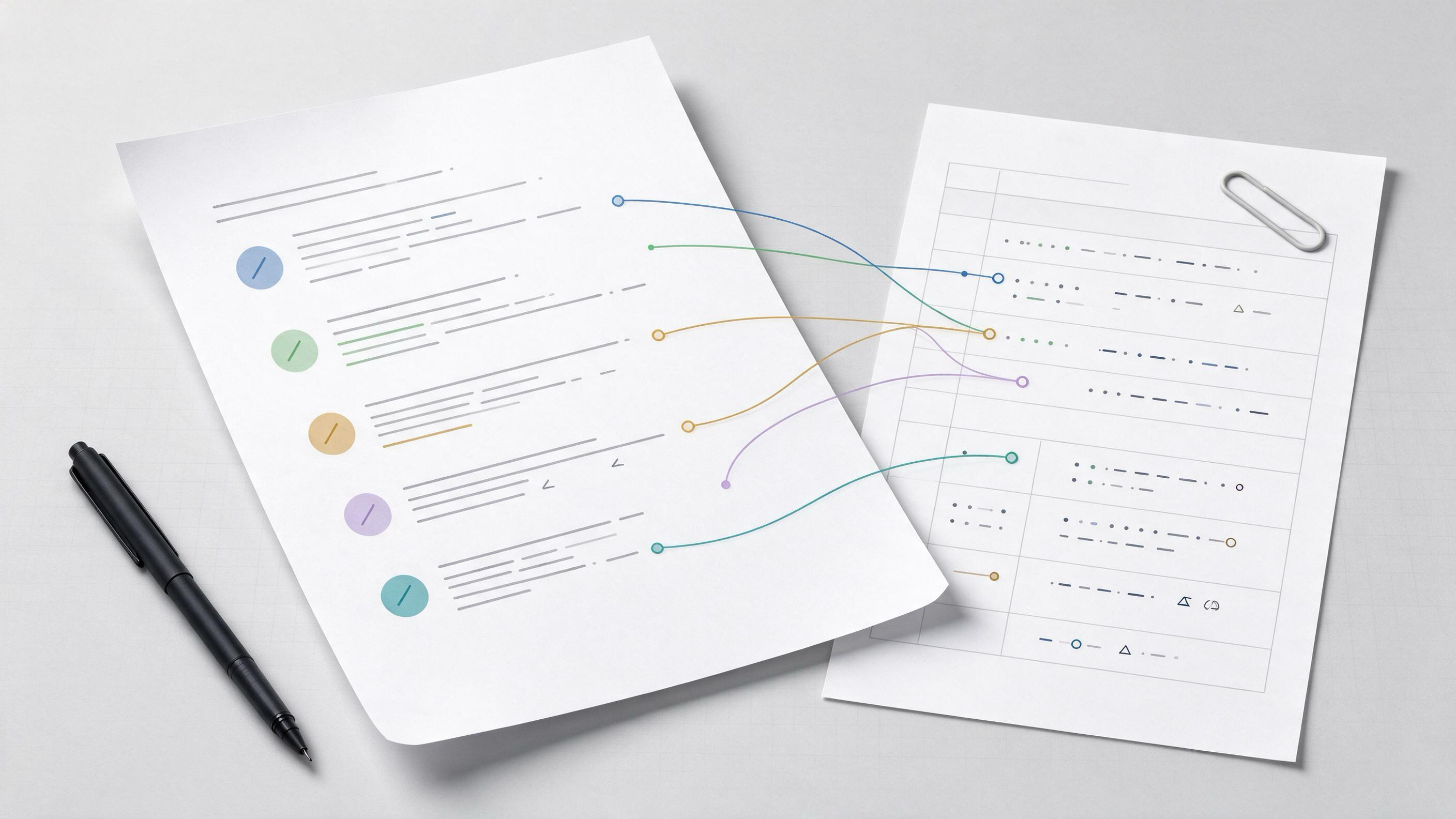
The core artifact in any statistical reporting check is a map from every reported number to the analysis that produced it. Do not attempt this from memory. Open your analysis files or outputs and work through the manuscript in order.
For every statistic in the text, record four fields in a simple table:
- Location: section, paragraph, table, or figure.
- Reported value: the exact number as written, including test statistic, degrees of freedom, p-value, confidence interval, or effect size.
- Analysis source: the file, script, or output block that generated the value.
- Check status: matches, does not match, or needs rounding decision.
When you cannot identify a source for a number, that is a finding, not a failure of your checking process. The number either needs a source restored or needs to be removed or explicitly described as a hand calculation.
Where does this work fit in an existing workflow? If your manuscript has been assembled from many papers and files, a WisPaper library gives you one place to keep the papers and outputs that support the reporting pass. For a larger revision that spans many related analyses, a research project area helps you keep the manuscript, the reporting table, and the checklist in the same working context.
Which numbers deserve the closest attention?
Not all statistics carry equal risk. Prioritize these five categories:
- Degrees of freedom. They are easy to misreport after any change in the model or exclusion criteria.
- p-values versus thresholds. Check that the reported significance statement matches the exact p-value and the alpha you stated in the methods.
- Effect sizes and confidence intervals. These travel from output to text to tables to the abstract, and they are the most prone to transcription drift.
- Sample sizes. The n in the abstract, the analysis n, and the table n must reconcile. List every loss or exclusion explicitly.
- Direction and sign. A negative coefficient reported as positive, or a group label reversed, survives a spell check but changes the conclusion.
Work through these five columns in the number-to-analysis map before moving to anything else. In most manuscripts, correcting these resolves the majority of substantive reporting problems.
What does a worked example look like?
Suppose a coauthor hands you a revised results section for an observational study. The methods say the study followed a cohort design and that the analysis used a multivariable model adjusting for age and sex.
Step 1: Identify the standard. Because this is an observational cohort study, you open the STROBE checklist. You note which items require reporting of participants at each stage, descriptive data, outcome data, and main results.
Step 2: Build the map. You extract every statistic from the text and the main table. One reported odds ratio is 1.42 with a 95% confidence interval of 1.05 to 1.92. You locate the model output. The output shows 1.42 (1.05–1.92). That row matches.
Step 3: Find the drift. The next paragraph reports a low event count in one subgroup and says a secondary model was adjusted for age only. The table still shows the age-and-sex adjusted number. The reported value matches the output but not the described analysis. This is a description mismatch, not a transcription error.
Step 4: Trace the total n. The abstract reports 1,204 participants. The methods describe 34 exclusions for missing exposure data. The table reports 1,170. That reconciles only if the exclusion is stated clearly. You add the missing line to the participant flow so the reader can reconstruct the number.
Step 5: Check against the standard. You mark each STROBE item relevant to results as complete, incomplete, or not applicable. The two mismatches found in steps three and four are now fixed in text and table.
Completion result: every reported number in the example now traces to an analysis, the described model matches the reported model, and the STROBE-relevant items for the results are marked complete.
Can you ask targeted questions about your own uploaded papers?
Part of checking reporting is checking the papers you cite against your description of them. If you have saved a set of papers in your library, you can ask questions about those papers directly. This is most useful when you are verifying that a cited method is described as you described it, or that a reported value you are comparing against is stated as you remember.
The Library QA area lets you ask questions based on papers you have uploaded to your library or added from search results. Use it to confirm the wording of a method or a number in a paper you cite, before you finalize the comparison in your manuscript. Keep the confirming question narrow: one paper, one claim.
Whose checklist is final?
The last reader of your reporting is not you. Choose a reviewer for the check itself:
- For a solo submission: Use the reporting standard plus a fresh read-through after at least one day away from the document.
- For a coauthored submission: Assign one person to own the number-to-analysis map. That person reads the manuscript without looking at the analysis files first, then checks the map. A second person verifies a random sample of rows.
- For a lab handoff: The receiver should be able to rebuild the reported table from the files you provide. If they need to ask a question, the trail is incomplete.
The checkpoint is simple: after the independent read, no row in the map sits in "does not match" or "needs decision" status.
How do you preserve the evidence trail?
The auditable method trail is what survives after the submission. It includes at least:
- The reporting standard checklist you used, with items marked complete.
- The number-to-analysis map with source locations.
- The analysis outputs or a manifest pointing to their exact locations.
- A short note on any intentional rounding or exclusion decisions.
If your work involves reproducing a previously published result or checking a paper's reported statistics against its data, PaperClaw supports research-paper reproduction planning from an uploaded PDF and reproduction instructions. That can anchor the handoff when the task is to verify another paper's reporting rather than only your own.
What makes the result ready to submit?
You can declare the reporting check complete when all of these are true:
- Every statistic in text, tables, figures, and abstract appears in the number-to-analysis map.
- Every mapped number matches its source or has an explicit, reasoned rounding decision.
- Degrees of freedom, p-values, effect sizes, confidence intervals, sample sizes, and directions reconcile across the manuscript.
- The methods section states the analysis behind every reported result.
- The primary reporting standard is marked complete for all applicable items.
- An independent reader, coauthor, or handoff receiver can trace a random number from the results back to the output without your help.
If any item is not true, the remaining work is specific: close that row in the map, not a general rewrite.
FAQs
Keep Reading

How to Check Tables and Figures Before Submission
A manuscript can be rejected or sent back for revision because a table’s footnote contradicts the text, a figure omits the sample size, or a statistical abbreviation is used without definition. The fastest way to avoid t

How to Check Terminology Consistency Across a Manuscript
Terminology inconsistency is one of the quietest reasons a manuscript stalls in peer review. A paper may use *myocardial infarction* in the abstract, *heart attack* in the methods, and *MI* in the results. Each term is d
How to Check That Every Reviewer Comment Was Addressed
You have finished the hard part of a revision: the rewritten methods section, the new figure, the added sensitivity analysis, and the point-by-point letter. The remaining risk is quieter and more damaging. A reviewer com