
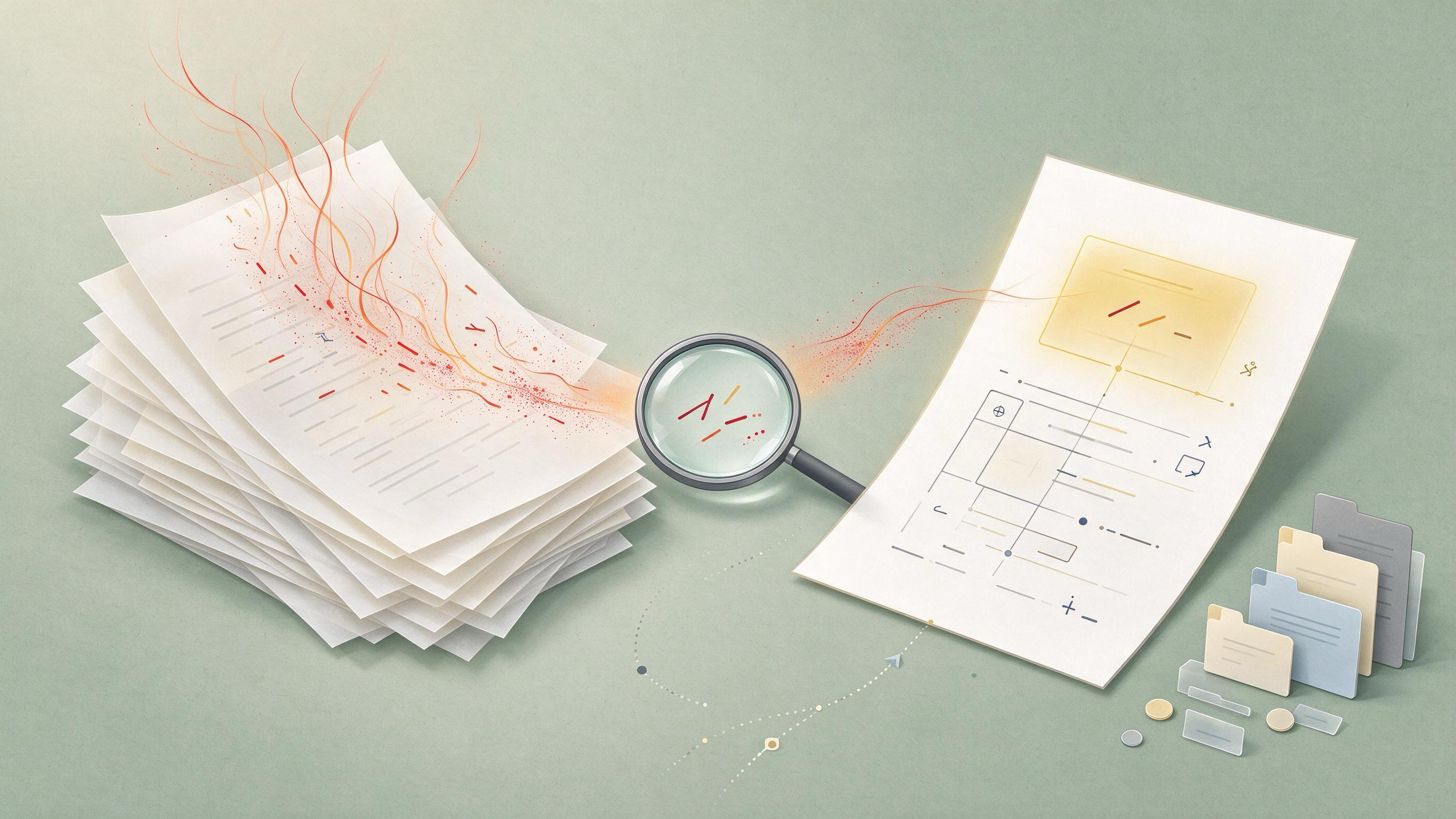
Most word-limit problems are not writing problems. They are selection problems. You have more material than the journal wants, and the real task is deciding which 20–30% of the paper carries the argument and which material is scaffolding you no longer need. This article walks through a complete reduction workflow: diagnosing where the length lives, making cut decisions in order, running checks that preserve scholarly integrity, and knowing when the revision is genuinely ready to submit.
The example throughout is a thesis chapter being reshaped into a journal article with a 6,000-word limit for body text. You can adapt every checkpoint to a coursework paper, a supervisor-requested revision, or a winter-break cleanup of an overstuffed draft.
Where Is the Length Actually Hiding?
Before cutting anything, measure where the words sit. In a typical academic manuscript the surplus is unevenly distributed. Count the body sections separately and compare them against what each section should carry.
A dependable way to do this is to mark a copy of the manuscript with section-level word counts. Three patterns account for most journals' word-limit failures:
- The methods swamp. Detailed procedural narrative absorbs length without proportionally supporting the conclusion.
- The literature review expansion. Background becomes a survey that outgrows the specific question the paper answers.
- The discussion spiral. Results are restated, then interpreted, then restated again in a slightly different register.
Start by locating your surplus rather than making uniform cuts. Uniform cutting often produces a weaker paper because it removes evidence from the core argument at the same rate it removes redundancy.
A practical first artifact is a table with one row per section: current word count, target word count based on how much argumentative work that section performs, and the gap between them. Sections where the gap is largest become your first targets.
Which Claim Is Doing the Real Work in This Paper?
A paper that must lose 25–40% of its words can only survive if you know the load-bearing claim. Write a single sentence, no more than 35 words, stating what the paper establishes. Then test every paragraph against it.
Material in one of three categories gets cut first:
- Context that does not set up the claim. A paragraph explaining a field's history is only relevant if a reader cannot understand your method or result without that history.
- Parallel demonstrations. When two examples prove the same point, keep the stronger and delete the other. Do not compress both into weaker versions.
- Defensive qualifications. Phrases that preempt hypothetical reviewer objections but do not clarify a real, identifiable ambiguity.
When you saved sources for this project in My Library, you probably kept more than the final paper needs. That is correct for the research phase. The cut phase is a different operation: you are now choosing which saved material has earned a place in the argument, not which material was useful for understanding the topic.
The reverse test is also useful. For each section, ask what the paper loses if the section vanishes. If the answer is "nothing a reader would notice," the section is a candidate for deletion rather than revision.
What Gets Cut First: A Sequence That Protects the Argument
Cut in this order so you do not waste effort polishing text that will later be removed.
Step 1: Cut whole paragraphs and subsections
Remove anything the load-bearing claim does not require. This is where the largest gains appear and where the damage is most reversible because the deleted text still exists in a separate file. Do not edit sentences yet.
Step 2: Remove repeated information across sections
Methods repeated in results, results summarized in the introduction, limitations announced in three places. Decide the single home for each piece of information and delete the others.
Step 3: Tighten remaining paragraphs
Only now compress sentences. Convert passive constructions to active ones where the actor is known. Remove hedge clusters that duplicate each other. Turn multi-clause sentences into one clause when the subordinate clause adds no information.
Step 4: Verify citations survive the surgery
Deleting text is the most common way a manuscript loses a citation that another passage still depends on. When a reference supported a claim that moved or shrank, confirm the support is still present where the claim now lives.
If the final manuscript will be passed to a reference-management step, a citation screen such as TrueCite helps you check the BibTeX entries against academic databases before submission, which matters after heavy edits because cut-and-paste revisions can quietly corrupt reference metadata.
How Far Can a Section Compress Before the Scholarship Breaks?
Some sections can lose 50% and improve. Others break at 10%. Your limits depend on the section's job.
Methods can compress further than most drafts suggest. A reader only needs enough procedural detail to judge whether the approach was appropriate and to locate the essential conditions. Everything else can move to supplementary material if the journal allows it, or be cut.
Results cannot compress below the level of the evidence. Every reported finding must remain connected to enough methodological detail that a reader can see what produced it. If a cut inside results leaves a number without a denominator, a comparison without its condition, or a figure without its caption context, stop.
The discussion compresses by subtraction, not summarization. Remove restated results and remove interpretations that overreach. Keep the interpretation that connects findings to the original question, one explicit limitation if the journal practices require it, and the answer to "so what."
A useful line test: read the compressed section aloud. If a sentence makes sense only because you remember what the deleted sentence said, that information has not actually been cut—it has been hidden. Move it back or delete its dependent.
A Worked Example: Thesis Chapter to 6,000-Word Article
Here is one realistic example with numbers that match the pattern many writers face.
Starting draft: 8,200 words for body text. Journal limit: 6,000 words for body text excluding abstract, references, and captions.
Diagnosis by section:
| Section | Current | Target | Surplus |
|---|---|---|---|
| Introduction | 1,150 | 850 | 300 |
| Literature review | 1,900 | 900 | 1,000 |
| Methods | 2,100 | 1,400 | 700 |
| Results | 1,400 | 1,400 | 0 |
| Discussion | 1,250 | 1,100 | 150 |
| Conclusion | 400 | 350 | 50 |
The cut plan: The literature review loses a full subsection comparing three theories when only one theory informs the research question. The methods section moves two procedural appendix-like paragraphs into a supplementary file. The introduction drops one paragraph of field history and removes the roadmap sentence that repeated section order already visible in headings.
What was protected: The results section stays at 1,400 words because all reported conditions remain present. The discussion loses only restated sentences, not interpretive content. The load-bearing claim, which connects intervention design to a measurable outcome, survives with every piece of its evidence intact.
Verification step: After deletion, a paragraph-level pass confirms that every claim still has its source and that the word count comes from removing material, not from shrinking the typeface or margin settings that journals ignore anyway.
How Do You Know the Cut Version Is Ready?
Words deleted is not the same as paper ready. Use completion criteria that test the argument, not just the counter.
The claim survives a stranger's summary
Hand the compressed draft to a peer who has not read the original. Ask them to state the paper's main claim in one sentence. If their sentence misses the claim you intended, a supporting passage was likely cut and the argument no longer travels without it.
Section proportions now match section jobs
In most article-length papers, intro plus discussion should not outweigh methods plus results by much. If compression made your framing longer than your evidence, you have not cut a paper—you have written a different paper.
Citation support survives the deletions
Every in-text citation still appears next to the claim it supports. Deletion does not leave a citation pointed at a gap.
One more pass removes only polish-level words
When you can read the draft and find only small style improvements, not sentences that should not exist, you have reached the revision floor for this round.
When the Revision Needs a Second Reader for Search and Structure
Some cut decisions become clearer when you compare the compressed draft against the current conversation in your field. If you are uncertain whether the surviving literature review is still the right set of references, you can search for related academic papers through WisPaper search and check whether another foundational source now deserves the space you just freed.
For longer rebuilding tasks, such as turning the deleted theory comparison into a separate review project, the Scholar Agent area supports literature review work that no longer fits inside the original manuscript.
What Should You Do After the Cut Is Done?
The cut version is an intermediate artifact, not the submission. Two more steps get it submission-ready.
First, rebuild the reference list from the in-text citations in the final text. Do not carry forward a reference list from the longer draft and trim it; entries that no longer have an in-text anchor are exactly the ones that cause editorial queries late in review.
Second, update the abstract to match the paper that now exists. Many writers cut the body and leave an abstract describing an earlier, longer argument. The abstract must promise only what the compressed paper delivers.
If you start a follow-up project from the ideas this cut removed, Research Projects gives you a place to hold the new direction separately from the manuscript you are about to submit. Deleted text is often not waste—it is the seed of the next paper—but only if you file it somewhere it cannot re-enter this one.
FAQs
Keep Reading

How to Decide Which Research Project to Pause
Deciding which research project to pause is not a single binary choice. It is a portfolio decision made under constrained time, attention, submission deadlines, and funding. The goal is to stop work on the project that c

How to Hand Off an Unfinished Research Project
Handing off an unfinished research project fails most often because the person receiving the work cannot reconstruct what the original researcher knew. A clean handoff is not a polished document; it is a decision-ready p

How to Name and Organize Files for Journal Submission
You are finishing a course paper, a thesis chapter, or your first manuscript, and the draft exists in a folder somewhere. The writing is done. What often still separates a stressful submission from a smooth one is how th