
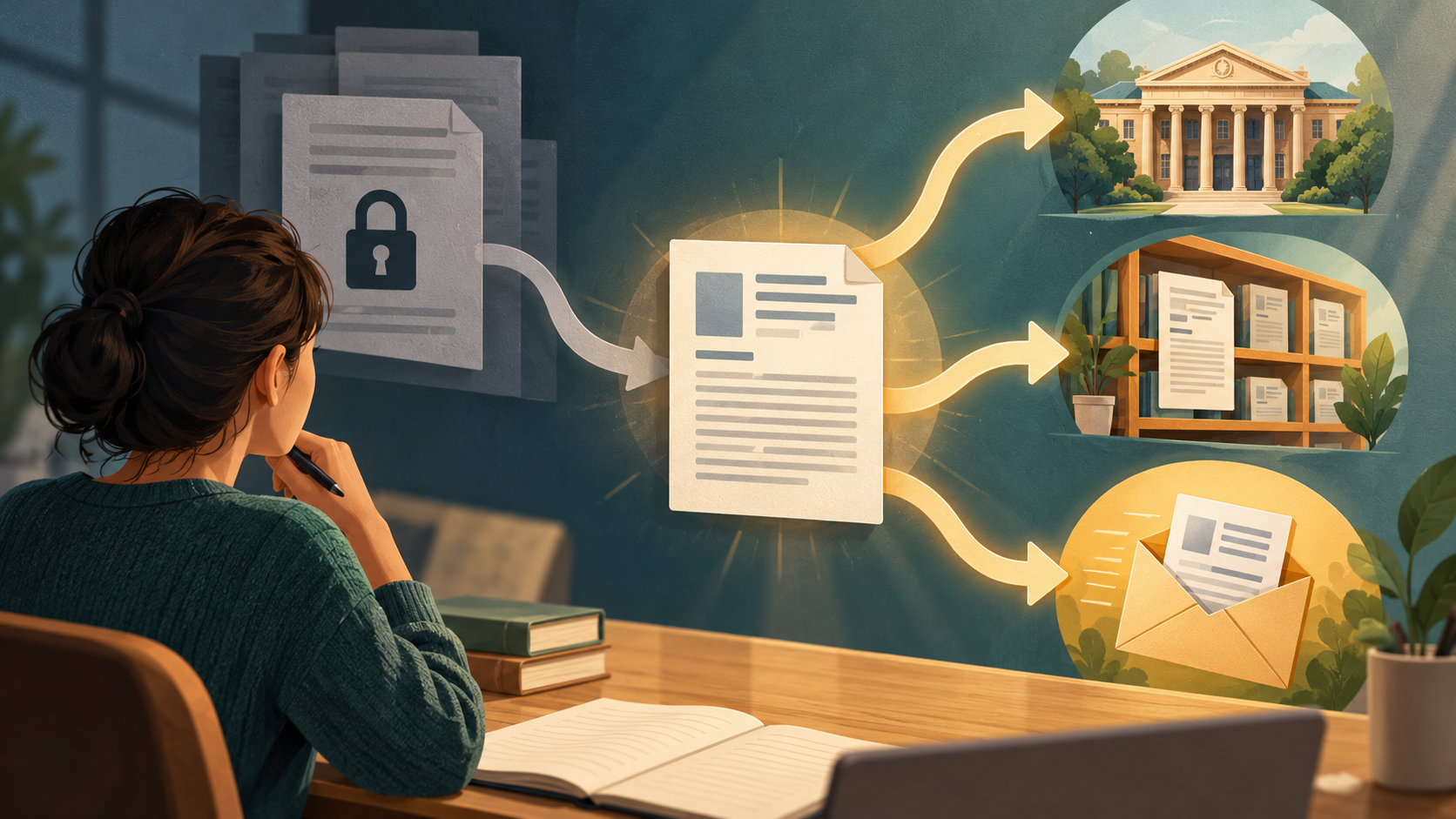
A paywall is a routing problem, not a dead end. When a report is due and the key study sits behind a subscription, the fastest safe path is a fixed sequence: confirm the canonical record, check institutional access, look for author and repository copies, then request document delivery — all while keeping the citation you will actually publish. This guide gives that sequence with diagnostic checkpoints, a worked decision-memo example, a reusable checklist, and clear stop and escalation rules.
Start from the canonical record, not the PDF
Before hunting for a file, lock the citation. A full-text copy found on a personal site or a preprint server may differ from the version of record, so the canonical record is your anchor. Use the publisher landing page or a bibliographic database to capture authors, title, journal, year, volume, pages, and DOI.
PubMed supports citation lookup and field tags, which helps when you already have a partial reference and need to confirm the exact record. Its search details also reveal how terms were translated and combined, so you can see whether a lookup matched the intended paper. Google Scholar documents searching by author and title, which is useful when you have an author name and a fragment of the title but not the DOI.
Checkpoint: you can state the DOI and the version of record. If you cannot, stop and resolve the citation before searching for files.
Check institutional access first
Institutional access is the cleanest legal route and should come before open-web file hunting. Google Scholar documents library access links, so a Scholar result can tell you whether your institution provides access to that item. If your library offers a link resolver or proxy, use it from the canonical record so you land on the licensed version.
If access fails, diagnose rather than give up:
- Off-campus? Confirm you are authenticated through the library proxy or VPN.
- Wrong version? Some platforms license the journal but not a specific backfile year.
- Wrong record? A DOI mismatch can send you to an unlicensed mirror.
Checkpoint: you have either a licensed PDF or a clear reason access is unavailable (no subscription, no backfile, authentication failure). Record that reason — it belongs in your provenance notes.
Look for author copies and repositories
When institutional access fails, author-provided and repository copies are the next legal stop. Google Scholar documents ways to locate alternative versions of a work, which is exactly the diagnostic you need: an alternative version may be an author manuscript, a repository deposit, or a preprint.
Treat every alternative version as a distinct source with its own status:
- Version of record — the publisher's final article.
- Author accepted manuscript — peer reviewed, but not the publisher's typeset file.
- Preprint — posted before or alongside peer review.
Checkpoint: label the version you obtained. If you cite a number from an author manuscript, note that the figure comes from that version, because pagination and wording can differ from the version of record.
Use document delivery as a planned step, not a last resort
Interlibrary loan and document delivery are legitimate routes to a paywalled article. Build them into your timeline rather than discovering them the day the memo is due. When you request delivery, submit the canonical citation — DOI, authors, title, journal, year, volume, pages — so the supplying library retrieves the correct item.
Checkpoint: log the request date and expected delivery window in your provenance notes. If the deadline is tighter than the delivery window, escalate to your librarian or switch to a claim you can support with accessible sources.
Keep the canonical citation while using an alternative copy
This is the rule that protects the report. You may read an author manuscript or repository copy, but the citation you publish should point to the canonical record unless your style guide says otherwise. Keep a provenance note that separates the two:
| Field | What to record |
|---|---|
| Canonical citation | DOI, authors, title, journal, year, volume, pages |
| Version consulted | Version of record, author manuscript, or preprint |
| Access route | Institutional link, repository, or document delivery |
| Access date | When you retrieved the copy |
| Claim supported | The specific sentence or figure the source backs |
| Confidence | High, medium, or low, with the reason |
This table is the reusable artifact for the whole team. It makes every claim traceable to a version and a route.
A worked example: a due-diligence memo
Suppose your team is preparing a client briefing on a clinical intervention and the pivotal trial is paywalled. Here is the sequence in practice.
- Lock the record. Confirm the trial's DOI and full citation through a bibliographic database. PubMed's citation lookup and field tags help you match a partial reference to the exact record.
- Try institutional access. Check the library access link from the Scholar result. If the PDF opens, you have the version of record — record the route and date.
- If access fails, find alternative versions. Use Scholar's alternative-version links to locate an author manuscript or repository deposit. Label it clearly.
- If no legal copy exists, request delivery. Submit the canonical citation to interlibrary loan and log the request date.
- Write the claim with a confidence level. For example: "The trial reported the primary outcome as stated in the author manuscript (medium confidence; version of record not yet retrieved)." That sentence is traceable, honest about the version, and keeps the canonical citation in the reference list.
When the team is assembling many such claims, a shared workspace helps. You can save or upload papers and organize them in My Library so the version consulted and the canonical record stay together. For the initial literature sweep, WisPaper search gives a scholarly search interface to find candidate papers before you begin the access sequence.
Build the access sequence into your search plan
Cochrane's guidance on searching for studies is a useful model for the whole workflow: plan searches from eligibility criteria, use multiple sources, combine free-text terms with subject headings, document the process, deduplicate records, screen in stages, link multiple reports of one study, and rerun searches before publication.
Map that onto paywall access:
- Eligibility criteria → what counts as an acceptable version for your claim.
- Multiple sources → institutional access, repositories, author copies, document delivery.
- Document the process → the provenance table above.
- Link multiple reports → connect preprints and author manuscripts to the version of record.
- Rerun before publication → recheck whether the version of record has become accessible before the memo ships.
PubMed's filters, Advanced Search, saved searches, and Similar Articles features support the discovery side of this plan, and its links to full text show when a free copy is available directly.
Where a research assistant fits the sequence
A research assistant is most useful at the discovery and organization stages, not as a substitute for the access steps above. Use WisPaper Scholar Search to find candidate papers, then run the institutional-access and repository checks yourself. When you need to interrogate the papers you have already collected, Library QA lets you ask questions based on papers uploaded to My Library or added from search results — a way to extract claims from the copies you legally hold.
For longer synthesis work, Scholar Agent supports literature review and related research tasks. Keep the provenance table alongside whatever the agent produces, so every claim still points to a version and a route.
Stop and escalation rules
Clear rules prevent a paywall hunt from consuming the deadline.
Stop when:
- You have the version of record through institutional access.
- You have a labeled alternative version and your style guide permits citing it.
- The claim can be supported by an accessible source without the paywalled paper.
Escalate when:
- Institutional access fails for a reason you cannot resolve (no subscription, no backfile).
- The only available copy is a preprint and your claim depends on peer-reviewed findings.
- Document delivery will not arrive before the deadline.
- Two versions disagree on a number you plan to cite.
Escalation targets: your librarian for access and delivery, your editor or client for a deadline extension, or a downgrade of the claim's confidence level with an explicit note in the memo.
FAQs
Keep Reading
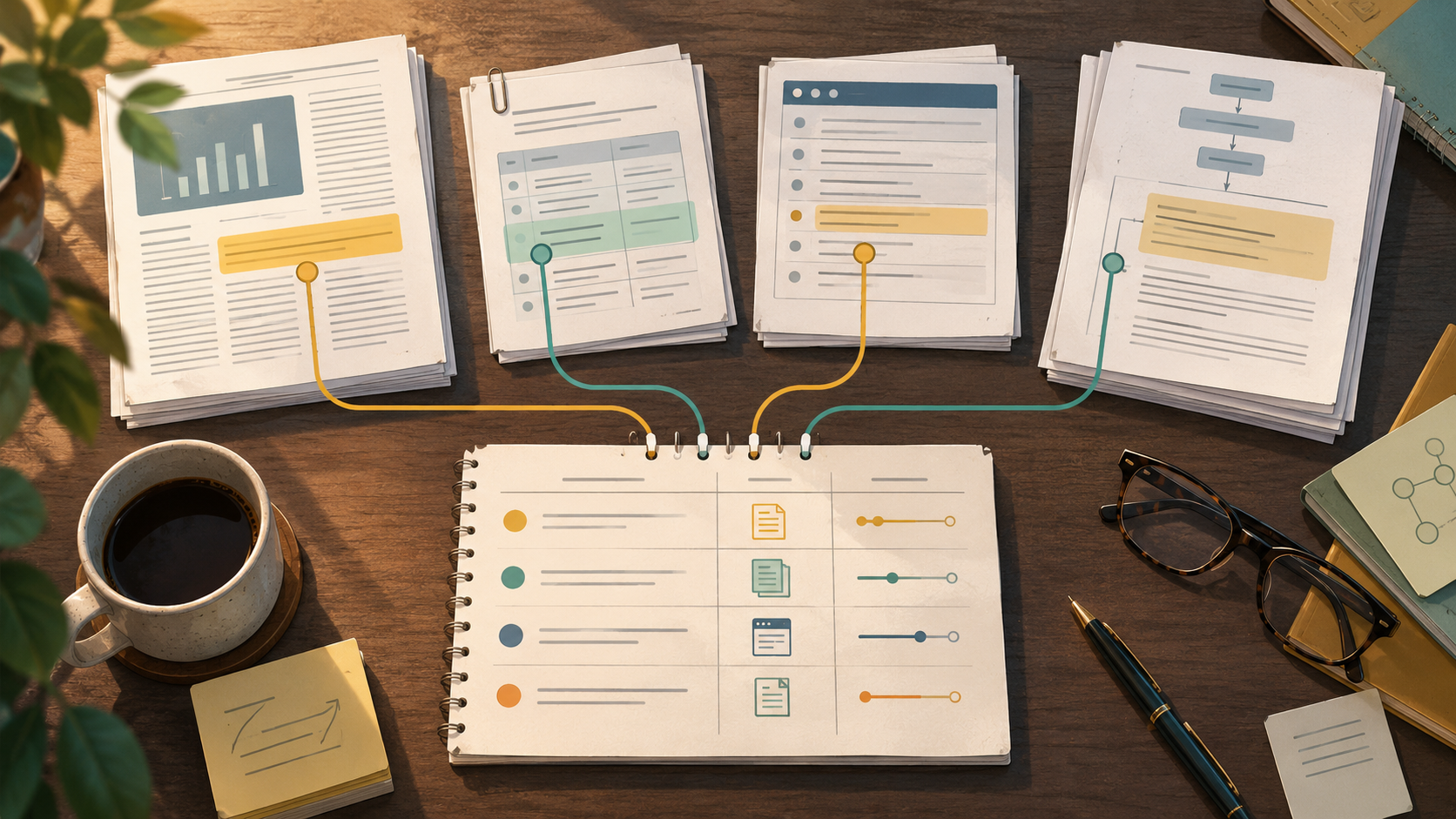
How to Find Methods Details Hidden in Supplements and Registries
A trial's main paper rarely tells the whole methods story. Planned outcomes, analysis plans, and protocol deviations usually sit in supplements, registration records, and linked reports. For a time-sensitive decision mem
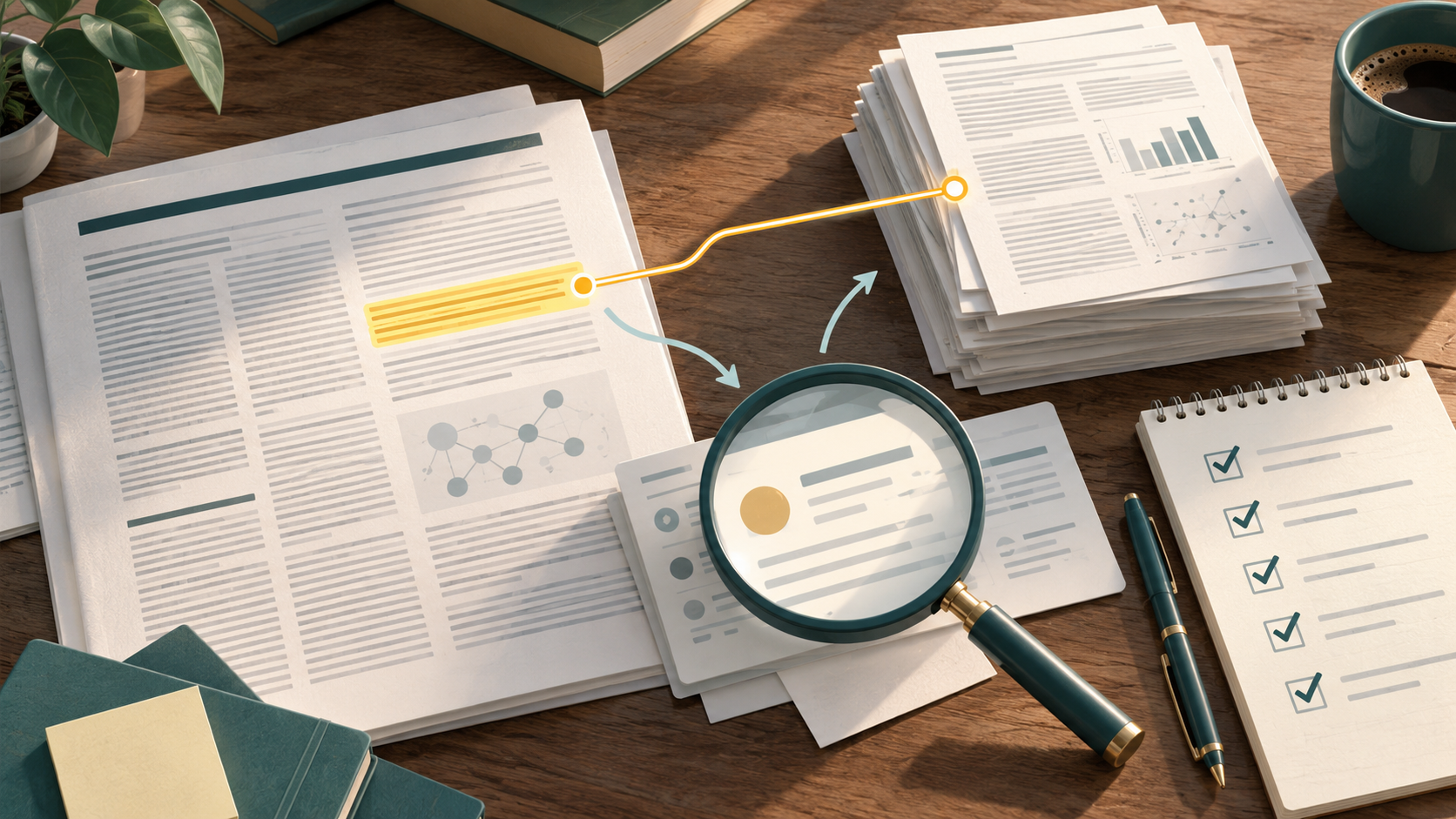
How to Find the Original Study Behind a Claim in a Review Article
A review article compresses dozens of primary studies into a few sentences. When you need to cite, replicate, or challenge one of those sentences, the review is a signpost, not the destination. The task is to trace the r
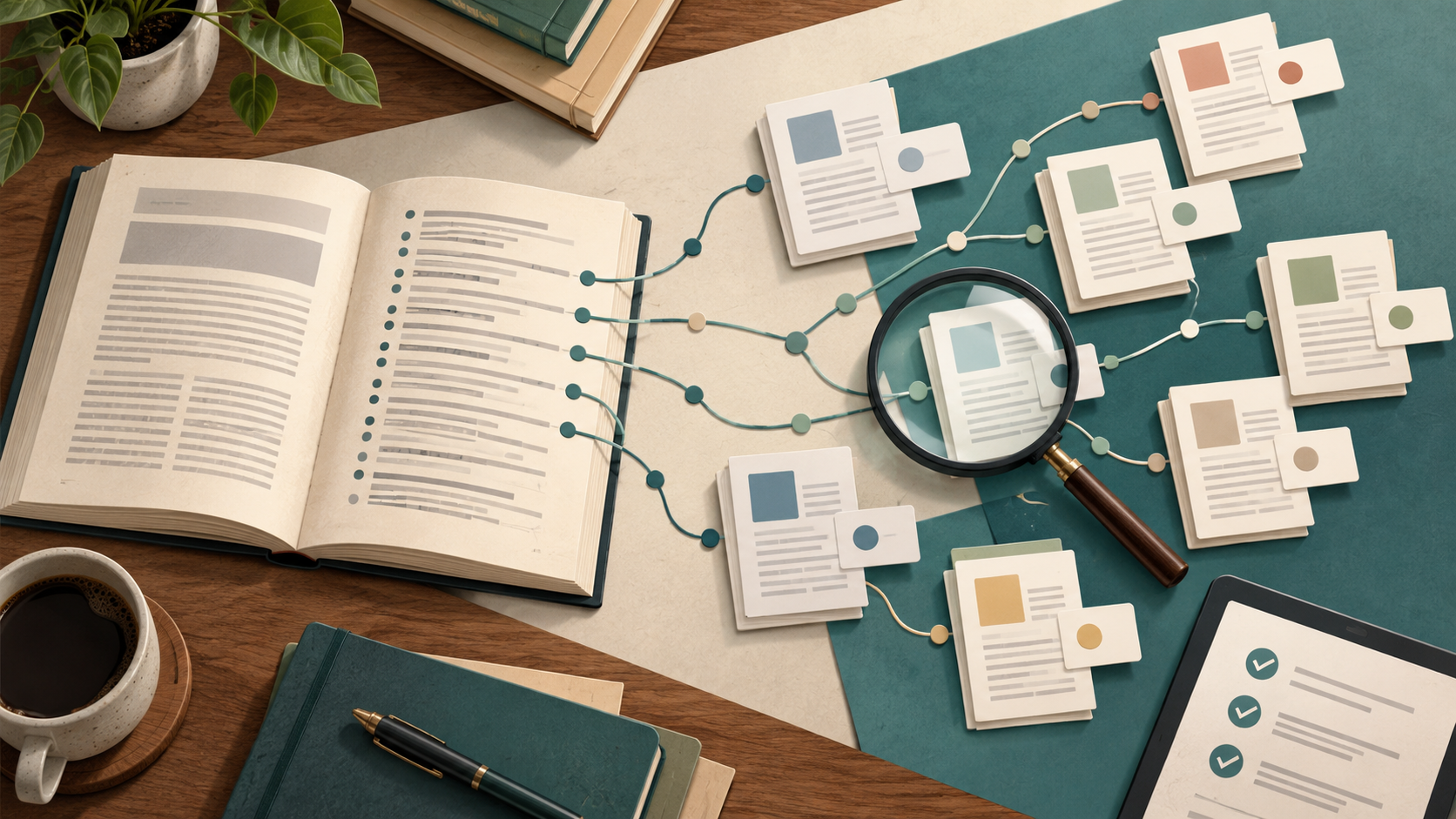
How to Find the Primary Studies Missing from a Literature Review
A review's reference list is a map of what its authors found, not a census of what exists. When you are answering a focused evidence question—for a guideline, a grant, or a scholarly manuscript—the fastest route to the m