
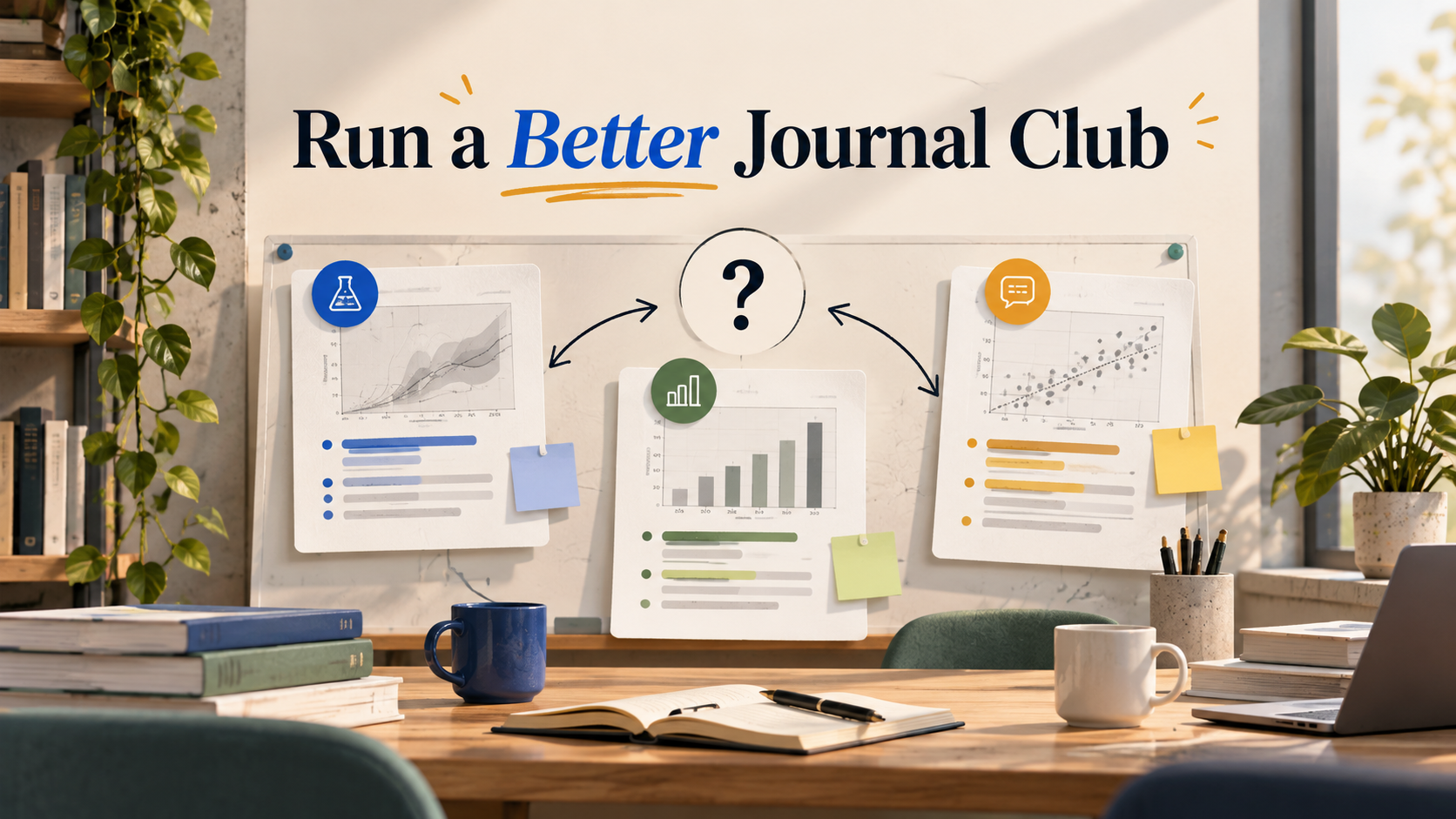
Journal club is tomorrow. An AI summary can save time, but if it becomes your only contact with the paper, the first audience question about a figure or exclusion rule will expose the gap.
Use AI to structure your reading, not replace it.
Read the paper once before asking for a verdict
Start with the abstract, figures, tables, and conclusion. Write your own one-sentence answer to three questions: What did the authors ask? What did they do? What did they find?
Now upload the paper and ask AI to challenge your understanding:
Compare my three sentences with the paper. Identify anything inaccurate, missing, or stronger than the evidence. Point me to the relevant section.
This keeps you active. You have an interpretation to test rather than a summary to memorize.
Build the presentation around decisions
A useful journal-club presentation answers:
- Why was this question worth asking?
- Does the design answer it?
- Who or what was studied?
- What result changes our understanding?
- What is the strongest alternative explanation?
- What would we do differently in a follow-up study?
Ask AI to locate material for each question, then open the passages and figures yourself. Put one main message on each slide rather than pasting generated prose.
Spend most of your time on one figure
Choose the figure or table that carries the central result. Explain axes, groups, sample size, comparison, uncertainty, and what is not shown. Ask:
Walk through this figure panel by panel. Separate what is directly displayed from the authors’ interpretation. List two questions a skeptical audience might ask.
Check every answer against the caption and methods. Figures are where fluent summaries most often lose denominators, conditions, and subgroup labels.
Prepare discussion questions that can divide the room
Avoid “What did you think?” Use questions with a decision:
- Would the conclusion change if this exclusion were reversed?
- Is the chosen outcome the one that matters clinically or theoretically?
- Which result would you try to replicate first?
- Does this paper change practice, or only suggest another study?
AI can generate candidates. Keep the questions that require people to use the paper, not speculate about the topic generally.
Use WisPaper for context around the paper
Save the focal paper and two or three close studies in My Library. Ask Library QA how their populations, methods, and findings differ. Use WisPaper Search to find one recent paper that cites, replicates, or challenges the focal study.
That context gives the discussion somewhere to go after the slides end.
FAQs
Keep Reading
NotebookLM vs. ChatGPT for Comparing Research Papers: One Task, Two Results
Compare NotebookLM and ChatGPT for multi-paper research, from source grounding and tables to flexible analysis and verification.
One Research Question, Three Search Strategies: Which Finds More Relevant Papers?
Compare keyword search, question-shaped search, and citation chasing to see which papers each route finds and misses.
How to Find Out Whether a Paper Has Been Challenged or Corrected
Check whether a paper has been corrected, challenged, or retracted by tracing DOI records, notices, citations, and later evidence.