
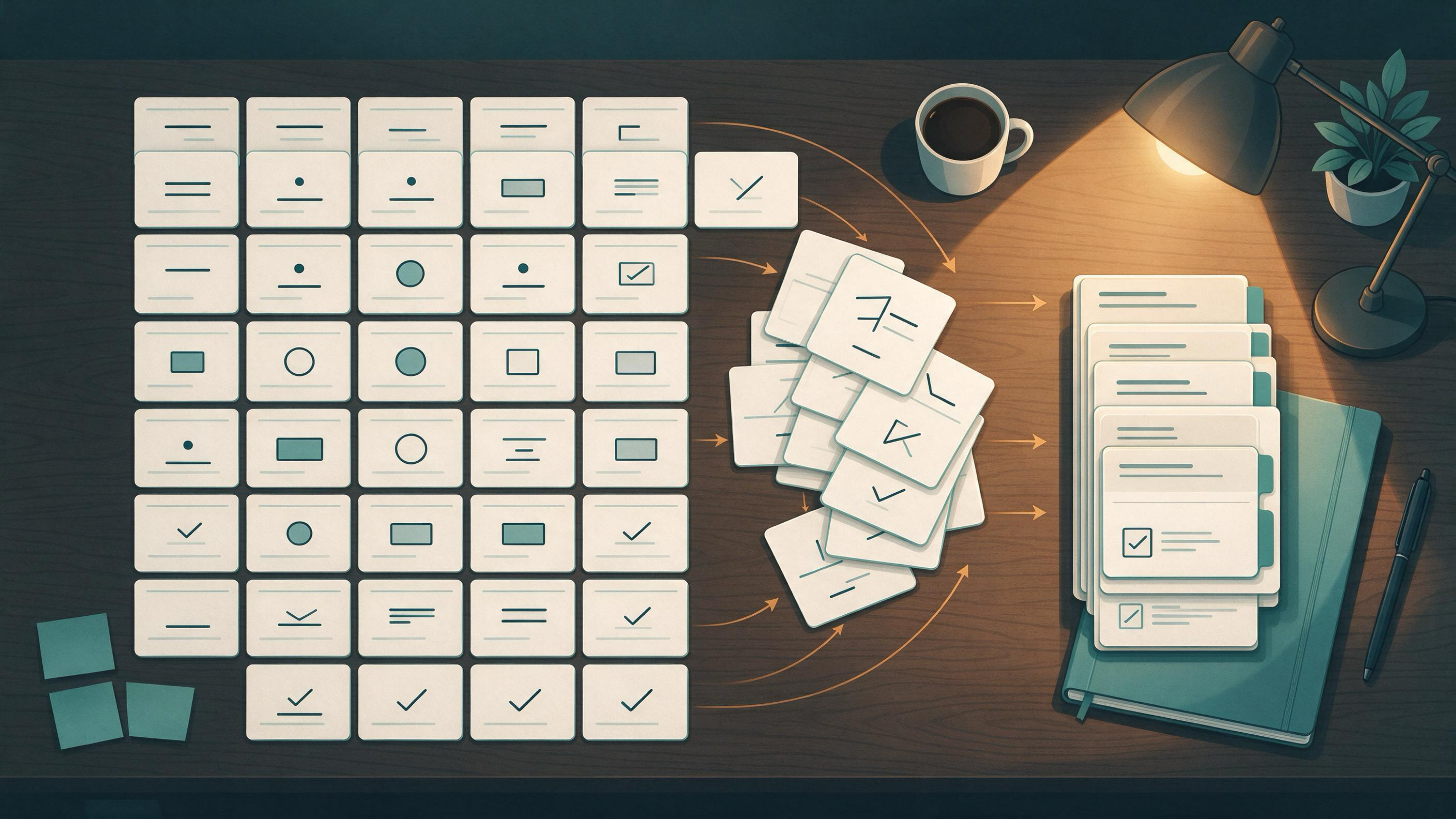
An evidence matrix is a grid of studies and the claims, methods, and findings you extracted from them. A literature review outline is the argument you will make from that grid: an ordered set of sections, each with a job, a set of studies, and a claim those studies support. Turning one into the other is a sorting and sequencing task, not a writing task. You are deciding which studies belong together, what each cluster lets you say, and in what order a reader should meet them.
This guide gives you a complete sequence with checkpoints, a worked example, a reusable checklist, and explicit completion criteria. It assumes you already have a matrix with rows for studies and columns for the details you care about. If your matrix is thin, the outline will be thin too, so the first step is a quick audit.
What state is your evidence matrix actually in?
Before you outline, check whether the matrix can carry an argument. A matrix built for reading is not the same as a matrix built for writing. Reading matrices collect everything; writing matrices separate what each study contributes.
Run this audit:
- Every row has a stable identifier. Author, year, and a short title are enough to keep rows distinct.
- Every row has a finding, not just a topic. "Studies remote work" is a topic. "Reports that remote workers logged longer hours during a specific period" is a finding you can compare.
- Method and sample columns are filled. You need these to explain why findings differ.
- Eligibility is recorded. You should be able to say why each row is in the matrix and, ideally, which records you excluded.
- Multiple reports of one study are linked. If two rows describe the same study, mark them so they do not become two pieces of evidence.
That last point matters more than it looks. Cochrane's guidance on searching and selecting studies treats linking multiple reports of one study as part of the review process, because counting the same study twice inflates a cluster. If your matrix has duplicate rows, merge them before you outline.
Checkpoint: you can point to any row and say what claim it could support. If you cannot, the row is not ready to outline from.
Decide what the outline is arguing before you sort anything
The most common failure is sorting studies into themes before deciding what the review needs to establish. Themes are a filing system; an outline is an argument. Decide the argument first, then let the themes serve it.
Write one sentence in this form: This review shows that [claim], because [two or three kinds of evidence], and the main open question is [gap]. Keep it to a single sentence. If you need three sentences, you have three candidate arguments and should pick one.
For a course paper, the claim can be modest: that a body of work converges on one mechanism but disagrees on its size. For a thesis chapter, it can be structural: that the field has measured one construct three different ways, and the disagreement explains inconsistent results. For a first manuscript, it can be a positioning claim: that your study fills a specific gap the matrix makes visible.
Checkpoint: your sentence names at least two clusters of evidence and one gap. If it names only one cluster, you have a summary, not a review.
How do you cluster studies without forcing them?
Clustering is where the matrix earns its keep. Sort rows by the column that best explains variation in findings, not by the column that is easiest to sort.
Try these sort keys in order and keep the one that produces clusters with real disagreements inside them:
- By finding. Group studies that reach similar conclusions. This is the default and works when the literature is large.
- By method or design. Group studies by how they measured the construct. This works when results conflict and design is the likely reason.
- By population or context. Group by who or what was studied. This works when context is the contested variable.
- By mechanism. Group by the explanation offered. This works for theory-heavy chapters.
A cluster is usable when it contains at least two studies and you can state what the cluster collectively shows. A cluster with one study is a point, not a section. A cluster where every study agrees and nothing is contested is usually background, not a main section.
When you need to find additional studies to fill a thin cluster, search from your eligibility criteria rather than from keywords alone. Cochrane recommends planning searches from eligibility criteria and combining free-text terms with subject headings; PubMed's field tags and Advanced Search support that kind of structured query, and its Search Details show how terms were translated and combined. Use those mechanics to make a cluster search reproducible.
If you are searching through WisPaper, the scholarly search interface is the place to run those cluster-filling queries, and the public Scholar Search page explains the entry point for finding academic papers.
Checkpoint: every cluster has a one-line claim, at least two supporting rows, and a note on what is contested inside it.
Build the outline skeleton from clusters, not from a template
Once clusters exist, the outline almost writes itself. Each cluster becomes a section with three parts: the claim, the evidence, and the tension.
Use this skeleton for each section:
- Claim sentence: what this cluster establishes.
- Evidence rows: which matrix rows support it, in a deliberate order (strongest first, or chronological if the history matters).
- Tension: what disagrees, what is unresolved, or what the cluster cannot explain.
- Bridge: one sentence connecting to the next section.
Order the sections so each one raises the question the next one answers. A reliable order for empirical reviews is: what is known, how it has been measured, where measurements disagree, what explains the disagreement, what remains open. A reliable order for theory chapters is: the dominant account, its predictions, the evidence that strains it, the alternatives, the gap your work addresses.
Keep a separate section for method and scope near the front. Readers need to know how you selected studies before they trust your clusters. Documenting the search process is part of Cochrane's recommended practice, and your outline should reserve space for it.
Checkpoint: reading only your section claim sentences in order produces a coherent argument. If it does not, reorder sections before drafting.
Worked example: a winter-break cleanup of a thesis chapter
Suppose a master's student has a matrix of 34 rows on remote work and productivity, built during a rushed semester. The matrix has author, year, design, sample, and finding columns, but no eligibility notes and several duplicate rows.
Step 1, audit. She finds four duplicate rows describing two studies reported twice. She merges them, leaving 32 rows. She marks six rows as background because they are reviews rather than primary studies.
Step 2, argument sentence. She writes: This chapter shows that remote-work productivity findings diverge mainly because studies measure output differently, and the open question is whether self-reported and objective measures converge.
Step 3, clustering. Sorting by finding produces two clusters that mostly agree, which is unhelpful. Sorting by method produces three clusters: self-report surveys, objective output logs, and supervisor ratings. The disagreement sits between the first two, so method becomes the organizing key.
Step 4, skeleton. The chapter outline becomes: scope and selection; what self-report studies find; what objective-log studies find; why the two diverge; what supervisor ratings add; the measurement gap. Each section gets a claim sentence and a list of matrix rows.
Step 5, thin-cluster search. The objective-log cluster has only four rows. She runs a structured search from her eligibility criteria, adds three studies, and records the query so the method section can describe it.
Step 6, verification. Before drafting, she checks that every citation she plans to use is real and correctly formatted. For BibTeX entries, TrueCite checks references against real academic databases to flag hallucinated entries, which is the right check at this stage rather than after drafting.
Step 7, storage. She saves the final set of papers in My Library so the matrix rows and the source PDFs stay together while she drafts.
Checkpoint: the outline has six sections, each with a claim, at least two rows, and a tension. The argument sentence is unchanged from step 2.
Where does each tool fit in the sequence?
The sequence above has distinct jobs, and each job has a natural tool moment. Placing tools at the wrong step creates busywork.
| Step | Job | Natural tool moment |
|---|---|---|
| Audit | Merge duplicates, mark background rows | Library organization |
| Argument | Write the one-sentence claim | None; this is your judgment |
| Clustering | Sort by the column that explains variation | None; spreadsheet or matrix |
| Thin-cluster search | Run structured queries from eligibility criteria | Scholarly search |
| Verification | Check citations against real databases | Citation screening |
| Drafting | Keep sources and notes together | Library and project workspace |
For longer tasks, such as a full chapter where you need to survey a cluster you have not read closely, Scholar Agent fits literature review and inspiration use cases. Use it to survey, then return to the matrix to record what you found. Do not let a survey output become a matrix row without reading the source.
When you want to ask questions across the papers you have already saved, Library QA supports questions based on papers uploaded to My Library or added from search results. That is useful for checking whether a cluster's claim holds across all its rows before you commit to a section claim.
If the outline is for a project with collaborators or a long timeline, Research Projects gives you a place to create and organize the work. For readers new to the platform, the WisPaper homepage introduces it as an AI research assistant for finding, screening, organizing, and working with academic papers.
What does a finished outline look like?
A finished outline is not a list of topics. It is a set of sections that each do one job, with evidence attached and tensions named. Use this checklist before you call it done.
- One argument sentence exists and has not changed since clustering.
- Every section has a claim sentence, not a topic label.
- Every section cites at least two matrix rows.
- Every section names a tension, disagreement, or limit.
- Duplicate reports of the same study are merged.
- Background rows are separated from primary evidence.
- A method and scope section describes how studies were selected.
- Thin clusters have been searched and the query recorded.
- Planned citations have been checked against real databases.
- Reading the claim sentences in order produces a coherent argument.
- The gap named in the argument sentence appears in the outline.
If any box is unchecked, fix that item before drafting. Drafting from an incomplete outline moves the problem into prose, where it is harder to see.
How do you know the outline is ready to draft from?
The outline is ready when three tests pass.
The claim-sentence test. Read only your section claim sentences, in order. They should read as a short argument. If they read as a list of topics, the outline is not ready.
The row-coverage test. Every primary-study row in your matrix should appear in at least one section, or be explicitly marked as excluded with a reason. Rows that appear nowhere are either irrelevant or a missing section.
The gap test. The gap in your argument sentence should be visible as the destination of the outline. A reader who finishes the last section should arrive at the question your work addresses.
When all three pass, you have a literature review outline. The next action is to draft the method and scope section first, because it is the section most likely to reveal a missing search step.
A reusable table for each section
Keep this table beside your outline as you draft. One row per section.
| Field | What to write |
|---|---|
| Section claim | One sentence stating what this section establishes |
| Supporting rows | Matrix identifiers, strongest first |
| Contested point | What disagrees or remains unresolved |
| Method note | How these studies were selected, if relevant |
| Bridge | One sentence leading to the next section |
Filling this table forces the decisions that a topic list hides. If the contested point column is empty for every section, your review is descriptive rather than argumentative, and you should revisit the clustering step.
FAQs
Keep Reading

How to Update an Old Literature Search Efficiently
An old literature search is not a document to reread; it is a set of decisions you can re-run. The efficient path is to recover the original eligibility criteria and search logic, then update only the parts that changed:

How to Update References Before Manuscript Submission
Updating references before submission is a verification pass, not a formatting pass. The goal is to confirm that every cited work still exists under the identifier you used, that its bibliographic fields match the record
How to Use Backward Citation Searching to Find Key Papers
Backward citation searching means working from a paper you already trust and following its reference list into the older work it builds on. You are not searching a database by keyword; you are reading the citation trail