
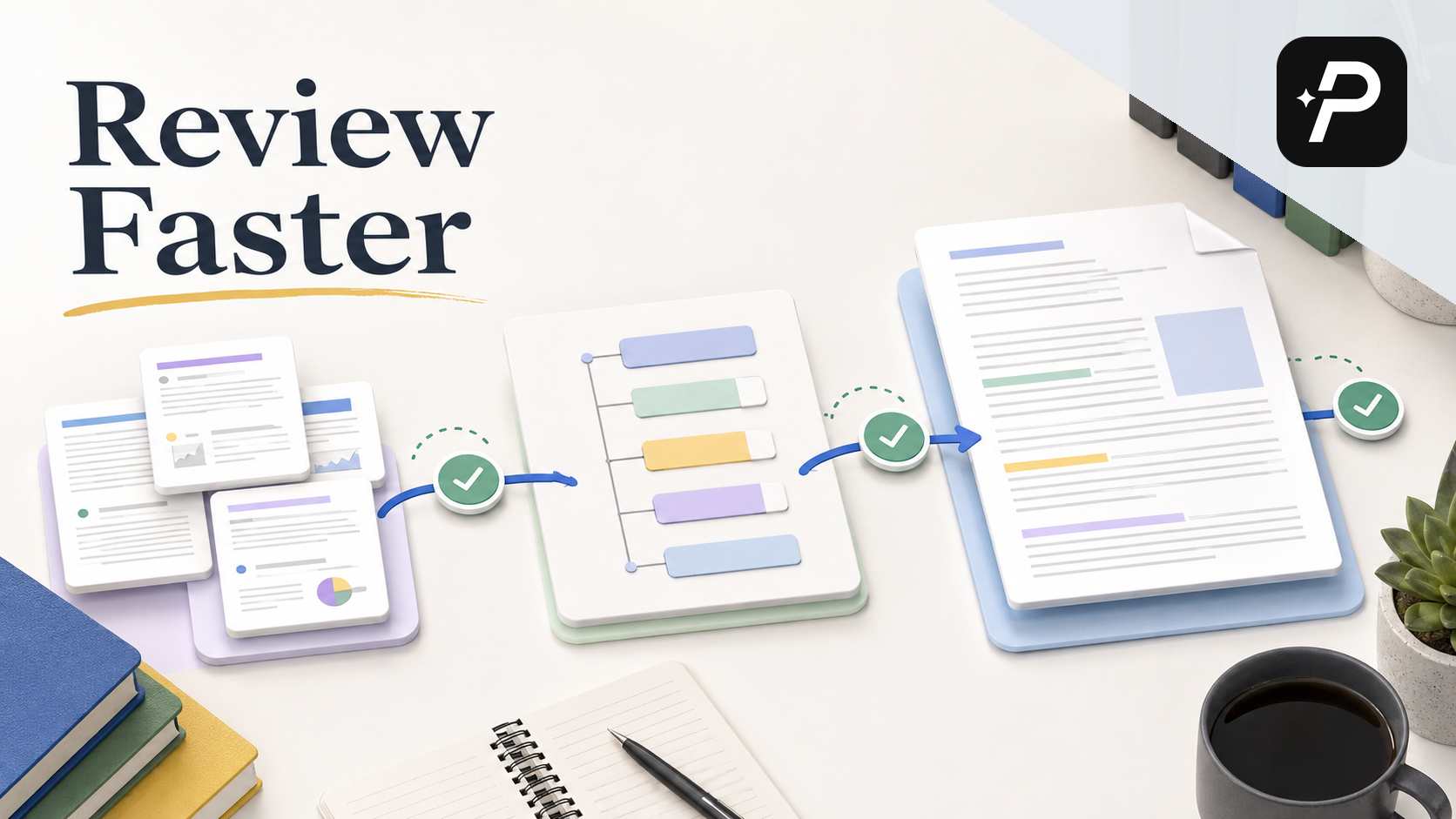
A literature review can consume weeks of your research timeline. You collect dozens of PDFs, read them, take notes, and then realize you cannot remember which paper said what. The writing itself becomes a second research project because you have to re-read half your sources just to reconstruct your own argument.
The instinct is to speed things up by skimming abstracts, skipping verification, or trusting AI summaries without checking them. That approach usually backfires. Errors introduced early get baked into your draft, and fixing them later takes more time than doing the work properly the first time.
The faster path is not to skip steps. It is to restructure the order of your work so you read less, write earlier, and verify as you go.
Why Do Literature Reviews Take So Long?
Most of the time lost in a literature review does not happen during writing. It happens in the disorganized phases before you ever open a blank document.
The first time sink is the "read everything first" approach. Many writers delay writing until they have finished reading, which means they carry the entire body of literature in their heads. By the time they sit down to draft, they have forgotten the details of papers they read three weeks earlier. They end up re-reading to recover what they already knew.
The second time sink is inconsistent note-taking. If you jot down a few lines per paper without connecting those notes to a structure, you will have to re-read each source when you start writing. You are effectively doing the reading twice.
The third time sink is unverified AI output. AI tools can summarize papers quickly, but summaries can misattribute findings or oversimplify caveats. If you build an argument on a wrong summary, you will have to untangle it later.
All three problems share the same root cause: reading and writing are treated as separate phases when they should be interleaved.
What Is the Source-Based Workflow?
A source-based workflow organizes your literature review around the papers you have collected rather than around a pre-conceived topic outline. You let the literature shape the structure of your review instead of forcing the literature into a structure you invented early on.
The difference looks like this:
- Traditional approach: Read papers one by one, take notes, finish reading, outline, then write.
- Source-based approach: Collect sources, group them by shared findings or themes, build an outline from those groups, then write section by section.
The source-based workflow removes the "memory tax." You never have to hold all your sources in your head at once. You work with small clusters of papers that address the same aspect of your research question, and each cluster becomes a section of your review.
To start, sort your PDFs into folders or tag them in a reference manager. As you read each paper, assign it to one or more thematic tags. After 10 to 15 papers, natural groupings will appear. Those groupings become the skeleton of your literature review.
When Should You Build the Outline?
You do not need to finish reading before you outline. A rough working outline built early will actually make your reading faster because it tells you what to look for.
Start with your research question. Break it into three to five sub-questions. Each sub-question becomes a section of your review. For example, if your research question is "How does remote work affect team collaboration?", your sub-questions might be:
- What theoretical frameworks are used to study remote work?
- What are the documented effects on communication quality?
- What are the effects on trust and social cohesion?
- What contextual factors moderate these effects?
As you read each paper, ask which sub-question it helps answer. Assign the paper to that section. If a paper does not fit any sub-question, either your sub-questions are incomplete or the paper is not relevant. That filter alone saves hours of reading.
The working outline also removes the blank-page problem. When you sit down to write, you are not deciding what to say. You are filling in a section you have already planned, using sources you have already grouped.
How Do You Use AI Without Losing Accuracy?
AI tools can speed up the reading and note-taking phase, but they require a verification step.
Use AI to generate summaries of papers you have already identified as relevant. The summary tells you whether the paper deserves a full read or just a quick skim. For papers central to your argument, read the full text and check the AI summary against the original.
The verification step is not optional. AI models can hallucinate, misattribute findings, or flatten nuanced conclusions. If you cite a paper based on a wrong summary, you have introduced an error into your review. Fixing it after you have built an argument around it is far more costly than verifying it upfront.
Keep a simple checklist for each AI-generated summary:
- Does the summary correctly state the paper's main finding?
- Does it accurately reflect the sample, methodology, and limitations?
- Are quoted statistics or claims present in the original text?
If you cannot verify these elements, do not use the summary. Read the relevant sections of the paper yourself.
Should You Organize Sources by Theme or Chronology?
Organizing sources chronologically or by author is easy to execute but produces descriptive reviews that read like annotated bibliographies. Thematic grouping is faster to write because each theme becomes a self-contained unit.
Cluster papers that address the same aspect of your research question, even if they were published in different years or come from different disciplines. In a review on remote work and collaboration, you might group papers on:
- Communication media richness
- Trust-building in virtual teams
- Synchronous versus asynchronous communication
- Cultural differences in remote collaboration
Each theme becomes a subsection. Within each subsection, you synthesize findings, noting agreements, disagreements, and gaps. You do not need the entire review in your head. You only need to understand the papers in front of you.
A synthesis matrix helps you build these groups. Rows are themes, columns are papers, and each cell holds a brief note about what that paper says on that theme. The matrix shows you which themes have strong support and which are underdeveloped. For a detailed guide, see how to build a synthesis matrix for a literature review.
How Do You Write the First Draft Quickly?
Once you have thematic groups and a working outline, the writing becomes faster if you work in small chunks. Aim for 300 to 500 words per session, focused on one theme or subsection.
This chunked approach reduces cognitive load. You only think about the papers in front of you, not the entire review. It also makes progress visible. Each completed chunk is a tangible step forward, which matters when you are working on a project that takes months.
Each chunk should follow a simple structure:
- A topic sentence that states the main finding or debate in this theme.
- A synthesis of two to four papers that support or contradict each other.
- A gap or question that leads into the next theme or section.
This structure keeps the review analytical rather than descriptive. You are not listing what each paper says. You are building an argument about what the literature shows, where it agrees, and where it falls short.
How Do You Avoid Source Overload?
Source overload happens when the volume of reading becomes paralyzing. The solution is not to read less. It is to read more strategically.
Set a target number of sources per theme. For an undergraduate or master's thesis, five to ten sources per theme is usually enough. For a doctoral dissertation, you may need fifteen to twenty. Once you hit your target, stop searching for that theme and move on. You can add more sources later if your writing reveals a gap.
Use a reading queue to manage the flow of papers. When you find a new paper, do not read it immediately. Add it to the queue and process it in batches. This prevents you from interrupting your writing to chase new sources. For a practical system, see how to build a reading queue for a new research topic.
Paper cards can also help with screening. They show source labels, summaries, publication details, authors, and preview information. Use them to decide whether a paper deserves a full read or just a quick skim. This screening step cuts reading time significantly.
What Should You Verify Before Citing a Source?
Speed should not come at the cost of accuracy. The academic record is not static. Papers get corrected, retracted, or challenged by subsequent research. Citing a retracted paper can damage your credibility.
Before you include a source, check whether it has been corrected or retracted. This matters most for older papers or papers from journals with questionable practices. A quick search on the publisher's website or a database like PubMed or Google Scholar usually confirms a paper's status. For a step-by-step guide, see how to check whether a paper has been corrected or retracted.
You should also verify that the paper actually supports the claim you are citing. This is where AI summaries can be dangerous. If you rely on a summary that misrepresents the paper's findings, you may end up making a false claim. Trace your citations back to the original text, even if it means re-reading a section of a paper you have already skimmed.
The final draft is also where you should check for conflicting evidence. A good literature review does not hide disagreements. It highlights them. Use your synthesis matrix to identify where sources conflict, and write about those conflicts explicitly. This strengthens your review and demonstrates critical thinking. For guidance on handling disagreements, see how to find conflicting evidence in a literature review.
How Can You Protect Yourself from AI Detection False Positives?
If you use AI tools to speed up your literature review, you need to think about AI detectors. Many universities screen student work with detection software. If your writing is flagged as AI-generated, you may face academic integrity charges even if you wrote the content yourself.
The best way to avoid false positives is to use AI tools for assistance, not for drafting. Use AI to summarize, organize, and answer questions, but write the actual prose yourself. Your own writing style—with its unique sentence rhythms, vocabulary choices, and argument structures—is much less likely to be flagged than text generated or heavily edited by an AI.
If you do use AI to help with phrasing or structure, revise the output substantially. Do not copy AI-generated sentences into your draft. Read the AI's suggestion, understand the idea, and rewrite it in your own words. For more tips on protecting your writing, see AI Detector False Positives: How to Protect Your Own Writing.
How WisPaper Helps During the Drafting Phase
By the time you are ready to write the final draft, you should have a well-organized library of sources. WisPaper's My Library feature lets you save and upload papers, and Library QA answers questions based on the papers in your own library. This is useful during the drafting phase.
For example, if you are writing a section on trust in virtual teams, you can ask Library QA: "What do my saved papers say about the role of face-to-face communication in building trust?" The tool scans your library and provides answers based on the papers you have saved. This saves you from re-reading multiple papers to find the specific information you need.
Use Library QA with the same caution as any AI tool. The answers are only as good as the papers in your library and the accuracy of the tool's interpretation. Verify the answers against the original papers before citing them.
FAQs
Keep Reading

Can AI Find Academic Sources You Can Actually Cite?
You have a thesis due in eight weeks. You type a research question into ChatGPT or Perplexity, and within seconds the chatbot hands you a list of references with authors, journals, and years attached. It feels like a sup

Can ChatGPT Reliably Find Peer-Reviewed Articles?
You have a research question, a blank document, and a deadline. Asking ChatGPT for a list of peer-reviewed articles feels faster than navigating databases, and the results look polished. But can ChatGPT find peer reviewe
Are ChatGPT Citations Real? How to Check Before You Use Them
You asked ChatGPT for sources, it handed you a clean reference list, and now you are staring at entries that look perfect. Author names, journal titles, years, DOIs—everything is formatted exactly the way your professor