
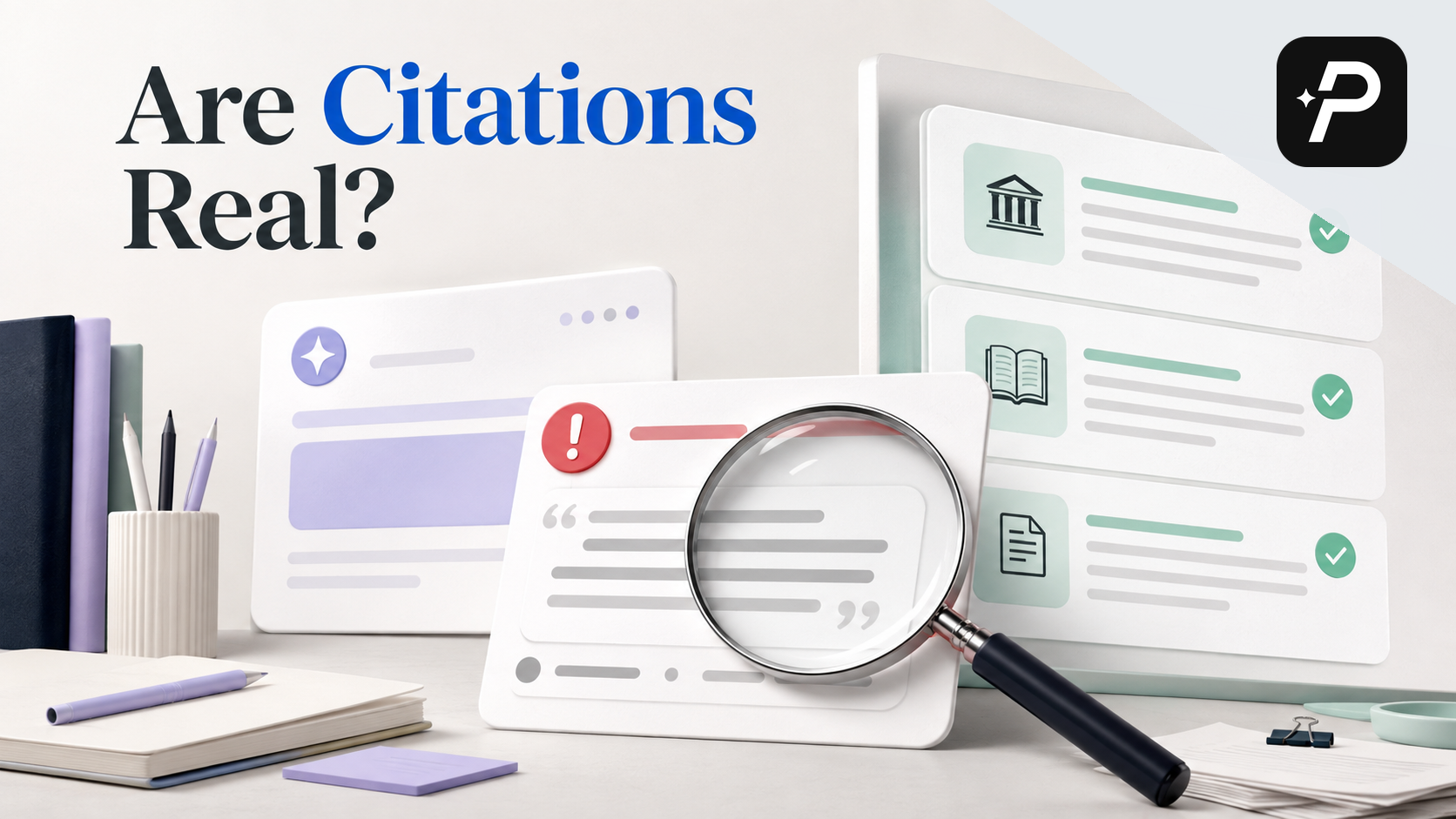
You asked ChatGPT for sources, it handed you a clean reference list, and now you are staring at entries that look perfect. Author names, journal titles, years, DOIs—everything is formatted exactly the way your professor expects. But are ChatGPT citations real?
Sometimes. The rest of the time, they are fabricated references that look convincing enough to slip into a bibliography. This happens often enough that you should treat every AI-generated citation as unverified until you confirm it exists.
This guide explains why ChatGPT produces fake references, how to spot them, and the exact steps to verify a citation before you submit academic work. You will also get a safer workflow for finding real sources, so you can use AI without risking your academic integrity.
Are ChatGPT citations real?
ChatGPT citations are not consistently real. The model can produce accurate references when it has seen the source in its training data, but it can also invent titles, authors, journal names, and DOIs that look entirely plausible. These fabricated references are often called "hallucinated citations."
The problem is not that ChatGPT is trying to deceive you. The model is designed to predict the next word in a sequence, not to look up facts in a database. When you ask for a reference, it generates text that looks like a citation based on patterns it learned from millions of academic papers. Sometimes the pattern matches a real paper. Often it does not.
Research on ai citation hallucination rates research tools shows that AI language models produce fabricated citations at a significant rate. Exact numbers vary by model and prompt, but the risk is high enough that every citation should be treated as unverified until you confirm it exists.
Why can ChatGPT create citations that look real?
ChatGPT does not have a built-in database of academic papers. It is a large language model trained on text scraped from the internet, books, and other sources. When you ask it for a citation, it does not search for the paper. Instead, it assembles a response from statistical patterns in its training data.
This process creates several problems:
- Plausible structure: The model knows what a citation should look like—author names, publication year, journal title, volume, issue, pages, DOI. It can produce this structure perfectly even when the underlying paper does not exist.
- Name blending: It may combine a real author's name with a real journal but attach them to a paper that was never published.
- Outdated or incorrect details: Even when the citation is based on a real paper, the model may get the year, volume, or page numbers wrong.
- Confident tone: ChatGPT does not express uncertainty about fabricated references. It presents fake citations with the same confidence as real ones, which makes them harder to spot.
This is not a flaw that will be fixed soon. Even the most advanced language models hallucinate because they are generative, not retrieval-based. Understanding this limitation is the first step to using AI responsibly in academic work.
What are the warning signs of a fake citation?
You cannot always tell a fake citation just by looking at it. But some patterns are red flags. Watch for these warning signs:
- The DOI does not resolve: If you copy the DOI into a browser and it leads nowhere, the citation is likely fabricated.
- The journal does not exist: Check the journal name. If you have never heard of it and cannot find it in a database like Scopus or Web of Science, be suspicious.
- The author is famous but the paper is unknown: ChatGPT often pairs well-known researchers with invented titles. If a citation claims a paper by a famous scholar that you cannot find, it is probably fake.
- The year is too recent: ChatGPT's training data has a cutoff. If it cites a paper from last year or this year, the details may be unreliable.
- The title is generic or awkward: Real papers usually have specific, descriptive titles. A vague title like "The Impact of AI on Education" may be a model-made title rather than a real article.
- The citation is missing key details: Real citations usually include volume, issue, and page numbers. If these are absent or look wrong, verify carefully.
None of these signs alone proves a citation is fake. But if you notice one or more, treat the reference as high-risk and verify it before using it.
How do you check whether a ChatGPT citation exists?
The verification process is straightforward, but it requires patience. Here is a step-by-step workflow to check a citation:
- Copy the full citation into a search engine like Google Scholar, PubMed, Scopus, or Web of Science.
- Search by title first. The title is the most unique part of a citation. If the exact title does not appear in any search results, the citation is likely fake.
- Search by author and year. If the title search fails, try the author's name combined with the publication year. This can help you find the paper if the title was slightly altered.
- Check the DOI. If a DOI is provided, paste it into doi.org. A valid DOI will redirect to the publisher's page. A fake DOI will return an error.
- Verify the journal. Look up the journal name in a database like the ISSN Portal or the publisher's website. Confirm that the journal covers the topic of the paper.
- Check the publisher's website. If the journal is real, go to the publisher's site and search for the paper there. This is the most reliable way to confirm a citation exists.
If you are checking many citations, this process can be time-consuming. For a faster workflow, you can use a dedicated how to verify ai citations guide that walks through best practices and tools.
How do you check whether the paper supports the claim?
Finding the paper is only half the battle. Even if the citation is real, you need to confirm that the paper actually supports the claim you want to make. AI models often cite real papers but misrepresent their findings.
To check this:
- Read the abstract. The abstract summarizes the paper's purpose, methods, and findings. Compare it to the claim you want to support.
- Find the relevant section. If the abstract seems related, locate the specific section of the paper that addresses your claim. Look for the exact findings, numbers, or conclusions.
- Check the context of the finding. A paper may mention a topic in passing without making it a central finding. Citing it as strong evidence would be misleading.
- Look for limitations and caveats. Real research is nuanced. If the paper has significant limitations that undermine the claim, you should address them in your writing.
- Compare multiple sources. Do not rely on a single citation. Find other papers that support the same claim to ensure you are not overinterpreting one study.
This step is essential for academic integrity. A real citation that is misused is still a problem. It can mislead your readers and damage your credibility.
What should you do if you cannot find the cited paper?
If you cannot find a paper after a thorough search, do not use the citation. It is that simple. Here is what to do instead:
- Assume it is fake. If the title, author, journal, and DOI all fail to produce results, the citation is almost certainly hallucinated. Do not try to "fix" it or guess the correct details.
- Search for the topic instead. Use the topic of the claim to find real papers. Search Google Scholar for keywords from the claim and look for recent, peer-reviewed sources.
- Use a different AI prompt. Ask the AI to find papers on the topic without generating specific citations. Then verify the papers it suggests.
- Check review articles. Review papers summarize the state of research on a topic and provide a goldmine of real citations. Find one recent review and mine its reference list.
- Ask a librarian. Academic librarians are experts at finding sources. If you are stuck, they can help you locate relevant literature.
If you are concerned about whether a paper you did find has been corrected or retracted, you should also check paper correction retraction before citing it.
How can you use AI for research more safely?
You do not have to abandon AI for research. You just need to change how you use it. Here are safer strategies:
- Use AI for brainstorming, not citing. Ask ChatGPT to explain concepts, suggest research questions, or outline arguments. Do not ask it to generate a reference list.
- Ask for source suggestions, then verify. You can ask the AI to suggest papers on a topic, but treat every suggestion as a lead, not a fact. Verify each one before using it.
- Use retrieval-based tools. Some AI tools are designed to search academic databases and return real sources. These are safer than general-purpose chatbots for finding citations.
- Keep a verification log. Track which citations you have verified and how. This helps you stay organized and proves your due diligence if questioned.
- Learn about academic integrity policies. Understand what your institution says about AI use. Many schools allow AI for brainstorming but prohibit using AI-generated text or citations without verification. You can read more about is using ai for literature review cheating to understand the boundaries.
The key is to treat AI as a research assistant, not an oracle. It can help you think, but it cannot be your source of truth.
How can TrueCite and WisPaper help with citation checking?
Manual verification works, but it is slow. If you have a long reference list, you need a faster way to check citations. This is where WisPaper's Citation Verification product, TrueCite, comes in.
TrueCite is designed to help you verify citations before you submit your work. Instead of checking each reference one by one in a search engine, you can use TrueCite to flag citations that may be hallucinated or incorrect. It scans your reference list and identifies entries that cannot be found in academic databases or that have mismatched details.
The workflow looks like this:
- Paste your reference list into TrueCite.
- Review the flags for citations that could not be verified.
- Check the details for any citations that are flagged as suspicious.
- Replace or remove any references that do not check out.
TrueCite does not guarantee that every citation is accurate. No tool can do that. But it saves you time by focusing your attention on the references most likely to be problematic.
After you have verified your citations, you can use WisPaper's deep research source audit academic to audit the quality of your sources. A reference still needs to be relevant and credible after you confirm that it exists.
You should use WisPaper search only after you have checked your citations, not as a substitute for checking. The goal is to build a verified reference list from the start, so you do not have to clean up later.
To check your citations with TrueCite, visit Check citations with TrueCite.
FAQs
Keep Reading
How to Verify AI-Generated Citations Before You Submit
You have a draft ready. The literature review reads well, the argument is coherent, and the reference list looks complete. Then you remember that some of those references came from an AI assistant, and you wonder: did it
How to Use AI for Research Without Cheating
You have a research paper due, a thesis deadline, or a literature review to finish. You open ChatGPT, type in your topic, and get a polished paragraph in seconds. It feels productive—until the doubt sets in: *Is this che
Can You Use AI for a Literature Review?
Yes, you can use AI for a literature review—but the useful question is which parts of the task you hand off and which parts you keep. A literature review is not a summary of what you found. It is an argument about what t