
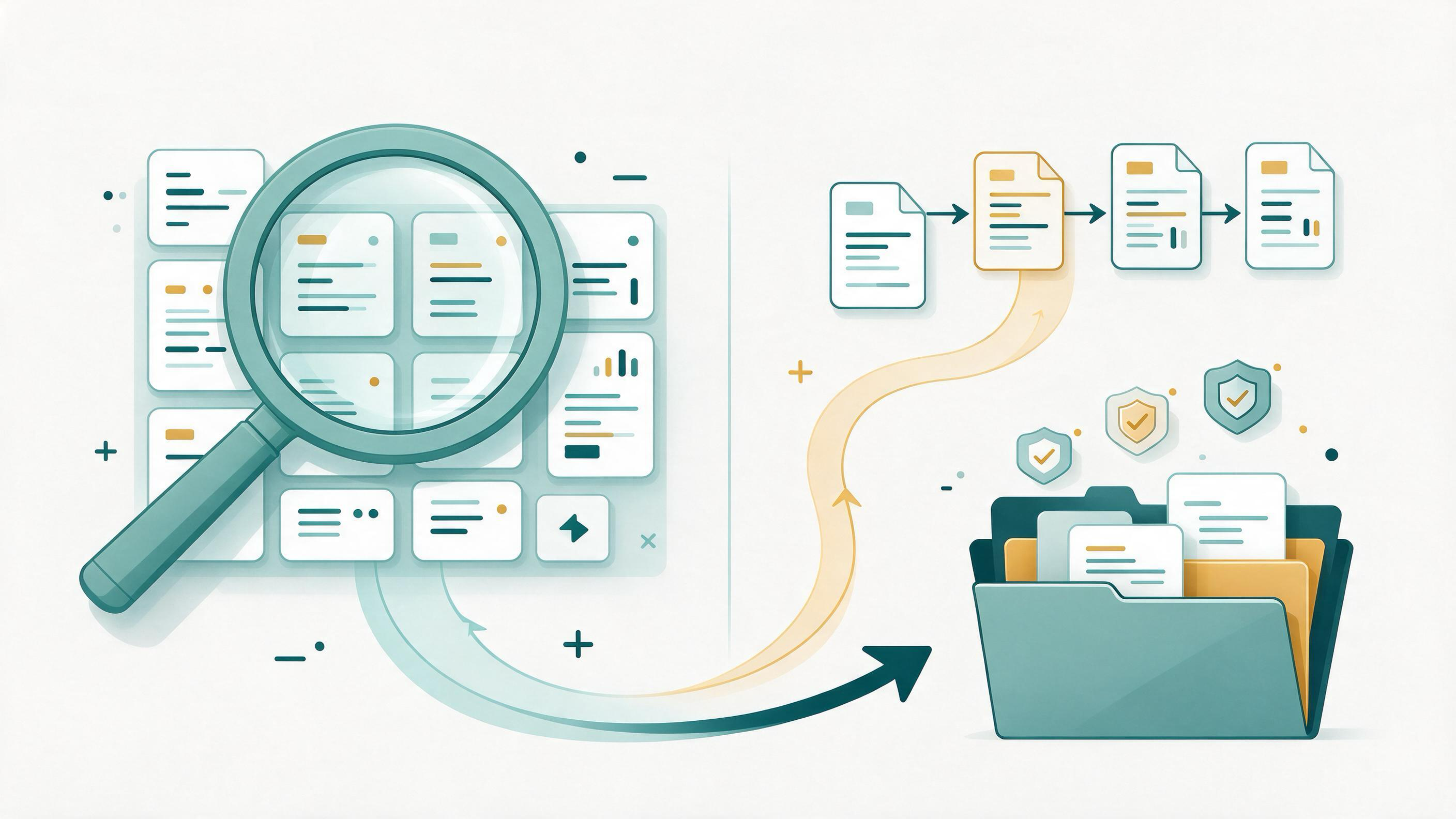
You have a research question, a deadline, and a report to produce. The first move most teams make is to type the question into a search box. That works for some tasks and quietly fails for others. The real decision is not which search engine is better — it is which retrieval method matches the shape of the evidence you need, and how you will prove the result is ready to hand off.
This article compares keyword search and citation search on the same research task, shows where each one breaks down, and gives you a combined workflow with source provenance and explicit confidence levels. It is written for enterprise research, analysis, and knowledge teams producing traceable reports, decks, decision memos, handoffs, or reusable evidence bases.
What is the difference between keyword search and citation search?
Keyword search matches your query terms against indexed text — titles, abstracts, author names, venues, and dates. Google Scholar, for example, documents searching by author and title, date sorting and date limits, and citation export. Crossref exposes publisher-deposited metadata through its REST API, including titles, authors, venues, dates, identifiers, licenses, funding, ORCID and ROR identifiers, abstracts when deposited, and post-publication updates.
Citation search starts from a paper you already trust and moves along its citation relationships — the works it cites and the works that cite it. Google Scholar documents Cited by and Related articles as ways to follow these connections.
The two methods answer different questions:
- Keyword search asks: "What exists that mentions these terms?"
- Citation search asks: "What is connected to this paper I already trust?"
That distinction matters because a keyword query can return a large set of loosely related items, while citation search can return a tight set that inherits relevance from a seed paper — but only if the seed is right.
Diagnose your starting state before you search
Before choosing a method, write down three things. This takes ten minutes and saves hours.
1. Do you have a trusted seed paper? If a colleague, a prior report, or a literature review has already identified one or two papers that are clearly on point, you have a citation-search starting point. If you are entering a field cold, you do not.
2. How precise is your vocabulary? If the field uses stable, distinctive terms, keyword search will perform well. If the concept is described with varied or contested terminology, keyword search will miss work that uses different words.
3. What does the deliverable require? A client deck needs a defensible shortlist. A decision memo needs the strongest evidence on both sides of a question. A team handoff needs enough provenance that the next person can retrace your steps. A reusable evidence base needs records that survive beyond the current project.
Write these answers into the project record. If you are setting up a workspace for the effort, you can create it in Research Projects so the search decisions and source list live alongside the deliverable.
What artifacts does each method require?
Both methods produce better results when you capture artifacts as you go, not after.
| Artifact | Keyword search | Citation search |
|---|---|---|
| Query log | Exact terms, date limits, filters used | Seed paper identifiers and direction (forward/backward) |
| Candidate list | Titles, authors, venues, dates, identifiers | Citing and cited works with relationship noted |
| Inclusion criteria | Written before screening | Written before screening |
| Provenance record | Where each item was found and when | Which seed led to each item |
| Confidence note | Why each item is trusted for this claim | Why the citation relationship supports relevance |
For keyword work, record the exact query strings and limits. Google Scholar supports date sorting and date limits, so a query run without limits and a query run with them are different artifacts. For citation work, record the seed and the direction of travel. A paper found because it cites your seed is evidence of downstream influence; a paper found because your seed cites it is evidence of foundational context. Those are different claims.
Where does keyword search work well — and where does it fail?
Keyword search is strongest when you can name what you are looking for.
It works well for:
- Locating a specific paper by title or author, which Google Scholar documents as a supported search mode.
- Building an initial map of a field with stable terminology.
- Applying date limits to find recent work.
- Pulling metadata for records you already hold, using Crossref fields such as identifiers, venues, and funding.
It fails when:
- The concept has many names. A query for one term returns a slice of the literature.
- You need the most influential work, not the most textually similar work. Keyword ranking does not encode citation weight.
- The field is new and vocabulary has not settled.
- You need to know what a specific paper's intellectual neighborhood looks like.
A practical fix is to run several synonym queries and compare overlap. Papers that appear across multiple query variants are stronger candidates than papers that appear once.
Where does citation search work well — and where does it fail?
Citation search is strongest when you have a trustworthy anchor.
It works well for:
- Expanding from a seed paper to its foundational and downstream literature.
- Finding related work when terminology is unstable, because citation relationships do not depend on shared vocabulary.
- Building a shortlist for a decision memo where you need the strongest connected evidence.
It fails when:
- The seed is wrong or only tangentially relevant. Every result inherits that error.
- The field is too new for a citation trail to have formed.
- You need coverage of a topic rather than depth around one paper.
- Citation counts are treated as quality signals without checking what the citing work actually says.
A DOI helps you locate a work through doi.org to its current registered destination, but resolution only locates the item. Bibliographic fields and the source text still need to be checked for identity and claim support. The same discipline applies to citation trails: a citation link tells you a relationship exists, not that the citing paper supports your claim.
Compare both methods on the same task
Take a concrete task: your team must produce a client deck on whether a specific intervention improves a measured outcome, with a decision memo attached.
Keyword pass. You search the intervention name plus the outcome. You get a broad set. You apply a date limit to focus on recent work. You export citations for the shortlist. You notice that several papers use a different term for the intervention and were missed. You run a second query with the alternate term and merge results.
Citation pass. You take the two strongest papers from the keyword pass as seeds. You follow their cited works to find foundational studies and their citing works to find recent extensions. You record which seed produced each item.
What each method contributed:
- Keyword search produced the initial candidate pool and the seeds.
- Citation search produced depth and found work the keyword queries missed.
- Neither method alone produced a defensible shortlist.
This is the normal outcome. The methods are complementary, and the comparison is only useful if you run both against the same inclusion criteria.
Build a combined workflow with provenance and confidence levels
Here is a workflow you can run end to end.
Step 1: Define the claim and the inclusion criteria
Write the specific claim the deliverable will make. Then write what counts as acceptable evidence: study type, date range, population, and what would disqualify a source. Do this before searching so the criteria are not shaped by what you happen to find.
Step 2: Run the keyword pass
Use a scholarly search interface to build the initial pool. WisPaper search is the place to find academic papers through a scholarly search interface. Run at least two query variants and record both. Apply date limits deliberately and note them.
Step 3: Screen and select seeds
Screen the pool against your criteria. Select one to three papers as citation seeds. Save them so the team works from the same set — My Library lets you save or upload papers and organize them in the library.
Step 4: Run the citation pass
For each seed, follow cited and citing works. Record the direction and the seed for every item you keep. Add strong finds to the library so the provenance stays attached to the source set.
Step 5: Assign confidence levels
Use a simple three-level scheme and define it in the deliverable:
- High: the claim is supported by multiple independent sources in the shortlist, and each source's identity and bibliographic fields have been checked.
- Medium: the claim is supported by one strong source or several related sources from the same group.
- Low: the claim rests on a single source, an indirect citation relationship, or a source whose claim support has not been read in full.
Attach a confidence level to each claim in the memo, not just to the source list. A deck that marks confidence per slide is easier to review than one that buries it in an appendix.
Step 6: Verify the citation record
Before the deck ships, check the bibliography against real academic databases. TrueCite checks BibTeX against real academic databases to flag hallucinated references. Run this on the final reference list, not an intermediate one.
Step 7: Package the handoff
For a team handoff or project closeout, the package should include the query log, the seed list with directions, the screened shortlist with confidence levels, and the verified bibliography. If the effort is a longer research task, Scholar Agent fits literature review, inspiration, or reproduction use cases and can carry work that extends beyond a single search session.
How do you know the result is ready?
A shortlist is ready for a client deck or decision memo when all of the following are true:
- The claim is written down and each source is mapped to it.
- Both retrieval methods were run against the same inclusion criteria, or you can state why one was sufficient.
- Every source has provenance — the query or seed that produced it, and the date it was captured.
- Identity is confirmed. DOIs resolve, and bibliographic fields match the source you actually read.
- Confidence levels are assigned per claim and defined in the document.
- The bibliography is verified against academic databases.
- A second reader can retrace the path from claim to source without asking you questions.
If any item is missing, the shortlist is a draft, not a deliverable.
How should you handle questions about the evidence base?
Once papers are in the library, the team will ask questions about them — during review, during handoff, or when a stakeholder challenges a claim. Library QA lets you ask questions based on papers uploaded to My Library or added from search results. Use it to interrogate the evidence base you built, and record the answers that change a confidence level so the change is traceable.
For teams that need a general entry point before committing to a workflow, the WisPaper homepage introduces WisPaper as an AI research assistant for finding, screening, organizing, and working with academic papers.
Decision table: which method first?
| Situation | Start with | Then add |
|---|---|---|
| Cold start, no known paper | Keyword search | Citation search from the best keyword finds |
| Trusted seed paper in hand | Citation search | Keyword search to catch parallel terminology |
| Specific paper by title or author | Keyword search | Citation search for context |
| Unstable or contested terminology | Citation search | Keyword search with synonym variants |
| Need breadth of coverage | Keyword search | Citation search for depth on key items |
| Need strongest connected evidence | Citation search | Keyword search to confirm nothing major is missing |
| New field with thin citation trail | Keyword search | Citation search once seeds exist |
The pattern is consistent: keyword search builds the pool, citation search deepens it, and the deliverable needs both the pool and the depth recorded.
FAQs
Keep Reading

Literature Review Search Strategy: A Complete Workflow
A literature review search strategy is a documented plan that turns a research question into a reproducible set of records, screening decisions, and synthesis-ready evidence. It is not a single database query. The workfl

Literature Review Update Workflow for New Evidence
A literature review update is not a fresh search pasted onto an old draft. It is a controlled revision: you re-enter the review at the point where new evidence could change your selection, your synthesis, or your reporte

Living Review vs. One-Time Literature Review: Choosing the Right Evidence Workflow
A one-time literature review answers a question once. A living review keeps answering it as new evidence arrives. The choice is not about effort or prestige; it is about how long your answer needs to stay true, and who w