
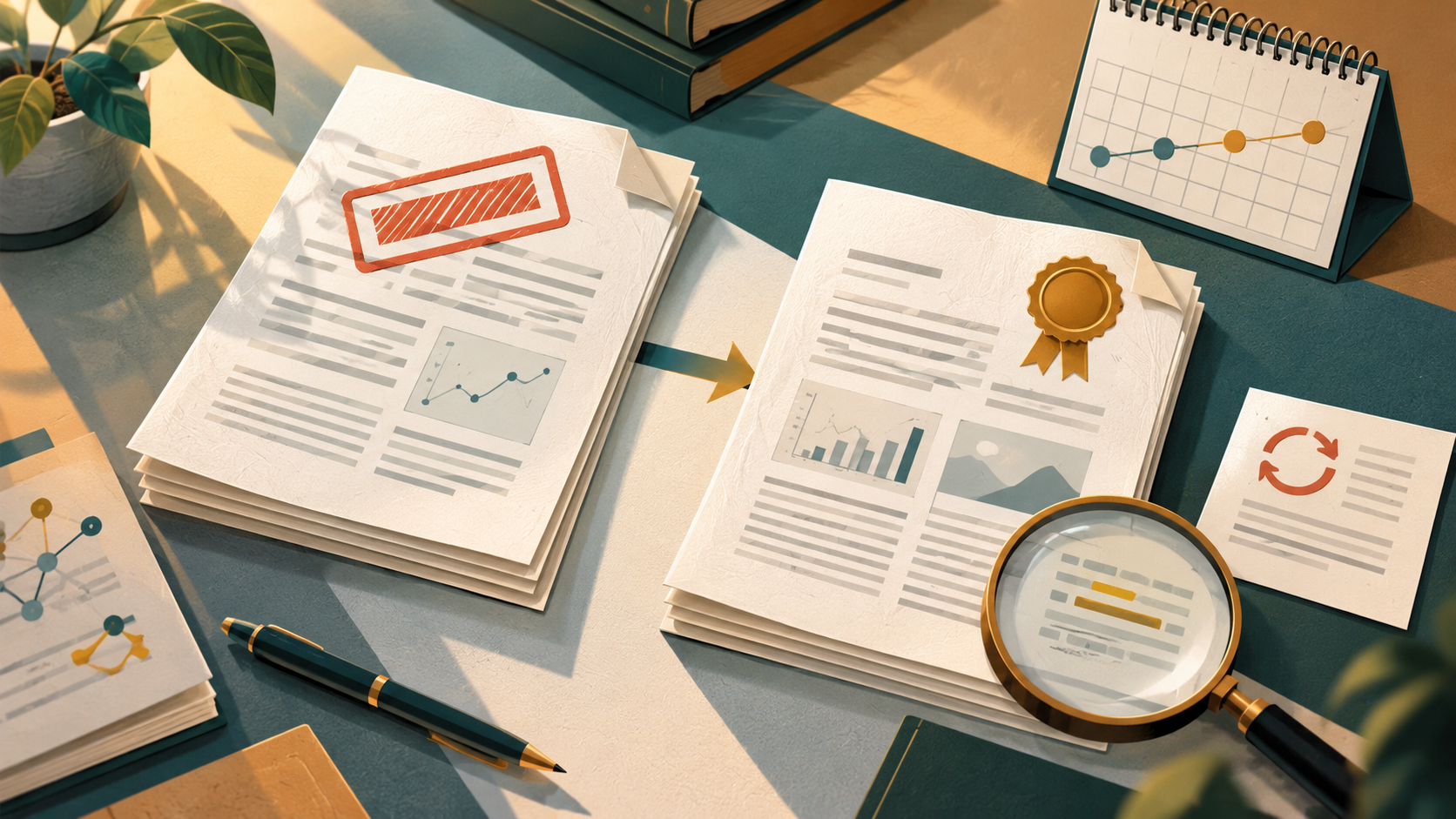
Cite the version you actually read, and cite the published version of record when it exists and you have access to it. If you relied on a preprint and a peer-reviewed version has since appeared, cite the published version and disclose that you used the earlier preprint. If the published version is behind a paywall you cannot reach before your deadline, cite the preprint you read and say so plainly in your methods or a note. The rest of this article turns that rule into a decision you can defend to a supervisor or rubric.
Start with the version you actually read
A citation is a claim about a specific document. If you read a preprint, your citation should point to the preprint; if you read the final published article, it should point to that. Mixing the two — citing the journal version while quoting text from the preprint — creates a mismatch a careful reader can catch.
Before you decide, write down three facts for each source: the exact version you opened, whether it has completed peer review, and whether any corrections or retractions are attached. These three facts drive every later choice.
Compare the options on the same criteria
Use one set of criteria for every candidate version so the comparison is fair. The table below applies the same questions to a preprint and to a published article.
| Criterion | Preprint | Published article |
|---|---|---|
| Version status | A version posted before or alongside journal review | The version issued by the journal after review |
| Peer review | Not yet through the journal's review at posting | Has passed the journal's review process |
| Corrections | May be superseded by later versions | Carries the journal's correction and retraction record |
| Identifiers | Often has its own preprint identifier | Has the journal's article identifier |
| Dates | Posting date is the relevant date | Publication date is the relevant date |
| Disclosure | You should state that you used a preprint | You should state if you relied on an earlier version |
Where each option fails: a preprint fails when your rubric or supervisor expects peer-reviewed sources, or when the preprint has been revised and you are citing an outdated text. A published article fails when you cannot access it before the deadline, or when you cite it while actually quoting the preprint. Neither failure is fatal — each has a clear next action.
Check peer review and version status first
Peer review is the clearest dividing line. A preprint has not completed the journal's review at the time it is posted; a published article has. If your assignment rubric names peer-reviewed sources as a requirement, that requirement points you toward the published version whenever it exists and is reachable.
Version status matters just as much. Preprints can be revised, and the version you read in week two may not be the version available in week six. Record which version you used, including any version number or date shown on the document, so your citation matches the text you quoted.
Handle corrections, retractions, and identifiers
Published articles carry a correction and retraction record that preprints generally do not. Before you finalize a citation to a published article, check whether a correction or retraction notice is attached to it. If one is, cite the corrected version and note the correction where it affects your claim.
Identifiers keep versions distinct. A preprint and its published counterpart usually have different identifiers, so a reference manager will treat them as two records. Keep both records in your library, label which is which, and cite the one you read. When you search for a paper, use the search interface to pull the record and confirm the identifier before you paste it into your bibliography: find academic papers through WisPaper's scholarly search.
Get the dates right
Use the date that belongs to the version you cite. For a preprint, that is the posting date of the version you read. For a published article, that is the publication date. If you cite the published version but relied on the preprint, your methods note should say when you read the preprint, because the two dates can be months apart.
Dates also affect how you describe a field. If you are writing a literature review, a preprint posted after the most recent published article may be the newest evidence available. Say that it is a preprint so the reader can weigh it accordingly.
Disclose use of an earlier version
Disclosure is a short, factual sentence, not an apology. Put it where your reader will look for it: a methods note, a footnote to the citation, or a sentence in the paragraph where the source first appears.
A workable pattern:
This paper cites the published version of [Author, Year]. An earlier preprint version was used during drafting; the published version was checked against it before submission.
If you could not access the published version, say that instead:
This paper cites the preprint version of [Author, Year], which was the version available at the time of writing.
Both sentences tell the reader exactly what you did. Neither overstates what you verified.
Worked example: a student deadline with a rubric
Suppose you are writing a course paper due Friday. Your rubric awards marks for peer-reviewed sources. You found a preprint in week one and built two paragraphs around it. On Wednesday you discover the paper has now been published, but the journal version sits behind a paywall your library cannot clear before the deadline.
Here is the decision path:
- Check the rubric. If peer-reviewed sources are required, the published version is the stronger citation — but only if you can read it.
- Try to reach the published version. If you can open it, read the relevant sections, confirm the claims you used still hold, and cite the published article. Add a one-line note that you drafted from the preprint.
- If you cannot reach it, cite the preprint you actually read and state in a note that the published version was not available to you. Do not cite the published article as if you had read it.
- Record both versions in your library so your supervisor can see the trail.
That fourth step is where a library pays off. Save the preprint and the published record side by side, label them, and keep your notes attached: organize saved and uploaded papers in My Library. When your supervisor asks which version a quoted sentence came from, you can answer from the record rather than from memory.
Build a combined workflow before you submit
A repeatable workflow keeps version decisions from becoming last-minute scrambles.
Step 1 — Search and capture both records. When you find a paper, search for its published counterpart as well. Capture the identifier and date for each.
Step 2 — Screen your bibliography. Before submission, check that every reference points to a real, matching record. A citation-screening step catches references that do not resolve to the version you intended: screen BibTeX citations with TrueCite.
Step 3 — Ask questions against your saved papers. If you need to confirm what a specific version says, query the papers you have already saved rather than re-reading everything: ask questions based on papers in My Library with Library QA.
Step 4 — Write the disclosure note. Draft the one or two sentences that state which version you cited and which you used while drafting. Place them before you finalize the reference list.
Step 5 — Re-check corrections. On the day you submit, confirm no correction or retraction has appeared on the published version since you last checked.
If your paper is a longer review rather than a single assignment, the same steps scale up: run the literature review through Scholar Agent so the version tracking stays with the project rather than in scattered notes.
Make the submission decision
Here is the decision in one place:
- Published version exists and you can read it: cite the published version. If you drafted from the preprint, add a disclosure note.
- Published version exists but you cannot access it: cite the preprint you read and state that the published version was unavailable.
- Only a preprint exists: cite the preprint and identify it as a preprint in the reference.
- A correction or retraction is attached to the published version: cite the corrected version and note the correction where it affects your claim.
For the Friday-deadline example, the concrete decision is: try the published version first; if it opens, cite it and add the disclosure sentence; if it does not, cite the preprint, note the access limit, and keep both records in your library. Either way, your citation matches the document you actually read, and your reader knows which version that was.
FAQs
Keep Reading

Primary Source Tracing: How to Get from a Claim to the Original Evidence
A claim in a decision memo is only as strong as the path you can draw back to the work that supports it. Primary source tracing is the practice of walking that path deliberately: from a sentence in a report, through the
PubMed Keywords vs. MeSH Terms: When Does Each Find More?
Neither free-text keywords nor MeSH terms wins outright. Free text reaches records that have not yet been indexed and captures phrasing that no heading describes; MeSH reaches records through a controlled, hierarchical v

Research Deadline Rescue: A Complete Evidence-Recovery System
When a course paper, thesis chapter, or first manuscript is due soon, the problem is rarely that you have no sources. It is that you have too many half-checked leads, a rubric you have not reread, and no clear point at w