
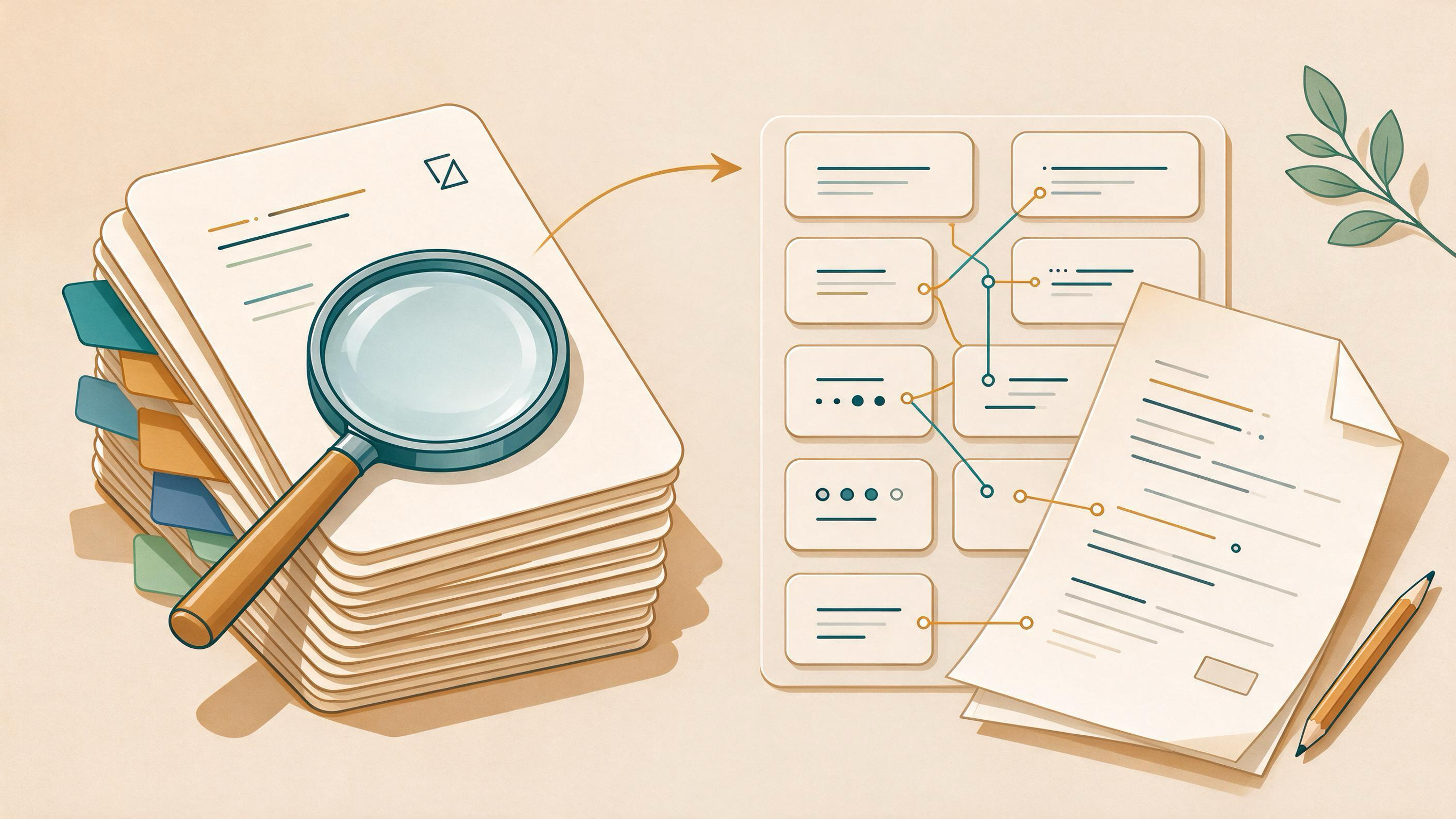
A reading list answers "what should I read?" An evidence matrix answers "what does each source actually let me claim?" If you are finishing a course paper, a thesis chapter, or a first manuscript, you probably already have a reading list. The gap that slows you down is usually the second artifact: a structured record of what each paper contributes, how it was found, and where it fits in your argument. Neither tool replaces the other. Each one misses something the other catches, and the fastest path forward is to know which gap you are standing in.
Start by diagnosing what you actually have
Before choosing a format, look at your current materials honestly. Most students and early-career researchers are in one of three states.
You have a pile, not a list. Papers sit in a folder or a reference manager with no shared structure. You can name the topic but not the boundary of what counts as relevant.
You have a list, not a map. Titles are collected and maybe tagged, but you cannot say which paper supports which sentence in your draft, or which claims still have no source.
You have a map, but it is stale. You built a matrix months ago, then added papers without updating it. The matrix no longer reflects what you have read.
The diagnosis matters because the two tools fail in different ways. A reading list is good at breadth and recall. An evidence matrix is good at traceability and synthesis. If your problem is "I keep finding more papers and never stop," you need list discipline. If your problem is "I have forty papers and a blank synthesis section," you need matrix discipline.
What a reading list does well
A reading list is a collection with intent. Its job is to make sure the right sources enter your workspace and stay findable.
Reference managers support this directly. Zotero collections can place one item in multiple project groupings without duplicating it, and tags can describe topic, method, status, or workflow. Saved searches update automatically, and a Duplicate Items collection supports review and merging. That combination is genuinely powerful for a reading list: one paper can belong to "Chapter 2" and "Methods reading" at once, and a tag like "to-read" or "cited-in-draft" tracks its state.
A reading list also supports the search side of research. Cochrane guidance for systematic reviews recommends planning searches from eligibility criteria, using multiple sources, combining free-text terms with subject headings, documenting the process, deduplicating records, screening in stages, linking multiple reports of one study, and rerunning searches before publication. Even a small coursework project benefits from the same instincts at a smaller scale: define what counts as eligible, search more than one place, and write down how you searched.
Where a reading list is weak is meaning. A title in a folder tells you a paper exists. It does not tell you the sample, the method, the finding, or the sentence in your draft it supports.
What an evidence matrix does well
An evidence matrix is a table, usually one row per source and one column per attribute you need to compare. Typical columns include the citation, the study design, the population or setting, the key finding, the limitation, and the claim in your draft it supports.
The matrix's strength is that it forces comparison on shared criteria. When every row answers the same questions, patterns become visible: which methods dominate, where findings agree, where they conflict, and which of your draft claims have no row behind them.
This is also where reporting discipline pays off. PRISMA 2020 provides a reporting checklist, expanded explanations, an abstract checklist, and flow-diagram templates for original and updated systematic reviews, including transparent reporting of search, selection, and synthesis methods. You do not need a full systematic review to borrow the logic: if your matrix records how each source was found and why it was included, your methods paragraph writes itself.
Where an evidence matrix is weak is coverage. A matrix only contains what you put in it. It will not remind you that a whole strand of literature is missing, and it will not update when a new paper appears.
Compare both on the same task
Take a concrete case. You are writing a thesis chapter on how a specific intervention has been evaluated, and your supervisor has asked for a synthesis section that groups studies by method.
| Criterion | Reading list | Evidence matrix |
|---|---|---|
| Getting sources in | Strong: collections, tags, saved searches, deduplication | Weak on its own: needs a source of records |
| Comparing studies | Weak: titles and metadata only | Strong: shared columns force comparison |
| Tracing claims to sources | Weak unless you add notes | Strong: each row maps to a draft claim |
| Documenting search and selection | Possible if you record it | Natural fit: inclusion and exclusion live in the table |
| Spotting gaps in coverage | Moderate: you can see what you saved | Weak: only shows what is already in the table |
| Updating over time | Strong: saved searches refresh | Needs manual maintenance |
| Handoff to a supervisor | Weak: a list is hard to review | Strong: a table can be read and critiqued |
Read the table as a division of labor, not a contest. The reading list manages intake. The matrix manages argument.
Where the reading list fails
A reading list fails at the moment you need to write. You open your draft, you know the paper is in your library, and you still cannot remember whether it supports your claim, qualifies it, or contradicts it.
The second failure is invisible duplication of effort. Without a shared structure, you re-read the same paper for the same purpose because nothing recorded what you concluded the first time.
The third failure is coverage that feels complete but is not. A list can grow large while remaining narrow, because nothing in it forces you to ask whether your search strategy reached beyond the sources you already knew.
Where the evidence matrix fails
An evidence matrix fails at the edges. It is excellent for the papers inside it and silent about the papers outside it. If your search missed a relevant strand, the matrix will look tidy and still be incomplete.
It also fails under maintenance pressure. A matrix built in one sitting and never updated drifts away from your actual reading. Rows get added without the search documentation that would let a reader reproduce your selection.
And it fails when the columns are wrong. A matrix with a "finding" column but no "method" column invites you to compare conclusions across incompatible study designs. The structure of the table is a claim about what matters, and a poorly designed table encodes a weak argument.
Build the combined workflow
Use both artifacts, in sequence, with a clear handoff between them.
Step 1: Define eligibility before you search. Write down what counts as in scope: population, intervention or topic, study type, date range, language. This is the Cochrane instinct applied at your scale, and it prevents the list from becoming an unbounded pile.
Step 2: Search across more than one source and record the strategy. Combine free-text terms with subject headings where the database supports it. Note the date of each search. If you use a scholarly search interface, WisPaper search is a place to find academic papers; keep your own record of terms and dates alongside it.
Step 3: Deduplicate and screen in stages. Screen titles and abstracts first, then full texts. Zotero's Duplicate Items collection supports review and merging, which handles the mechanical part. Record why each excluded record was excluded.
Step 4: Save included papers into a library. My Library is where you save or upload papers and organize them. This is your reading list layer: the intake side, kept separate from the argument side.
Step 5: Build the matrix from the included set only. One row per study, not per report. Cochrane guidance notes that multiple reports of one study should be linked, so a trial and its follow-up paper share a row with two citations.
Step 6: Map rows to draft claims. Add a column for the sentence or section each source supports. Rows with no claim are either background or candidates for removal. Claims with no row are your writing to-do list.
Step 7: Rerun the search before you submit. Cochrane recommends rerunning searches before publication. For a thesis chapter, rerun before you send the final draft to your supervisor.
Use a January project-start example
Suppose you are starting a new project in January after a winter break spent cleaning up last term's files. You have a folder of papers from a coursework essay and a vague plan for a thesis chapter that extends it.
The cleanup instinct is to sort the folder. Resist that first. Instead, write your eligibility criteria for the new chapter, then check which of the old papers still qualify. Many will not, and that is useful information.
Next, run a fresh search with terms drawn from your criteria, and record the date. Save the qualifying papers into a library so the intake side is clean. Then build a matrix with columns for design, setting, key finding, limitation, and the chapter section each source supports.
When the matrix is half full, you will notice gaps: a method nobody in your set used, a population nobody studied. Those gaps are your next search, not a reason to stop. This loop, search then matrix then search again, is what keeps coverage and traceability in balance.
If the project grows into a longer literature review, Scholar Agent is an area for longer research tasks with literature review use cases. Use it to extend the search, then bring the results back into your own matrix rather than letting a second, separate list form.
Check your citations before the matrix goes to your supervisor
A matrix is only as good as its rows, and a row with a fabricated or mistyped reference undermines the whole table. Before you hand anything over, check the bibliography itself.
TrueCite supports BibTeX citation screening: it checks BibTeX against real academic databases to flag hallucinated references. Run it on the export from your library, fix what it flags, then rebuild the matrix citations from the corrected file. Doing this before the supervisor review saves a round of corrections.
Know when the result is ready
A combined reading list and evidence matrix is ready when four conditions hold.
The list is bounded. You can state your eligibility criteria and point to the search dates and sources that produced the included set.
Every included study has one row. Multiple reports of the same study are linked, not duplicated.
Every draft claim has a row, or is explicitly marked as your own argument. You can trace each empirical sentence to a source.
The search has been rerun recently. The matrix reflects the literature as of a stated date, not as of the day you first built it.
If you can hand a supervisor the criteria, the search record, the matrix, and the corrected bibliography together, you have something reviewable. That is the practical test.
Your next action
Pick the artifact you are missing. If you have a list but no matrix, open a spreadsheet and create five columns: citation, design, key finding, limitation, draft claim. Fill one row for the paper you understand best. If you have a matrix but no clean list, write your eligibility criteria and deduplicate your library before adding another row.
Either way, do it today on one paper, not on the whole project. The workflow scales from a single row.
FAQs
Keep Reading
Reference Manager Notes vs. Markdown Notes for Literature Reviews
A literature review produces two different kinds of output at once: a set of bibliographic records that must resolve to the right works, and a body of notes and prose that must carry an auditable trail from claim to sour

Research Notebook vs. Reference Manager: Which Holds What?
A reference manager holds the identity of a source. A research notebook holds the reasoning you build on top of it. The practical answer to "which holds what" is that neither should hold everything: the reference manager
Research Paper Organization: A Complete System for Notes, PDFs, and Evidence
You are finishing a course paper, a thesis chapter, or your first manuscript, and the next project is already on the horizon. The problem is rarely a lack of sources. It is that your notes live in three apps, your PDFs a