
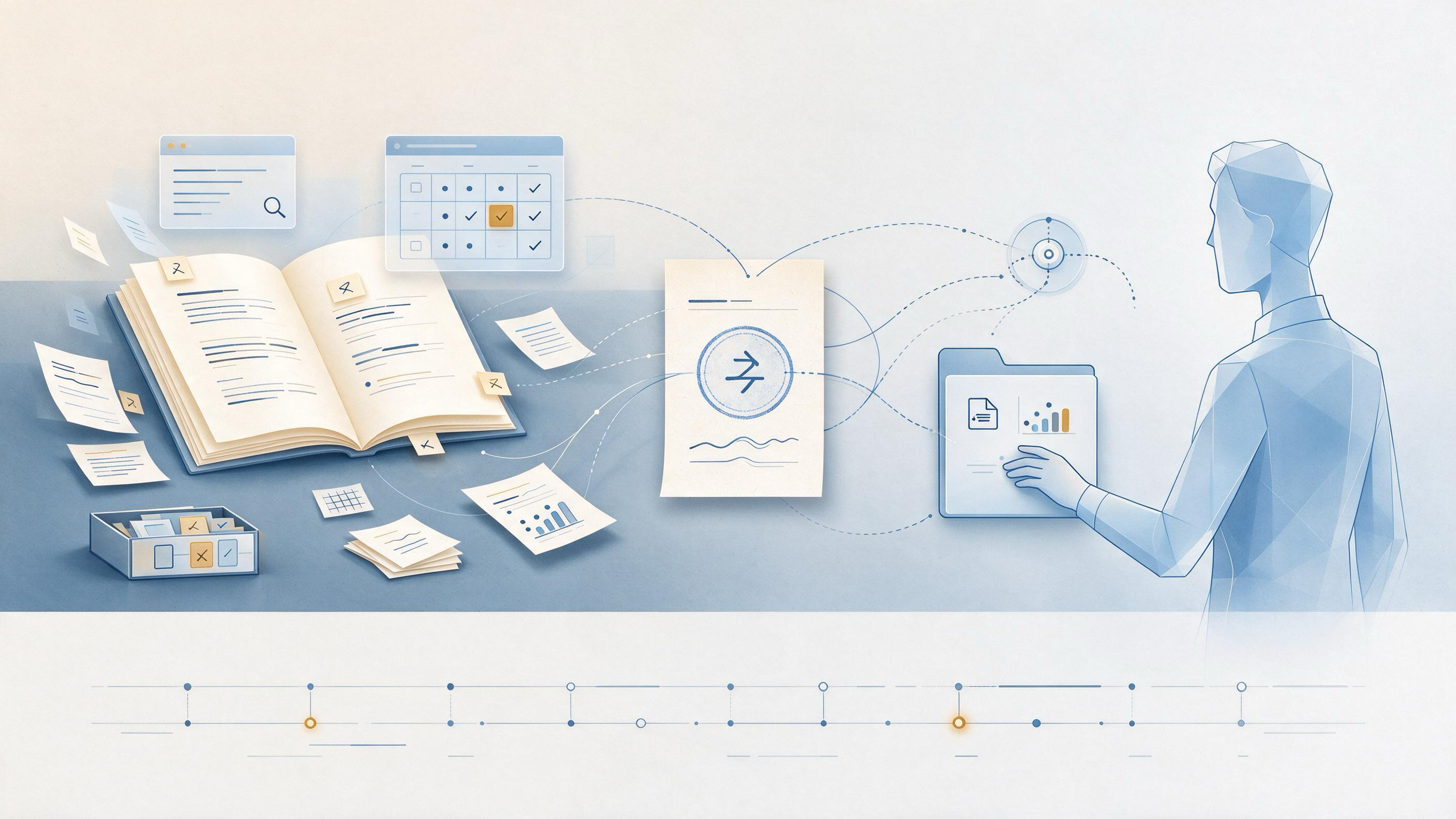
A handoff is not a favor to the next person. It is the moment you turn months of tacit method into something another researcher—or your future self—can open, understand, and continue without a private debrief. For faculty closing out a grant year, lab members rotating off a project, or coauthors who will not be in the room when the revision letter arrives, the handoff decides whether the work stays usable.
This guide treats the handoff as a research workflow, not an administrative chore. It covers submission readiness, revision ownership, searchable method trails, and the year-end reset that makes a new project start from evidence rather than memory. Along the way it connects to WisPaper, an AI research assistant for finding, screening, organizing, and working with academic papers, where the tool genuinely shortens a step.
How do I know which state my project is in?
Before you hand anything over, stop and diagnose the current state. Most messy handoffs come from treating every project as if it needs the same package. A manuscript being revised needs decision ownership and response tracking. A closed project needs an archive another person can audit. A laboratory method being passed to a new member needs reproducible steps, not a summary of findings.
Use four states as your entry routes:
| State | The question the handoff must answer | Core artifact |
|---|---|---|
| Preparing submission | Can a reviewer reconstruct how we got here? | Search log + citation packet |
| Responding to peer review | Who owns each point, and what changed? | Revision decision table |
| Handing off to a new person | Can someone execute the same work without me? | Reproducible method trail |
| Year-end project close | What stays, what is finished, and what starts next? | Archive manifest |
If you can answer the question in the middle column from the files you currently have, your handoff is nearly done. If you cannot, the gap tells you which section below to start with.
State the state in the first line of the handoff document: "This project is in revision, points 2 and 4 are unresolved," or "This project is closed as of December; the archive is read-only." The label stops the next reader from guessing.
What belongs in a manuscript handoff for submission?
A submission handoff is the evidence package behind the manuscript. The manuscript itself is the claim; the handoff is how the claim was built and how it can be checked.
For a manuscript built on a systematic or reproducible search, the Cochrane Handbook Chapter 4 gives the durable structure: plan searches from the eligibility criteria, use multiple sources, document the process, deduplicate records, screen in stages, link reports of the same study, and update searches before publication. Each of those steps is a section of the handoff, and each section should link to an artifact rather than a recollection.
Build the package as four layers:
- Criteria and protocol — the eligibility criteria and any search protocol, dated and versioned.
- Sources and queries — each source searched, the exact query run, and the date it ran.
- Deduplication and screening record — how duplicate records were merged and the staged screening decisions.
- Linked study records — reports of the same study tied together so a reviewer sees one study, not four paper titles.
Store the package where a coauthor can open it without your file path. In WisPaper, My Library is where saved and uploaded papers can live for the project, and the search that produced them can be rerun through the scholarly search interface when a reviewer asks whether the literature check is current.
How do I hand over a search someone can actually redo?
A search is not reproducible because you pasted the query. It is reproducible because another person could sit down with your log and arrive at the same candidate set, then explain any difference.
Write the handoff as a method trail, not a results list. For each source, record the platform, the query as run, the date, the number of results exported, and the deduplication decision. Zotero's model shows why this matters for organization: the same item can sit in multiple project collections without duplicating, while tags record topics, methods, or workflow status. That is the property your handoff needs—one source of truth for each study, with project views on top.
For identifier stability, the DOI Foundation describes a DOI as a persistent identifier that resolves through the DOI system and can remain stable when the location or descriptive metadata of an object changes. When your search log cites a record, cite the DOI so the link survives a publisher site redesign. Crossref's REST API exposes registered scholarly metadata—DOI, title, author, publication, funder, license, and relation fields when deposited—which means the identifier you hand over can be verified back to a registered record.
The reproducibility check is simple: give the log to a colleague who has not worked on the project. If they cannot say what you searched, when, and how many records each step produced, the log needs work.
Who owns each point in a peer-review response?
Revision handoffs fail when responsibility is implied. "We'll address the reviewer" becomes no one's job. Convert the reviewer letter into a decision table with one row per point and three columns that a coauthor can fill without a meeting.
| Reviewer point | Owner | Decision |
|---|---|---|
| Search window ends March; update to December | Person who ran the search | Rerun and re-screen |
| Studies X and Y report the same trial | First author | Link as one study |
| Missing funder information | Data manager | Confirm via registered metadata |
The decision column forces the team to choose: change, rebut, or scope. Every row closes with an action artifact—a rerun log, a merged record, a citation update. Store the table with the manuscript so the next reader sees not just what changed but who signed off on it.
If the revision requires checking whether a reference resolves to a real record, TrueCite covers BibTeX citation screening, checking entries against real academic databases to flag hallucinated references. That check belongs inside the revision workflow as a verification pass, before the response goes back to the journal.
What does a lab handoff need that a manuscript handoff does not?
A person inheriting a lab method needs execution knowledge. The difference from a manuscript handoff is that the recipient will run the procedure again, possibly on new data, so the handoff must separate what was found from how it was run.
The reproducible-search example applies directly. Cochrane's staged screening and deduplication steps become a checklist the new member executes; the prior results are only a worked example. Keep three things separate:
- The procedure — the ordered steps someone follows today.
- The parameters — dates, counts, thresholds, tool versions.
- The worked example — a completed run showing what a correct output looks like.
If a step involves planning a reproduction from an existing paper, WisPaper's PaperClaw is the area for research-paper reproduction planning from an uploaded PDF and reproduction instructions. The newly generated plan becomes part of the handoff, but the recipient still needs the parameter and worked-example layers to judge whether their run matches.
Time-bound the handoff. The new member runs the procedure once on a small test set while you are still available, then you both compare outputs. That paired run is the acceptance test.
How do I archive a closed project without losing the method?
A closed project is not a folder renamed "FINAL." It is a read-only package where a future reader can separate conclusions from evidence and rerun any step.
Build an archive manifest with six sections:
- Purpose and status — what the project set out to do and that it is closed.
- Outputs — manuscript, reports, datasets, each with an identifier.
- Search and screening log — the method trail described earlier.
- Library snapshot — the records that fed the work, linked not duplicated.
- Open threads — what was not finished and why it stopped.
- Restart note — what the next phase would need first.
The archive is for future you in January as much as for a new team member in September. The restart note is where the year-end reset starts: when a new project begins from the open threads, it inherits evidence instead of rebuilding it.
Use the Research Projects area to hold the new project separately from the closed one, rather than turning the archive back into a working folder. A closed project should stay closed; the new project links back to it.
When should questions replace file-passing during a handoff?
The fastest way to test whether a handoff actually transfers knowledge is to let the recipient ask questions of the material, not of you. If they can answer from the archive, the handoff worked.
For a library-based handoff, the natural next step is question-led. With papers uploaded to My Library or added from search results, Library QA supports asking questions based on those papers. Use it during the handoff meeting: the incoming researcher asks what the corpus says about a method decision, and the answer either comes from the saved records or exposes that the reasoning was never written down.
Questions also reveal the tacit layer. When the recipient asks something the files do not answer, write the answer into the handoff immediately. Every unresolved question is a section that was missing.
What does a year-end reset look like for a research group?
A year-end reset converts scattered project states into a single operating picture. It is the handoff from this year's work to next year's plan, and it runs best as a three-pass exercise.
Pass 1: classify. Put every active project into one of the four states from the opening table. The classification creates the handoff queue: submission packages to finish, revisions to assign, people handoffs to schedule, archives to close.
Pass 2: close or transfer. For anything finished, build the archive manifest. For anything moving to a new person, schedule the paired run. For revisions, update the decision table.
Pass 3: seed the next project. The open threads from closed archives become candidate starters. If the next phase needs a literature scan to decide what is worth pursuing, the Scholar Agent area covers longer research tasks and literature review, inspiration, or reproduction use cases. A new project starts with a working search log, not a blank page.
Review the reset at a fixed checkpoint: after two weeks, compare what the archive promised to what the new project actually used. The gap is next year's handoff lesson.
How do I know the handoff is ready to send?
Readiness is testable with five questions. If the answer to any is "ask me," the handoff is not done.
- Can the recipient state the project's current state from the first line of the document?
- Can they list the exact search steps without opening a messaging thread with you?
- Can they map every reviewer point to an owner and a decision?
- Can they run the method once and compare against a worked example?
- Can they ask a question of the saved material and get the answer from the archive?
The handoff is ready when the recipient can act on all five without live help. Before you send it, do one clean pass: remove file paths that only exist on your machine, replace vague dates with full dates, and confirm every identifier resolves. A DOI is the link that stays when the location changes; build your handoff identifiers on that principle.
FAQs
Keep Reading
Research Reporting Checklist: Methods, Statistics, and Transparency
A reporting checklist turns a finished analysis into a manuscript an editor can actually evaluate. The central task is not "find a checklist," but match the checklist to your study design and then prove, item by item, th

Reviewer Response Letter vs. Revision Checklist: Which Artifact Keeps a Revision on Track?
You have reviewer comments in front of you and a revision deadline behind you. The immediate question is practical: do you start drafting the reviewer response letter, building the revision checklist, or both at once? Cl
Structured Abstract vs. Unstructured Abstract: Choosing Before Submission
Authors rarely sit down intending to write the wrong abstract. The problem is that abstract format is one of the last decisions many teams make, and by then the manuscript, the tables, and the coauthor calendar have alre