
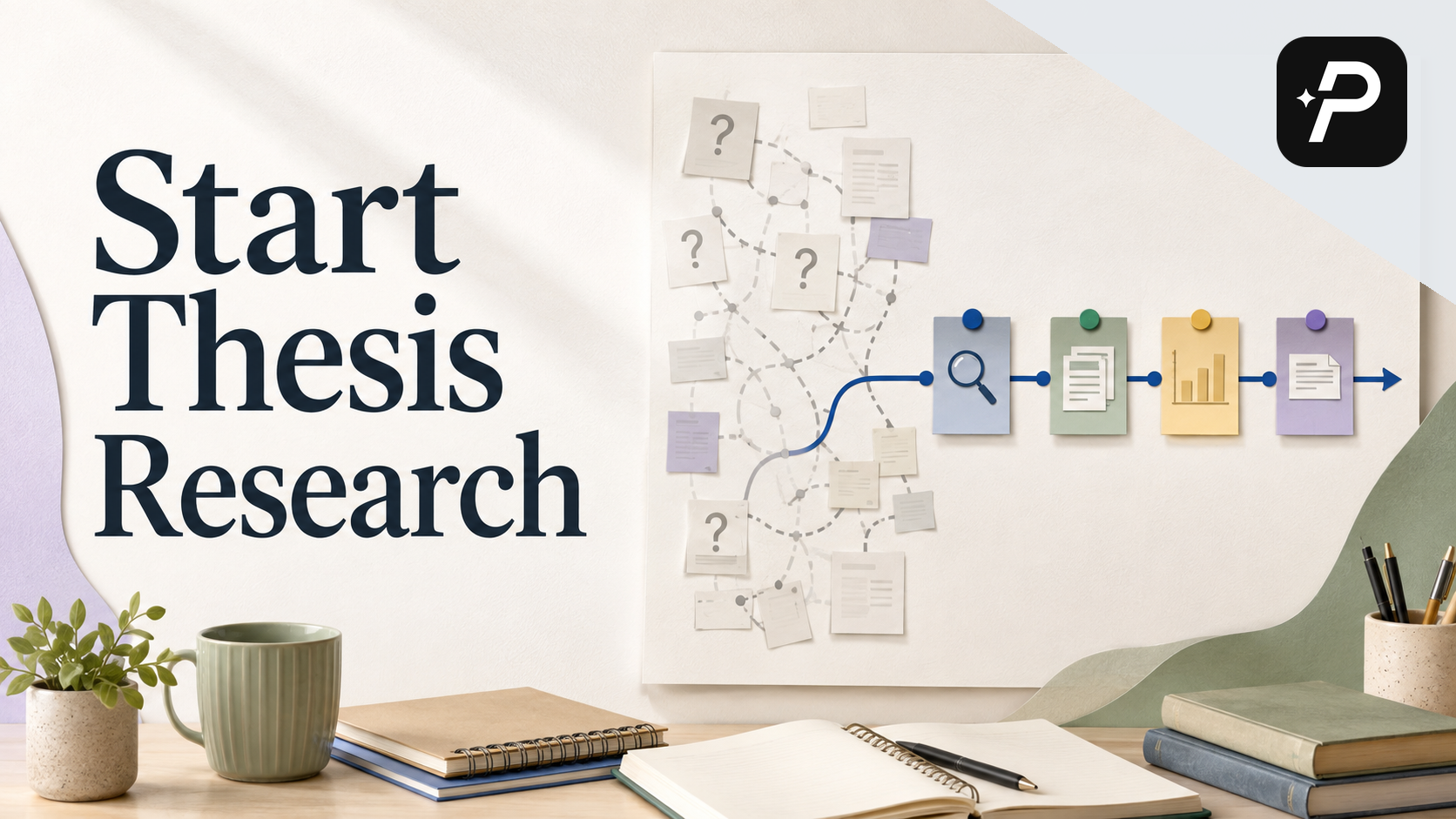
You have a thesis requirement, a deadline that feels distant enough to ignore, and no clear first move. Maybe you have a broad interest like "social media and mental health" or "renewable energy policy," but every search returns either too many results or too few that matter. The blank page problem is real, but it is solvable with a sequence rather than a stroke of inspiration.
This guide walks through a first-week workflow: map your broad idea, run focused searches, read strategically, organize what you find, narrow your question, and walk into your supervisor meeting with something concrete. You will still make your own decisions, but you will know what decision comes next.
What is the first step in thesis research?
The first step is not choosing a topic. It is mapping the territory around your broad interest so you can see what already exists.
Write down everything you already know about your area of interest. This can be messy and unstructured. If you are interested in "social media and mental health," write that down, then add sub-ideas: effects on teenagers, passive scrolling versus active posting, the role of algorithms, long-term outcomes, platform-specific differences. Do not judge any of it yet.
Your goal is to externalize what you already carry in your head. That list becomes the raw material for your first searches. You are not trying to invent a new conversation in the literature. You are trying to find an existing one you can join.
Treat this first step as exploration, not commitment. You are gathering enough information to make an informed choice later, not locking in a thesis topic on day one.
How do you turn a broad idea into a starting search?
Typing "social media mental health" into a search bar returns thousands of results, most of them irrelevant. The problem is that your broad idea contains multiple concepts, and the search engine treats them as one fuzzy blob.
Break your broad idea into core concepts before searching. For "social media and mental health," those concepts might be:
- Population: adolescents, college students, working adults
- Exposure or intervention: Instagram use, passive scrolling, specific platform features
- Outcome: anxiety, depression, self-esteem, sleep quality
Now combine those concepts into a focused query. Instead of "social media mental health," search for "Instagram use AND adolescent anxiety" or "passive social media consumption AND self-esteem."
This is where Boolean searching gets frustrating. Many students know they need AND, OR, and NOT operators but struggle to build a query that captures their actual question. WisPaper's Deep Search lets you use a natural-language research question instead. You can ask "What is the relationship between passive Instagram use and anxiety among college students?" and the search processes it as a research question rather than a keyword match. That often surfaces more relevant academic literature than a manually constructed Boolean string.
The goal of this step is a manageable set of results. You are not looking for everything on the topic. You are looking for a starting point: a handful of papers directly relevant to your core concepts.
What should you read in the first week?
In the first week, you are reading for orientation, not deep comprehension. Your job is to identify the key players, major debates, and common methodologies in your area.
Focus on three types of documents:
- Review articles. A good review article summarizes the state of the field. It introduces key terminology, maps the major debates, and points you toward the most important studies. One strong review article can save you days of scattered searching.
- Highly cited papers. These are the foundational studies everyone in the field knows. Citation counts in Google Scholar or similar databases help you identify them.
- Recent papers from the last two to three years. These show where the conversation is heading and often highlight gaps or emerging questions.
When you find a promising paper, do not read the whole thing. Read the abstract, the introduction, and the conclusion. That tells you what the authors did, why they did it, and what they found. You are building a mental map, not memorizing facts.
WisPaper displays search results as paper cards with source labels, summaries, publication details, and author information. That preview lets you screen a paper for relevance without opening the full PDF. You can scan ten papers in the time it takes to read one, which is exactly what you need in the first week.
How do you avoid collecting random papers?
The biggest risk in the first week is the rabbit hole. You find one interesting paper, which cites another, which cites another, and suddenly you have fifty tabs open and no idea how they connect. That is not a collection. That is clutter.
You need a system with a clear structure for what you save and why. Before saving a paper, ask: does this directly address one of my core concepts? If the answer is no, skip it.
A simple spreadsheet or document with these columns works well:
- Paper title and full citation
- Core concept: which of your concepts (population, exposure, outcome) does it address?
- Key finding: one sentence on the main takeaway
- Relevance: why does this matter for your thesis? (e.g., "provides methodology," "confirms my hypothesis," "shows a gap")
This forces active reading. Instead of collecting PDFs, you are extracting information and organizing it.
WisPaper's My Library feature serves the same purpose with less manual work. You can save papers directly from search results or upload papers you found elsewhere. A single organized location for your sources prevents the chaos of scattered bookmarks and downloads.
When should you narrow the topic?
Narrow your topic when you have enough information to see the boundaries of the field. That usually happens after you have read a few review articles and a handful of recent papers. You will notice the research is not one big blob. It divides into distinct sub-areas.
Within "social media and mental health," those sub-areas might include:
- Visual platforms (Instagram, TikTok) versus text-based platforms (Twitter, Reddit)
- Specific features (likes, comments, infinite scroll)
- Specific populations (adolescents, new mothers, people with pre-existing conditions)
Your goal is a sub-area that interests you, has enough research to support a thesis, but is not so saturated that your contribution would be trivial. That balance is hard to strike.
A useful test: you should be able to state your potential topic in one or two sentences. If you cannot, you are not ready to narrow it. Go back and read more.
If you feel stuck, WisPaper's Inspiration Discovery can surface related angles you might not have considered. It is useful for exploring the edges of your topic when it feels too broad, too narrow, or just underdeveloped. It is not a tool for making the final decision. That choice is yours.
How do you prepare useful notes for your supervisor?
Your supervisor is not there to tell you what to do. They are there to guide you and help you avoid pitfalls. The quality of that guidance depends on the quality of your preparation.
Do not walk into a meeting with "I'm thinking about doing something on social media." Bring a one-page document with:
- Your proposed research question. Your best attempt at a focused question, even if it is not perfect.
- Your core concepts. A brief breakdown of the population, exposure, and outcome you are considering.
- Five to ten key papers. The most relevant papers you found, with a one-sentence summary of each.
- Your initial observations. Common themes, debates, and what seems to be missing.
- Specific questions for your supervisor. What are you struggling with? Are you unsure about scope? Do you need help finding a specific type of study?
This preparation turns the conversation from a brainstorming session into a strategic planning session. Your supervisor can quickly see where you are and offer targeted advice on refining your question or where to look next.
For a more detailed framework on structuring this conversation, see our guide on how to prepare supervisor meeting literature review.
What should you not do at the beginning?
Several common mistakes waste weeks at the start of a thesis. Knowing them in advance helps you avoid them.
Do not try to read everything. You will never read everything, and attempting it will paralyze you. Be selective and strategic.
Do not start writing your introduction. You do not have enough information yet. Writing too early leads to wasted effort when your topic shifts, and it will shift.
Do not obsess over the "perfect" topic. There is no perfect topic. There is only a topic that is interesting enough and manageable enough. You will refine it as you go.
Do not ignore your supervisor. They are a resource. Do not wait until you have a fully formed proposal to reach out. Early, informal conversations save time.
Do not be afraid to change direction. If your initial searches are not turning up good results, that is a signal your approach needs to change. It is not a personal failure.
Do not use AI to write your thesis. Tools like WisPaper support research and discovery. They do not replace your thinking and writing. Generating text with AI and submitting it as your own is academic dishonesty, and it will not help you learn.
The beginning of a thesis is a time for exploration. Be curious and open-minded. Avoid rushing to conclusions or being overly critical of your own ideas. The process matters.
How can WisPaper support the early thesis research workflow?
WisPaper handles the tedious parts of early research so you can focus on thinking and synthesis. It will not write your thesis or choose your topic. It acts as a research assistant that helps you find, organize, and understand the literature.
Here is how it fits the workflow described above:
- Deep Search lets you search academic literature using a natural-language research question instead of building a Boolean query. That is useful when you are not sure of the exact keywords. You ask a question and see what comes up.
- Scholar Agent helps you explore research questions and paper directions inside the search workflow. If you are unsure how to phrase a search or what angle to take, it can help you refine your approach.
- Paper Cards show summaries, publication details, and author information in search results. That allows quick screening so you can identify papers worth your time.
- My Library saves papers to your personal library, creating a central repository for your sources from day one.
- Library QA answers questions based on the papers in your library. When you are preparing for a supervisor meeting, you can ask something like "What are the common limitations in these studies?" and get an answer grounded in your own sources.
WisPaper moves you from a blank page to a curated collection of relevant literature faster. The critical thinking, synthesis, and final decisions remain yours.
FAQs
Keep Reading
How to Narrow Down a Broad Research Topic
You have a general interest—maybe "climate change," "social media," or "artificial intelligence"—but no clear direction. Every search returns thousands of results. The problem is not a lack of ideas. It is a lack of focu
How to Turn a Broad Topic Into a Researchable Question
Every thesis starts with a spark of interest—a broad topic like "social media and mental health," "remote work productivity," or "sustainable urban transportation." The excitement of exploring a big idea quickly fades wh
Is Your Research Question Too Broad? Signs and Fixes
You have a draft research question. You have read a few papers. But something feels off. Every search returns thousands of results, and none of them seem to answer what you actually want to know. The problem might not be