
Your supervisor wrote "this is just a summary" in the margin of your literature review draft. You had read every paper, taken detailed notes, and described each study in turn. The feedback feels unfair because you did the work. What you missed is the difference between reporting what each source says and building an argument from what the collective research means.
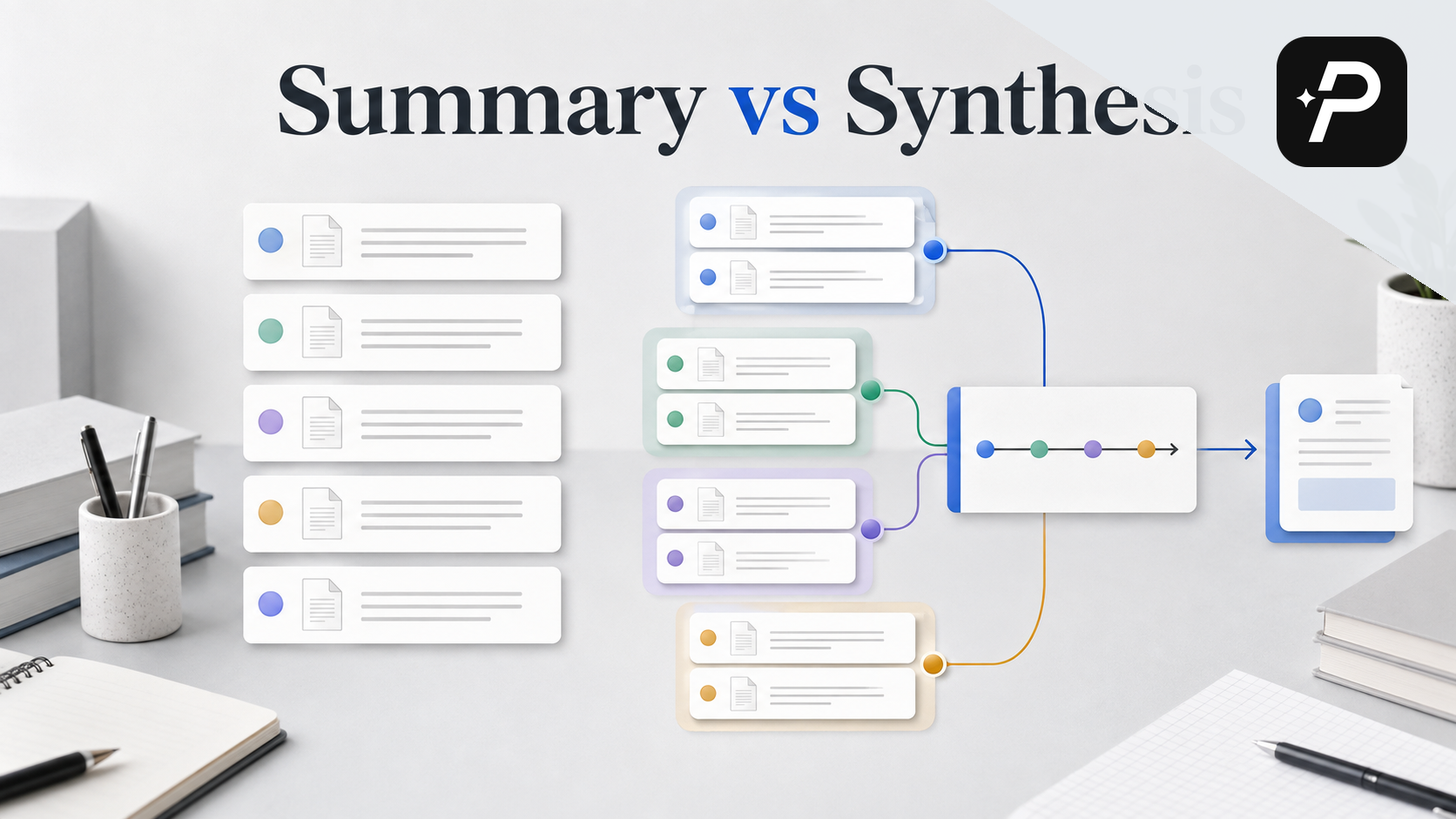
Summary and synthesis serve different purposes in academic writing. A summary restates one source's main ideas. Synthesis combines multiple sources to create a new insight. A literature review needs both, but the review itself must be organized around synthesis.
What Counts as Summary in a Literature Review?
A summary condenses a single source's argument, methods, and findings into your own words. You are accurately representing what the original author said without adding interpretation or connecting it to other work.
In a literature review, summaries often look like this:
- "Smith (2021) studied remote learning and found that student engagement decreased."
- "Johnson (2020) argues that social media use correlates with anxiety in teenagers."
- "Lee (2019) examined sleep deprivation's effects on cognitive performance and concluded that memory consolidation is impaired."
Summary is a necessary skill. You need it for note-taking and for confirming you understand a source. But a literature review built only from summaries is essentially an annotated bibliography. It tells the reader what individual studies say. It does not tell the reader what the body of research means as a whole.
A summary-only review is usually organized by author or by paper. The structure runs through Smith's findings, then Johnson's findings, then Lee's findings, and stops. This approach does not show why these studies matter together, where they disagree, or what gaps they leave. It reads like a stack of index cards rather than a coherent argument.
What Does Synthesis Actually Look Like?
Synthesis combines ideas from multiple sources to create an overarching insight. Instead of discussing one paper at a time, you group papers by theme, methodology, or finding. You identify patterns, debates, and connections across the literature.
When you synthesize, you are building an argument about what the collective research shows. You are answering questions like:
- Where do these studies agree?
- Where do they conflict?
- What methodological differences explain the conflicting results?
- What is missing from this body of research?
A synthesized literature review is organized by idea rather than by author. Instead of writing "Smith found X," you write "Several studies have demonstrated a link between sleep and memory, although the strength of this link varies by age group (Smith, 2021; Lee, 2019)."
Synthesis is what moves your literature review from background material to a scholarly contribution. It demonstrates that you understand the field's big picture and have identified where your own research fits.
Summary vs. Synthesis: What Is the Core Difference?
The simplest way to distinguish them is by their primary verb. Summary reports. Synthesis connects.
Summary focuses on one source at a time and restates the author's argument. Synthesis focuses on themes across multiple sources and builds a new argument from them. Summary answers "What did this paper say?" Synthesis answers "What does this body of literature mean?" Summary organizes by author or chronology. Synthesis organizes by theme or concept.
Think of sources as ingredients. A summary describes each ingredient: this is a carrot, this is an onion, this is a potato. Synthesis is cooking them together into a stew, where the final flavor is more than the sum of the parts.
A Before-and-After Example with the Same Three Papers
Consider research on green spaces and mental health in urban areas. You have read three papers:
- Paper A (2020): Access to parks reduces stress biomarkers.
- Paper B (2021): Community gardens improve mood but not necessarily stress hormones.
- Paper C (2022): The effect of green space is moderated by socioeconomic status.
The summary version:
Smith (2020) investigated the relationship between park access and stress. The study measured cortisol levels in 100 participants and found that those living within a 10-minute walk of a park had significantly lower cortisol. Johnson (2021) explored the benefits of community gardening. Using a survey of 50 gardeners, the study found that participants reported better moods after gardening sessions, although their cortisol levels were unchanged. Finally, Lee (2022) analyzed data from a national health survey and found that the benefits of green space were stronger for high-income individuals than for low-income individuals.
This version reports what each study did but leaves the reader to do the analytical work. It does not explain what we should conclude from these three studies together.
The synthesis version:
The mental health benefits of urban green space are well-documented, but the mechanisms and moderators of this effect remain contested. Some research points to a physiological pathway, showing that proximity to parks can lower cortisol levels (Smith, 2020). Other studies suggest the effect is more psychological, with improvements in self-reported mood occurring independently of stress hormones (Johnson, 2021). This discrepancy may be explained by the type of green space involved. Passive exposure to a large park may trigger a biological relaxation response, whereas active engagement in a garden may provide a sense of accomplishment that boosts mood without altering stress hormones. However, these benefits are not evenly distributed. Lee (2022) found that socioeconomic status is a critical moderator, suggesting that the stress-reducing potential of green space is often inaccessible to the populations who need it most, potentially due to park safety concerns or a lack of maintenance in lower-income neighborhoods. This gap between the physiological potential and the social reality of green spaces highlights an area for policy intervention and future research.
This version groups the studies by theme: mechanism, type of space, and inequality. It points out the conflict between Paper A and Paper B and offers a hypothesis for that conflict. It uses the findings to build a larger argument about social inequality.
How Do You Move from Summary to Synthesis in Your Writing?
Moving from summary to synthesis is a learned skill. These four strategies help you start connecting sources.
Organize by Theme, Not by Author
Stop structuring your review paper-by-paper. Re-read your notes and look for common threads. What are the major debates? What are the recurring methodologies? What findings repeat across studies?
Once you have three to five themes, use those as your section headings. In a review on educational technology, your themes might be "Impact on Student Engagement," "Effect on Knowledge Retention," and "Barriers to Implementation." This structure forces you to discuss multiple authors in each paragraph.
Use Language That Shows the Conversation Between Authors
Synthesis requires signaling how sources relate to each other. Use phrases that highlight agreement, disagreement, and extension:
- For agreement: "Similarly," "Building on this," "This aligns with the work of..."
- For disagreement: "In contrast," "However," "This contradicts the findings of..."
- For extension: "While Smith focuses on X, Johnson expands this to consider Y."
This language tells your reader you are interpreting relationships between sources, rather than listing facts.
Build a Synthesis Matrix Before Writing
A synthesis matrix lists your sources on one axis and your themes on the other. Fill in each cell with brief notes about what each source says about each theme. This tool shows you at a glance where the gaps and overlaps are. If a theme has only one source, you need to do more reading. If a source speaks to multiple themes, it is a key paper. For a detailed guide on setting this up, see how to build a synthesis matrix for a literature review.
Write the Topic Sentence After the Body Paragraph
A common mistake is writing a narrow topic sentence like "Smith (2021) found that..." Instead, write the body of your paragraph first. Once you have described several studies and how they relate, go back and write a topic sentence that captures the point of the paragraph. For example: "The literature presents conflicting evidence regarding the role of technology in classroom distraction."
What Common Mistakes Keep Students Summarizing?
Even when you understand the distinction, it is easy to slip back into summary habits. Watch for these three patterns.
The Quilt Approach
This is placing summaries back-to-back with no connecting tissue. Each paragraph describes one study, and the next paragraph describes another. To fix this, make sure every paragraph has a clear point that connects the studies to your main argument.
The Source Dump
This happens when you cite too many sources in one sentence to look synthetic without actually discussing them. For example: "Many studies show that exercise is good for you (Smith, 2020; Jones, 2021; Lee, 2022)." This is not synthesis. It is a citation list. You need to explain how those studies are similar or different.
The No Man's Land
This is the opposite of the source dump. You write a paragraph that is entirely your own opinion without citations to ground it. Synthesis requires a balance between your voice and the evidence. Anchor your claims in the literature you have read.
How Can You Check Whether You Are Summarizing or Synthesizing?
A quick test is to look at your paragraph structure. If you mention the author's name in the first sentence and spend the rest of the paragraph describing their study, you are summarizing. If you start with a theme or a claim and then use multiple studies to support or challenge that claim, you are synthesizing.
Another test: cover up the citations in a paragraph and read what remains. If the paragraph still makes a coherent point about the research topic, you are probably synthesizing. If it becomes a list of disconnected statements, you are probably summarizing.
How Do You Handle Sources That Disagree?
Disagreement is not a problem. It is an opportunity for synthesis. Categorize the different positions and explain the reasons for their differences. Conflicting results often trace back to varying methodologies, sample populations, or theoretical frameworks. Naming that source of conflict is itself a contribution.
For example, if two studies on social media use and anxiety found different results, examine whether they measured anxiety differently, studied different age groups, or used different time frames. Your synthesis can then argue that the effect depends on these factors rather than being universal.
How WisPaper Helps You Find Connections Between Papers
The cognitive load of synthesis comes from holding many papers in your head at once and tracking how they relate. Tools that reduce the searching and organizing burden free up mental energy for interpretation.
If you are struggling to identify where studies conflict, WisPaper can help you find conflicting evidence in a literature review more quickly, so you can spend your effort on explaining why the conflict exists rather than hunting for it.
If your topic is broad or underdeveloped, WisPaper's Inspiration Discovery can surface related angles you might not have considered. Once you have your sources, a structured approach to building a reading queue for a new research topic ensures you are reading strategically rather than sequentially.
As you collect sources, be careful not to suffer from source overload. A good synthesis prioritizes relevant, high-impact studies over exhaustive citation. Learn how to avoid source overload in a literature review so you can focus on the studies that actually matter for your argument.
FAQs
Keep Reading

Too Many Sources for Your Literature Review? How to Organize Them
You have 80 tabs open, three reference managers, and a folder called "final_final_lit_review" that contains 47 PDFs. If this sounds familiar, you are not alone. Hitting the wall of **too many sources literature review**

How to Organize 20-30 Papers Into a Literature Review
You have 25 papers. They are sitting in a folder, a reference manager, or a stack of PDFs. Your supervisor wants a draft chapter next week, and you have realized the difference between a collection of sources and a liter

How to Build a Literature Review Outline From Your Sources
A literature review outline is supposed to make writing easier. Instead, many students find themselves stuck at the outline stage itself, staring at dozens of highlighted papers and wondering how to turn them into someth