
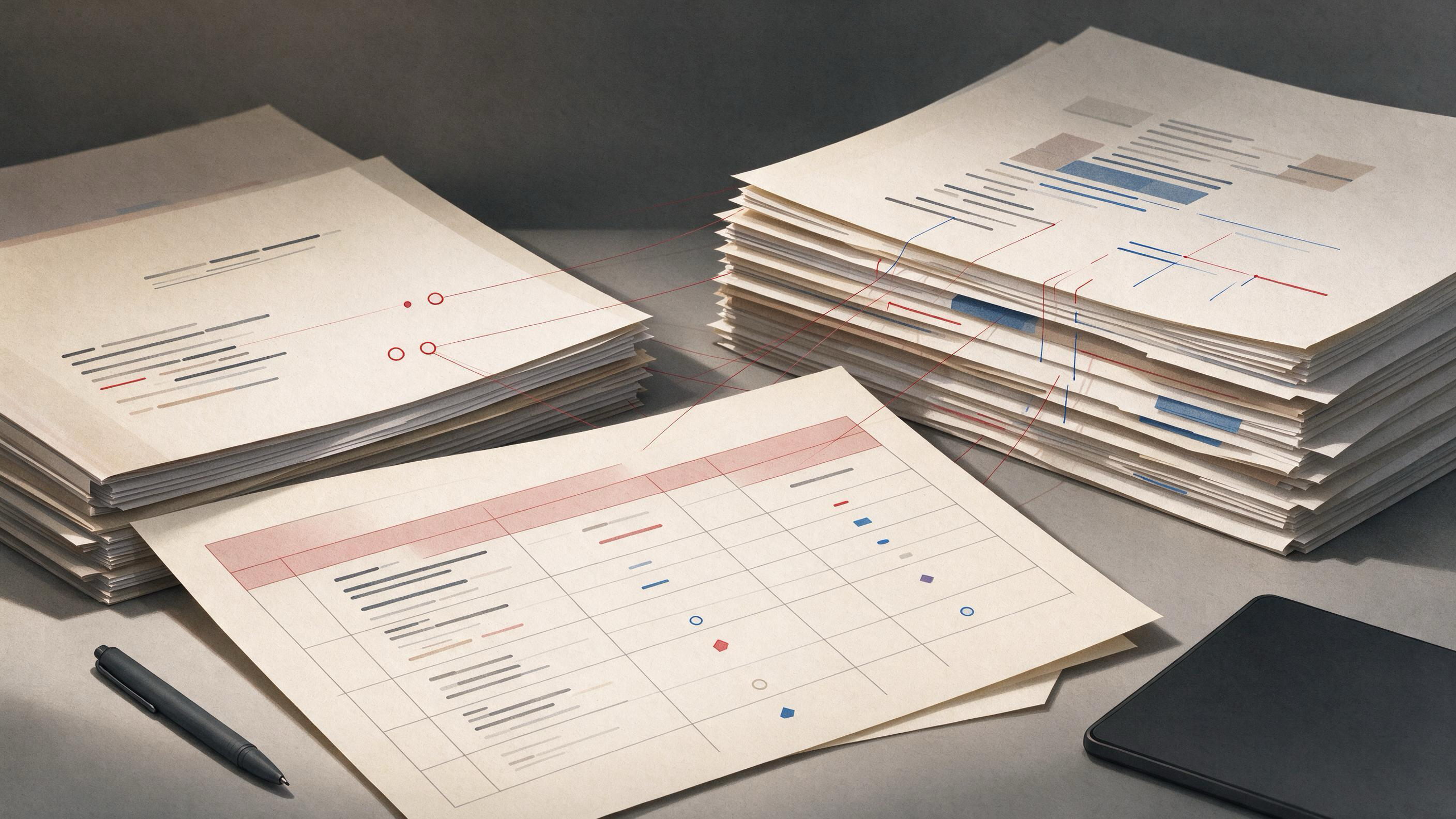
You open the reviewer comments one more time, then open the revised manuscript, and start checking off what you changed. By the third comment, something is wrong: the response letter says you replaced the old analysis with a mixed-effects model, but the methods section still describes the first model. Two comments later, the letter promises a new robustness check, but the table is unchanged and the appendix is missing. You are not really sure whether the manuscript, the letter, or your memory is the source of the mismatch.
This is not a formatting problem. It is a version-control problem that happens when the revised manuscript and the response letter are written as two separate documents by two different mental timelines. The fix is to treat them as two views of one tracked change record. This article walks through how to diagnose where your revision pair broke, rebuild a single source of truth, verify the pair against each other, and end with a submission-ready package plus a transferable workflow for the next manuscript.
Why Do the Response Letter and Revised Manuscript Drift Apart?
The most common cause is that the response letter was written for reviewers and the manuscript was written for readers, and neither document was updated when the other changed. When a supervisor asks you to "address the comments," the natural workflow is to draft reply text first, then open the manuscript and try to implement the changes from memory. By the time a second or third round of supervisor feedback arrives, the letter has become a promise log and the manuscript has become a patchwork of edits that may not correspond to any single promise.
A related cause is the order of revision. If you edit the manuscript first and write the response letter last, you may forget to record every change, or you may record changes you intended but did not make. If you write the letter first and edit the manuscript second, you may implement the change differently from how the letter describes it, leaving a mismatch that a reviewer will find immediately. Neither order is wrong on its own; the problem is that the two orders produce two separate records unless you deliberately reconcile them.
The final common cause is a missing checklist. Reporting guidance documents such as the ICMJE Recommendations describe the standard parts of a manuscript and direct authors to follow the selected journal's current instructions for article type, format, required statements, and submission materials. Those standards do not ask you to maintain a revision log, but they do assume that the text you submit is internally consistent. When your response letter cites a section that has moved, a figure that has been renumbered, or a reporting element that was never added, the manuscript is internally inconsistent even if every sentence looks correct in isolation.
How Do You Diagnose Which Document Is Wrong?
Start by exporting both documents into a form that can be compared side by side: the response letter file and the revised manuscript file, with each reviewer comment numbered. Do not try to hold the comparison in your head across a 40-page manuscript. Instead, make a table with three columns: the reviewer comment number, what the response letter claims was changed, and what the manuscript actually says at the location the letter points to. Where the two columns disagree, you have found a drift point. Where the letter points to a location that no longer exists, such as "Section 3.2" after sections were renumbered, you have found a second kind of drift.
At this stage, do not fix anything yet. Just classify each mismatch into one of three categories. The first category is "letter is accurate, manuscript is stale": you made the change but forgot to save it into the submitted version, or you edited a different copy. The second is "manuscript is accurate, letter is stale": the paper says what you actually decided after discussion, but the letter still describes an earlier plan. The third is "both are stale": neither document reflects the supervisor's latest comment, and you need to decide what the text should say.
If you are working in a shared research workspace, a practical way to contain this diagnosis is to gather the current version of each file in one place before you compare. When files live in email threads, downloads folders, and an unsynced laptop, the first "mismatch" you find may simply be an old version. Save the versions you are actually revising into one project area so that the comparison is between the files that matter. If your working files are currently scattered, create a project in WisPaper's Research Projects area so that the comparison happens between the versions you actually mean to revise.
How Do You Rebuild One Source of Truth?
Once you have classified the mismatches, rebuild the pair from a single revision record. The record can be a plain table, a document with one row per reviewer comment, or a series of tracked-change comments in the manuscript itself. The key property is that every row links one reviewer comment, one reply, and one specific manuscript location. Do not allow a reply that says "this has been clarified throughout" unless the whole manuscript search for the relevant term shows the clarification actually appears at every place the reviewer could look.
Begin with the manuscript when the change is analytical or structural. If the methods section must describe the model you actually ran, edit that section first, then write the response letter text to quote or summarize the exact sentence that now exists. Begin with the letter when the change is a decision that still needs to be implemented, such as "we will report effect sizes for all primary outcomes." Write the decision, then immediately implement it before moving to the next comment. The order matters less than the immediate reconciliation: after editing either document, update the other one in the same sitting.
For a thesis chapter or coursework paper, the same principle applies at a smaller scale. Create the revision record as a two-column document with the supervisor's comment on the left and the edited passage plus a one-sentence explanation on the right. When the supervisor returns a second round of feedback, add the new comments to the same record rather than starting a new document. That way the final response letter and the final manuscript both derive from the same cumulative list.
Why Should You Use the Manuscript as the Verification Anchor?
A mismatch is often easier to fix when you can point to an external standard that tells you what the manuscript should contain. For biomedical work, the ICMJE guidance on preparing a manuscript provides the standard structure and directs authors to the selected journal's instructions for required statements and format. If your response letter promises that a conflict-of-interest statement has been added, the ICMJE structure gives you a concrete place to verify it. If the letter says a reporting checklist is now attached, the journal instructions or the standard manuscript parts tell you where that attachment is expected.
For study-design-specific checks, the EQUATOR Network's reporting guideline database organizes guidelines by study type and specialty. Choose the checklist that matches the design you are reporting, open the checklist next to the revised manuscript, and confirm that each promised reporting element exists in the text or supplement. If the response letter claims a guideline was followed, the checklist is the concrete object that proves the claim. If the checklist cannot be verified against the manuscript, the letter should not make the claim.
For psychology and related work, the APA Journal Article Reporting Standards provide design-specific modules for quantitative, qualitative, and mixed-methods research. The purpose of those standards is to let readers evaluate how a study was conducted and analyzed. When your response letter says a sample-size rationale was added or an analytic transparency statement was inserted, the JARS module for your design gives you the section-level location where a reviewer will expect to find it. If you need to locate the underlying papers behind a cited guideline, search WisPaper's scholarly search interface to find the papers that describe the standard you are applying.
Where Do Citation Checks Fit Into the Repair?
Some mismatches are not about main-text claims but about the reference list. A response letter may say that a disputed citation was replaced, but the old reference still appears in the bibliography. Or the letter may cite a new source that was never added to the reference manager, so the in-text citation and the reference list no longer correspond. Because this kind of drift is invisible in a quick read, it survives until a reviewer or editor checks the references one by one.
A BibTeX-based screening step can close this gap before submission. When you export or maintain your references as BibTeX, a screening tool that checks the entries against real academic databases can flag references that do not match a real published record, which in turn forces you to reconcile the in-text citation with the corrected entry. Run that check after every revision round, not just once, because new references are often added in response to reviewers and are the most common place for a new mismatch to appear. For readers who maintain references in this format, TrueCite checks BibTeX entries against academic databases, which is useful at the moment the response letter and reference list must align.
How Do You Verify the Pair Before Resubmission?
Verification is a mechanical pass, not a re-read. Take the revision record you built and run three checks. First, trace every reviewer comment from the original decision letter into the response letter and then into the manuscript. Every comment must have a reply, and every reply must have a verifiable manuscript location. Second, trace the reverse direction: search the manuscript for every substantive change and confirm that the response letter announces it. Unannounced changes are not always a problem, but a reviewer who discovers an unannounced analytical change will treat it as a hidden decision, so either announce it or revert it. Third, renumber cross-references after all edits, because "as shown in Figure 3" only matches if Figure 3 is still Figure 3.
At this point the "ready" signal is simple: the three-column table you created during diagnosis now has no rows where the letter and manuscript disagree. If you can produce a clean trace from each reviewer comment to a changed passage, and from each changed passage back to a letter entry, the package is internally consistent. That is the minimum bar, and it is also the bar most resubmissions fail before the first content objection is raised.
For the written pair, consistency with the selected journal's instructions is the second bar. The ICMJE guidance makes clear that authors should follow the journal's current instructions for article type, format, required statements, and submission materials. A manuscript can be internally consistent but still fail this bar if the response letter promises a statement the journal's format does not include or the manuscript omits a required declaration. Verify the pair against the journal instructions and the relevant reporting checklist as the final consistency check.
What Does a Corrected Deliverable Actually Look Like?
Imagine a coursework thesis chapter revised after supervisor feedback. The final package contains three artifacts: the revised manuscript with tracked changes visible until the final version, the response letter with one numbered reply per supervisor comment, and the revision record table that produced both. In the letter, each reply names the section, quotes or summarizes the changed sentence, and states the page or line number. In the manuscript, each change is actually present at the stated location. The reference list matches the in-text citations, and the reporting checklist for the design is attached or verifiable.
The corrected deliverable does not need to be a maximally polished document. It needs to be traceable. A reviewer or supervisor can follow any single comment through the letter and into the text without asking you to explain what you meant. When that trace is possible for every comment, the mismatch is resolved, and the remaining decisions are content decisions rather than consistency repairs.
If this is your first manuscript, the workflow transfers directly. Keep one revision record from the first reviewer round onward. Update the letter and manuscript in the same sitting. Run the reporting checklist and the reference check at the end of each round. The next time you face "the revised manuscript and response letter do not match," you will be looking at a missing row in a table rather than an unexplained contradiction across two long documents. If keeping the files, references, and evolving revision record together feels fragile across rounds, save and organize the working papers in My Library so the trace stays attached to the same set of sources from one revision to the next.
FAQs
Keep Reading
Tracked Changes vs. Clean Copy During Revision: Which Gets Your Paper Ready Faster?
You have just finished a full chapter or manuscript draft, and the same file now has to serve two audiences at once: a supervisor who needs to see what changed, and a future version of you who needs clean, readable text
Two Reviewers Give Conflicting Revision Advice: How to Decide What to Change
You open the decision letter expecting a clear to-do list. Instead, Reviewer 1 wants you to add a control condition and reconsider your main claim. Reviewer 2 says the argument is strong but asks you to cut a section and

Version History vs. File Naming for Manuscript Control
If you have ever opened a folder named `thesis_final` and found `thesis_final_REAL`, `thesis_final_v2_SupervisorEdits`, and `thesis_final_USE_THIS_ONE`, you already know the question this article answers: should you cont