
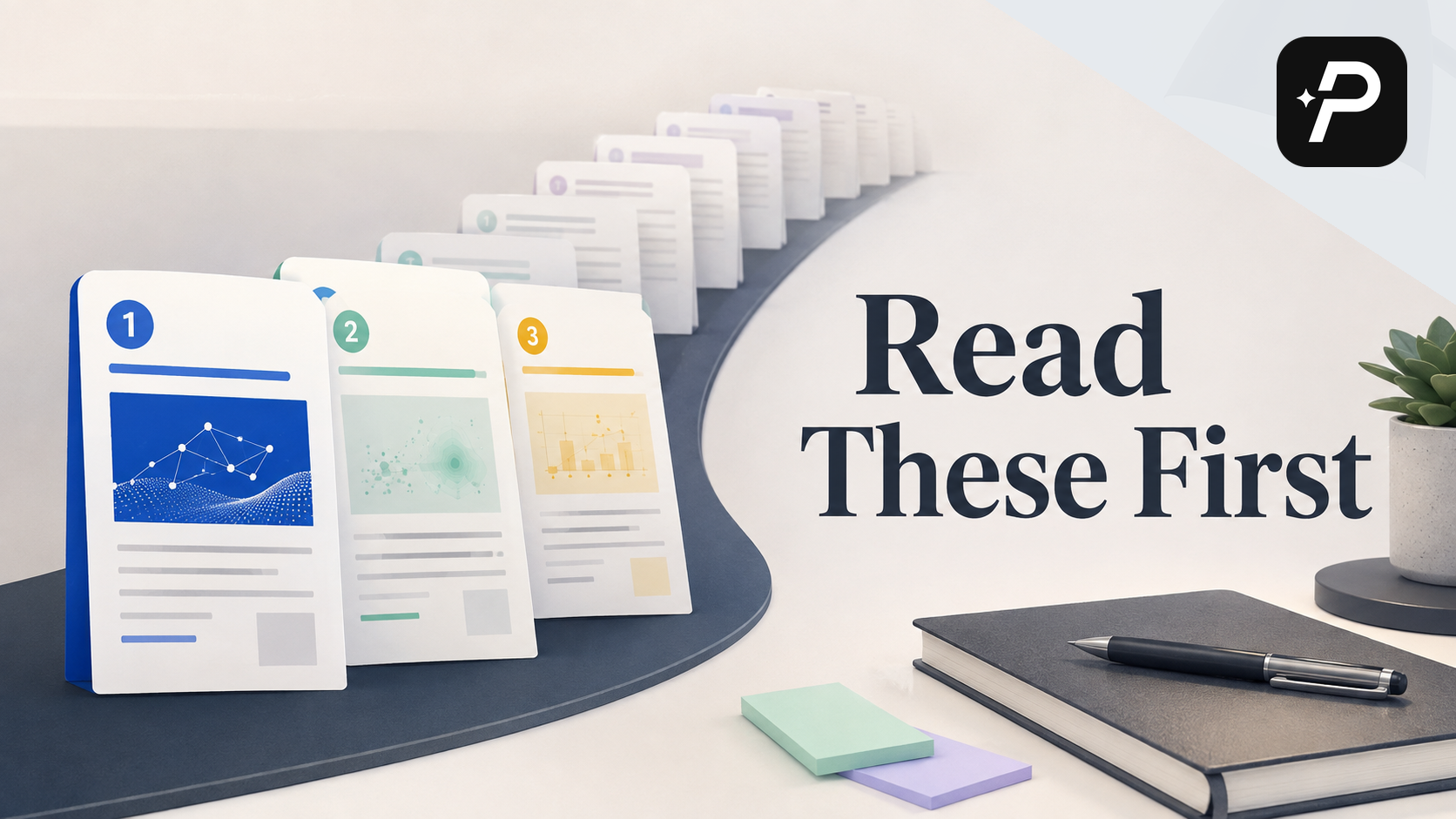
You have a new research topic, a growing pile of PDFs, and no clear idea where to start. The search results are overwhelming, your advisor sent a list of "essential readings," and every paper you open references five more you have never heard of. The problem is not how to read papers. It is deciding which ones deserve your attention first.
This guide gives you a practical prioritization framework: the five paper types that matter in your first batch, a quick screening routine for spotting high-value sources, and a reading sequence that works for most thesis projects. You will also learn where AI tools can help—and where they cannot make the decision for you.
Why "Read Everything" Fails
When you are new to a field, reading broadly feels like the safe choice. You worry that skipping a paper means missing a key concept. In practice, this leads to a common failure: you spend weeks reading tangentially related work and still cannot explain the core debate in your field.
The goal of your first reading pass is not coverage. It is orientation. You need to understand the landscape before you can navigate it.
Think of it like arriving in a new city. You do not memorize every street on day one. You learn the main roads, the central square, and the neighborhoods relevant to your destination. Research reading works the same way. Your first papers should map the territory, not exhaust it.
This is also where a reading queue becomes useful. Instead of treating your reference list as a flat pile, you organize it into a sequence. Some papers are read fully, others are skimmed, and a few are set aside for later. The order matters more than the total count.
If you already have a long list of sources, the mechanics of organizing that list are covered in our guide on how to build a reading queue for a new research topic. Here, the focus is on the selection logic—which papers earn a spot in that queue.
The Five Paper Types You Need in Your First Batch
Not all papers serve the same purpose. When you are deciding which research papers to read first, sort them into five functional categories. Each category answers a different question.
1. Review Papers (The Map)
A review paper summarizes a body of research. It tells you who the major contributors are, what debates exist, and where the field is heading. This is your single best starting point.
Read the abstract and the conclusion first. If the review is recent—within the last 2–3 years—it will point you to the most influential older work. You do not need to read every citation, just the ones that appear repeatedly.
2. Seminal Papers (The Landmarks)
These are the papers that defined the field. They are cited constantly, often with phrases like "classic work by..." or "building on the foundational study of...". You need to know these because everyone else assumes you do.
Seminal papers are not always the most readable. They may be dense, methodologically dated, or written in a style that feels foreign. Read them for the ideas, not the details. If you struggle, find a secondary source—a textbook chapter or a blog post—that explains the contribution in plain language.
3. Recent Papers (The Current State)
A field changes quickly. A review from 2018 may be outdated by 2024. You need at least 3–5 papers from the last two years to understand what is happening now.
These recent papers also show you the current methods, data sources, and open questions. They are often easier to read because they assume less background knowledge.
4. Methods Papers (The Toolkit)
If your project involves a specific technique—a statistical model, an experimental setup, a data collection protocol—you need the methods paper that introduced or standardized it.
Read these carefully. Unlike a review, you cannot skim the details. You need to understand the procedure well enough to replicate or adapt it. Highlight the equations, the assumptions, and the limitations.
5. Direct-Fit Papers (The Gap)
These are the papers that are almost your research question. They study the same population, use the same variables, or address the same gap you plan to fill.
Direct-fit papers are your most important sources. They define your contribution. If you find a paper that answers your exact question, you need to adjust your scope. If you find a paper that almost answers it, that is your opportunity.
How to Spot a High-Value Paper in 60 Seconds
You do not need to read a full paper to know if it belongs in your first batch. Use a quick screening routine.
Step 1: Read the title. Does it mention your core concepts? If not, skip it for now.
Step 2: Read the abstract. Look for three things: the research question, the main finding, and the method. If the abstract does not clearly state these, the paper may be poorly written—a warning sign.
Step 3: Check the publication venue. Is it a peer-reviewed journal, a top conference, or a preprint server? Preprints are valuable for timeliness but have not been reviewed. Weigh them accordingly.
Step 4: Look at the citation count (with caution). A high citation count suggests influence. A low count does not mean the paper is weak—it may be too new or too niche. Use citations as a signal, not a verdict.
Step 5: Skim the figures and tables. Visuals often communicate the core finding faster than the text. If the figures make sense, the paper is likely worth your time.
This 60-second screen helps you avoid the trap of downloading 50 PDFs and reading none of them. It also feeds directly into your reading queue. For a deeper look at managing the volume, see our guide on how to avoid source overload in a literature review.
The Order of Operations: A Suggested Reading Sequence
Once you have identified your five paper types, you need a sequence. Here is a practical order that works for most thesis projects.
Step 1: Read the Review Paper First
Spend 1–2 hours on the most recent review paper in your area. Take notes on the key themes, the major authors, and the open questions. This gives you a mental scaffold.
Step 2: Read the Seminal Papers Second
Now that you have the map, visit the landmarks. Read them in chronological order. Notice how the field evolved. Pay attention to what the seminal paper did not address—that is often where your opportunity lies.
Step 3: Read the Recent Papers Third
With the historical context in place, read the recent work. Compare it to the review paper. What has changed? What new methods have emerged? What debates are still unresolved?
Step 4: Read the Methods Papers Fourth
Only read methods papers when you need them. If your project does not use a specific technique, you can skip this category entirely. If it does, read the methods paper just before you start designing your own study.
Step 5: Read the Direct-Fit Papers Last
The most relevant papers should be read last, when you have enough context to appreciate their contribution. Read these slowly and critically. They are your closest neighbors, and you need to know exactly where they end and where you begin.
When to Read Papers vs. When to Read Textbooks
A common question from early-stage researchers is whether to read textbooks or research papers first. The answer depends on your current knowledge level.
Read a textbook when:
- You do not understand the basic terminology.
- You cannot follow the abstract of a review paper.
- You need a broad, stable foundation before engaging with cutting-edge work.
Read research papers when:
- You understand the basics and need current findings.
- You are ready to identify a specific gap.
- You need to cite sources in your own writing.
A good strategy is to use a textbook as a reference, not a cover-to-cover read. Look up the chapters that explain concepts you encounter in papers. This is more efficient than reading a 500-page textbook before touching a single paper.
Using AI Tools to Prioritize Without Losing Control
AI-assisted research tools can help you decide which research papers to read first, but they require a clear workflow. The risk is that you outsource your judgment entirely.
Use AI for Screening, Not Selection
AI tools like Deep Search can search academic literature using a natural-language research question. Instead of crafting a complex Boolean query, you type: "What are the recent findings on sleep deprivation in medical residents?" The tool returns a set of candidate papers.
This is excellent for the discovery phase. It saves you hours of database searching. However, the tool does not know your specific research question, your advisor's preferences, or your project's constraints. You still need to apply the 60-second screen.
Use Library QA for Comprehension
Once you have saved papers to your library, Library QA can answer questions based on the papers you have uploaded. If you are unsure whether a paper addresses your topic, you can ask: "Does this paper discuss the effect of X on Y?" The answer helps you decide whether to read it fully.
This is useful for the screening phase, but again, the final decision is yours.
Use Scholar Agent for Exploration
Scholar Agent helps you explore research questions and paper directions inside the search workflow. If your topic is too broad or too narrow, it can suggest related angles. This is helpful when you are still shaping your research question.
The key principle is to use AI as a filter, not a replacement for your own reading. You still need to understand the arguments, evaluate the evidence, and situate your work in the field. For a broader look at how AI tools fit into your workflow, compare the AI answer engine vs research library: which do researchers need?
Building a Conceptual Framework as You Read
As you read your first batch of papers, you should be building a conceptual framework. This is a visual or written representation of the key concepts, their relationships, and the gaps you have identified.
Your framework does not need to be perfect. It just needs to capture the main ideas you are encountering. Start with a simple diagram: put your main research question in the center, then add the key variables, theories, and debates you find in the literature.
This framework serves two purposes. First, it helps you remember what you have read. Second, it reveals the connections between papers—connections that are not always obvious when you read them in isolation.
For a step-by-step guide on this process, see how to build a conceptual framework from literature. The framework becomes your roadmap for the rest of your literature review.
Common Mistakes When Choosing Your First Papers
Even with a clear strategy, researchers make predictable mistakes. Here are the ones to avoid.
Mistake 1: Starting with the Most Recent Paper
New papers are tempting because they feel current. But without context, they are hard to understand. You end up chasing references backward, spending more time than if you had started with the review.
Mistake 2: Reading Papers in Alphabetical Order
Your reference manager sorts alphabetically, but that is not a reading order. It is a storage order. Always read by priority, not by convenience.
Mistake 3: Skipping the Methods Section
Early-stage researchers often skip methods because they seem boring or technical. This is a mistake. The methods section tells you how the authors collected and analyzed data. It is the foundation of the paper's credibility.
Mistake 4: Trying to Read Every Paper on Your List
You will not read every paper you find. That is normal. Your goal is to read the papers that matter most. The rest can be skimmed, summarized, or cited without full reading.
Mistake 5: Reading Without Taking Notes
If you are not taking notes, you are not reading for a thesis. You are reading for pleasure. For a research project, every paper should produce some output: a summary, a quote, a critique, or a connection to your framework.
How to Build a Synthesis Matrix Along the Way
As your reading list grows, you need a way to compare papers systematically. A synthesis matrix is a table where each row is a paper and each column is a theme, method, or finding.
For example, if you are studying the impact of remote work on productivity, your columns might be:
- Study population
- Method (survey, experiment, case study)
- Main finding
- Limitations
Fill in the matrix as you read. After 10–15 papers, patterns will emerge. You will see which findings are consistent, which are contested, and where the evidence is thin.
This matrix is also the foundation of your literature review chapter. It helps you move from summarizing individual papers to synthesizing the field. For a detailed walkthrough, see how to build a synthesis matrix for a literature review.
Preparing for Your Supervisor Meeting
Your first supervisor meeting after starting your reading is a critical milestone. You need to demonstrate that you have made progress, but you also need to signal where you need help.
Before the meeting, prepare a short document that includes:
- Your research question (even if it is still rough)
- The 5–10 papers you have read so far
- A one-sentence summary of each paper
- The gaps or contradictions you have noticed
- Two or three specific questions for your supervisor
This preparation shows that you are taking the project seriously. It also gives your supervisor a concrete basis for feedback. Instead of vague advice like "read more," they can point to specific papers or suggest a different angle.
For a complete workflow, see how to prepare for a supervisor meeting with an AI literature review workflow. The goal is to make the meeting productive rather than simply report what you have done.
Your First Reading Session: A Simple Action Plan
You have the strategy. Now here is a concrete plan for your next 90 minutes.
Minutes 0–15: Search for a recent review paper in your field. Use Deep Search or your library database. Download the top candidate.
Minutes 15–30: Read the review paper's abstract, introduction, and conclusion. Note the key themes and the most-cited older papers.
Minutes 30–45: Choose 3–5 seminal papers from the review's reference list. Download them. Skim the abstracts.
Minutes 45–60: Choose 2–3 recent papers (last 2 years) that cite the seminal work. Download them.
Minutes 60–75: Create a new folder in your reference manager called "First Batch." Move these papers into it.
Minutes 75–90: Write a short paragraph summarizing what you have learned so far. Note any questions or gaps you have identified.
This is your starting point. From here, you can build your reading queue, develop your conceptual framework, and prepare for your supervisor meeting.
The question of which research papers to read first does not have a single answer. It depends on your field, your project, and your current knowledge. But the process is always the same: start with a map, visit the landmarks, check the current state, and then dive into the details. Follow that sequence, and you will never feel lost in the literature again.
FAQs
Keep Reading
How Many Papers Do You Need for a Literature Review?
If you are planning a literature review, the first question is usually "How many papers do I need?" It is a practical question, and you want a practical answer. The honest answer is that there is no single number that wo
How Do You Know When You've Read Enough Papers?
You are three weeks into your literature review. Your reference manager holds 87 papers. You still cannot say with confidence whether you can start writing. Each new database query surfaces another seemingly essential ar
How to Research a Topic You Know Almost Nothing About
Starting a thesis, dissertation, or major research paper on a subject you have never studied feels different from other academic work. You do not know the key terms, the major debates, or even which authors matter. The u