
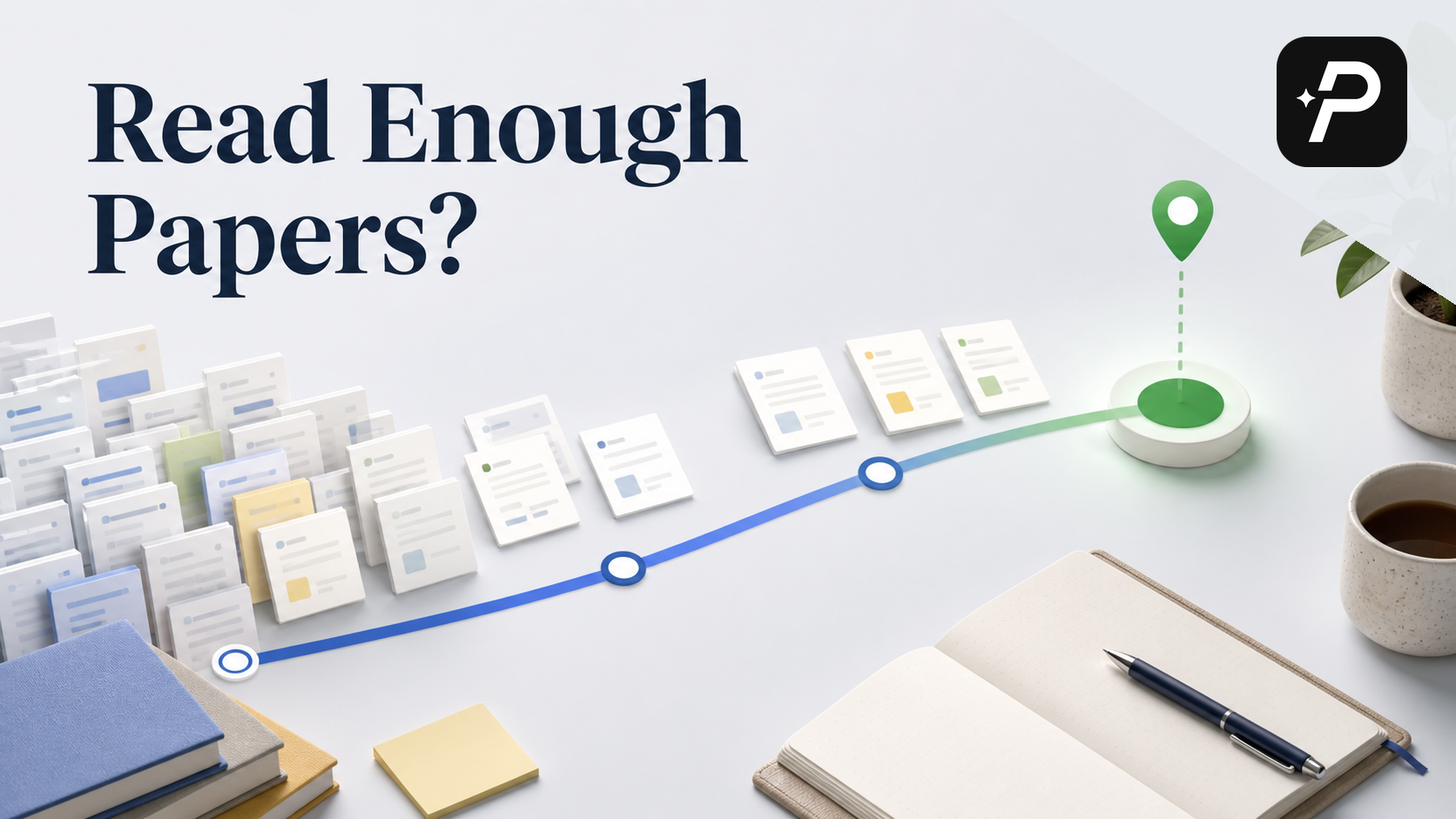
You are three weeks into your literature review. Your reference manager holds 87 papers. You still cannot say with confidence whether you can start writing. Each new database query surfaces another seemingly essential article, and the fear of missing a foundational study keeps you clicking.
This uncertainty is not a sign of poor planning. It is a structural feature of academic research. No official certificate declares your reading complete. But there are practical signals—patterns in what you are finding, how you are synthesizing, and what your sources are telling you—that indicate you are ready to move forward.
This guide will help you identify those signals, distinguish between "enough to start writing" and "enough to stop searching forever," and build a monitoring system that lets you proceed with confidence.
The Myth of the "Complete" Literature Review
Many students assume that a proper literature review requires reading every paper ever published on their topic. This belief creates paralysis. If you are researching a narrow niche, you might realistically cover 90 percent of the relevant work. But most thesis topics sit at the intersection of multiple fields, and the scholarly output is simply too vast.
Consider how academic publishing works. A single well-studied topic can generate hundreds of papers per year. Even a focused subtopic—say, the effects of gamification on adult learning motivation—will have dozens of new publications annually. No human can read all of them, and no human needs to.
What you actually need is coverage of the key debates, methods, and findings that shape your research question. You need to understand the major schools of thought, the landmark studies that everyone cites, and the recent work that reflects the current state of the field. This is a much more bounded task than "read everything."
The shift in mindset matters because it changes your stopping rule. Instead of asking "Have I read every paper?" you ask "Have I read enough to synthesize the field?" That question has observable answers. When you start noticing that new papers are telling you things you already know, you have reached a practical saturation point.
The Saturation Signal: When New Papers Stop Surprising You
The most reliable sign that you have read enough is the diminishing returns of each new source. Early in your reading, every paper feels revelatory. You encounter new frameworks, conflicting findings, and methodological approaches you had not considered. This is the steep part of the learning curve.
As you progress, the curve flattens. You start reading abstracts and thinking, "This is basically the same argument as the Smith et al. study, just with a different sample." You see the same citations repeated in the introductions. The "novel" contributions begin to look like variations on themes you already understand.
This is not a sign that you are reading bad papers. It is a sign that you have absorbed the field's core structure. When you can predict what a paper will argue based on its title and author affiliations, you have internalized the landscape.
To test this signal, try a simple exercise. Before reading the full text of a newly found paper, write down your prediction: What will the research question be? What methods will they use? What will they conclude? If your predictions are consistently accurate, you have reached saturation. The field is no longer surprising you because you understand its logic.
This does not mean you should stop reading entirely. It means you can stop searching and start writing, while keeping a light monitoring process for genuinely novel work.
The Citation Web Test: Recognizing the Core Canon
Another practical test involves the citation patterns in your sources. Every field has a set of foundational papers that appear repeatedly in reference lists. These are the works that define concepts, introduce methods, or settle debates. When you have read enough, you will recognize these recurring citations.
Here is a diagnostic exercise. Take your five most recent papers and examine their reference lists. Count how many citations appear in at least three of the five. If you see a consistent core of 10 to 15 papers that everyone cites, check whether you have read them. If you have, you have likely covered the essential canon.
The absence of a citation web is also informative. If your sources rarely cite each other, you may be pulling from disconnected subfields. This could mean your topic is interdisciplinary—which is fine—or it could mean your search strategy is missing a central conversation. In the latter case, you need to refine your search terms before you can claim sufficient coverage.
WisPaper's Deep Search can help with this process by allowing you to ask a natural-language research question instead of constructing a complex Boolean query. The tool surfaces academic literature that matches your conceptual interests, which can help you discover the citation networks you might be missing.
The "No New Names" Rule for Authors and Research Groups
Beyond individual papers, pay attention to the authors and research groups that dominate your topic. Most fields are shaped by a handful of active labs or scholars. If you have read papers from the same five or six research groups multiple times, and their names keep appearing in your search results, you have likely mapped the influential players.
The "no new names" rule is simple: when your last 20 or 30 search results contain no authors you have not already encountered, your search is nearing exhaustion. This is different from reading every paper. It is recognizing that the field's production is concentrated among a recognizable set of contributors.
This rule has a caveat for interdisciplinary work. If your topic bridges two fields, you will see two distinct sets of authors. You need to reach the "no new names" threshold within each field, not only one. A paper that applies machine learning to historical archives, for example, requires familiarity with both the computer science literature and the relevant history scholarship.
If you are struggling to identify the key authors in a secondary field, consider using a Scholar Agent to explore research directions. These AI tools can suggest related angles and help you understand how different scholarly communities approach a similar problem.
Thematic Saturation: Covering the Debates, Not Only the Topics
Reading enough depends on more than quantity or author coverage. It is about thematic completeness. Your literature review should reflect the major debates and disagreements in your field, rather than only the papers that support your preferred argument.
Ask yourself these diagnostic questions:
- Do I understand the main methodological controversy in my field?
- Can I articulate at least two opposing viewpoints on my research question?
- Have I read papers that use different research designs (qualitative, quantitative, mixed methods)?
- Do I know which findings have been replicated and which remain contested?
If you can answer "yes" to these questions, you have achieved thematic saturation. You understand the field as a set of arguments rather than a list of facts. This is the level of understanding required for a strong literature review, because a literature review is not a summary—it is a structured argument about what is known and what remains unknown.
When you reach this stage, you may notice that your own research question has sharpened. The vague "I want to study X" becomes "I want to test whether explanation A or explanation B better accounts for X in this specific context." This refinement is a sign that your reading has done its job.
If you are unsure whether your themes are sufficiently deep, WisPaper's thematic synthesis guidance offers strategies for moving beyond surface-level categorization. The risk for many students is creating themes that are merely descriptive ("papers about method A," "papers about method B") rather than analytical ("papers that assume rationality," "papers that challenge rationality").
The "So What?" Test: Connecting Sources to Your Argument
A literature review is not an end in itself. It exists to justify your research. Therefore, a practical test for reading sufficiency is whether you can explain why each source matters for your specific project.
Try this exercise. Create a document with your research question at the top. Below it, list your main sources. For each source, write one sentence explaining its role: "This paper provides the baseline method I will adapt," or "This paper represents the view I am challenging," or "This paper identifies a gap that my study addresses."
If you can assign a clear role to most of your sources, you have enough material to build your argument. If you have a pile of papers that all serve the same function—say, 15 papers that all show a correlation between social media use and anxiety—you may have depth in one area but gaps in others.
The "so what?" test also helps you identify which papers to read deeply versus which to skim. Not every source deserves a full close reading. Some papers are relevant only for a single statistic or a passing mention. Others are theoretical anchors that require careful study. Your time is better spent on the anchors.
This is where paper cards in WisPaper become useful. They display source labels, summaries, publication details, and author information, allowing you to quickly screen whether a paper is a potential anchor or merely a supporting citation. You can save promising papers to My Library and upload full texts for later reference.
How Many Papers Is "Enough"? Benchmarks by Project Type
While there is no universal number, some rough benchmarks can help calibrate your expectations. These depend on your project type and level.
For a course paper (5,000–8,000 words), 10–20 quality sources are typically sufficient. The goal is to demonstrate that you can engage with the key literature, not to exhaustively cover the field.
For an undergraduate thesis (10,000–15,000 words), 20–40 sources is a common range. You should cover the major debates and show awareness of recent work.
For a master's thesis (15,000–25,000 words), 40–80 sources is typical. At this level, you are expected to situate your work within a broader scholarly conversation and identify a clear gap.
For a doctoral dissertation, the range is wider—often 100–200+ sources—but the quality and depth of engagement matter more than the raw count. A PhD literature review is expected to demonstrate expertise, which means reading the seminal works and engaging critically with the state of the art.
These numbers are not rules. A master's thesis on a very narrow topic might require only 30 sources, while a broad comparative study might need 100. Use the benchmarks as a sanity check, not a target. If you have 50 sources for an undergraduate thesis, you may be over-reading and delaying your writing. If you have 15 for a master's thesis, you likely have gaps.
The more important question is whether your sources cover the range of perspectives your project requires. If your thesis compares educational outcomes across three countries, you need sources from each context, not only a single country's literature.
The Role of AI Tools in Knowing When to Stop
AI-assisted research tools can both help and hinder your stopping decision. Used well, they accelerate your ability to reach saturation. Used poorly, they create an illusion of completeness while obscuring gaps.
WisPaper's Deep Search is designed to search academic literature using a natural-language research question. This is useful because it allows you to explore concepts rather than keyword combinations. However, you should be aware that AI search tools have limitations in peer-reviewed literature. They may miss recent publications, struggle with highly specialized terminology, or fail to capture the nuance of a particular scholarly debate.
The practical implication is that AI tools can help you broaden your initial search and identify papers you might have missed, but they should not be your only search method. You still need to use discipline-specific databases, follow citation chains, and consult with your supervisor or subject librarian.
A more useful role for AI is in screening and organizing. When you have a large pool of candidate papers, AI can help you sort them by relevance, saving you from reading abstracts that lead nowhere. This screening process is distinct from the synthesis process. Knowing when you have screened enough is a different question from knowing when you have read enough for synthesis. WisPaper's guidance on when to stop screening in an AI-assisted review addresses the former, while this article addresses the latter.
The "Write First, Search Later" Strategy
One of the most effective ways to discover whether you have read enough is to start writing your literature review before you feel completely ready. This sounds counterintuitive, but it works for two reasons.
First, writing forces you to articulate your understanding. When you try to explain a concept in your own words, you quickly discover whether you actually understand it or are merely recognizing it. Gaps in your knowledge become visible as gaps in your prose.
Second, the act of writing often reveals what you still need. You may realize that you cannot adequately explain a methodological choice because you have not read a methods-focused paper. Or you may find that your argument requires a counterexample that you have not yet found.
This "write first, search later" strategy treats your literature review as a draft to be revised rather than a summary to be completed. You write a preliminary version based on your current reading, identify the weak spots, and then conduct targeted searches to fill those specific gaps. This is far more efficient than trying to read everything upfront.
The approach also reduces anxiety. Instead of facing the open-ended task of "reading enough," you face the bounded task of "writing a section about X." The reading becomes purposeful rather than diffuse.
When you write, you can use Library QA to ask questions based on the papers you have saved in your own library. This can help you quickly retrieve specific findings or arguments without re-reading entire papers. It is like having a research assistant who knows exactly where each claim lives in your collection.
Red Flags: Signs You Are Not Ready to Write
Just as there are positive signals that you have read enough, there are warning signs that you need to continue reading. Be honest with yourself about these red flags.
You cannot explain the basic debates. If someone asked you, "What is the main disagreement in this field?" and you cannot answer without hedging, you have not read enough. Every field has debates, and your literature review should reflect them.
Your research question keeps shifting. Some evolution is normal, but if your question changes every week because you keep discovering papers that invalidate your premise, you need more reading or a more focused question. The literature should be helping you narrow your scope, not endlessly expanding it.
You are citing only one type of source. If all your references are journal articles, you may be missing books, conference proceedings, or grey literature that are relevant to your topic. WisPaper's guidance on AI search for grey literature can help you decide what types of sources to include.
You feel defensive about your sources. If a supervisor or peer suggests a paper you have not read, and your immediate reaction is to explain why it is not relevant, pause. You may be protecting your sense of completion rather than honestly evaluating the suggestion.
Your writing feels thin. If you sit down to write and find yourself producing generic statements that could apply to any topic, you lack the specific knowledge that comes from deep reading. Your literature review should be dense with specific findings, author names, and methodological details.
Building a Monitoring System for Post-Writing Discovery
Reaching the point where you have read enough to draft your literature review does not mean you should never read another paper again. It means you shift from active searching to passive monitoring. You keep a light watch for new publications without letting the search consume your writing time.
Set up alerts for your key search terms in Google Scholar or your discipline's databases. Spend 15 minutes per week scanning new titles. If something genuinely novel appears—a paper that changes the conversation or fills the exact gap you are addressing—you can incorporate it. If nothing new appears, you proceed with confidence.
This monitoring system also extends to your writing process. When you finish a draft chapter, do a final targeted search to ensure you have not missed any recent work. This is not about reading everything; it is about checking that your review is current as of your submission date.
The monitoring mindset is healthier than the completion mindset. You are not trying to reach a finish line where no further reading is possible. You are trying to reach a point where your reading has given you enough to make a genuine contribution. That contribution—your argument, your analysis, your synthesis—is the goal. The reading is in service of it.
FAQs
Keep Reading
How to Research a Topic You Know Almost Nothing About
Starting a thesis, dissertation, or major research paper on a subject you have never studied feels different from other academic work. You do not know the key terms, the major debates, or even which authors matter. The u
How to Find Seminal Papers in an Unfamiliar Field
You have a new research topic, and everyone around you seems to know something you do not. They reference the same few studies in passing, assuming you have read them. You have not. Nobody handed you a reading list, and
How to Read a Research Paper for the First Time
Opening a research paper for the first time can feel overwhelming. The dense paragraphs, unfamiliar jargon, and complex data visualizations make many students wonder if they are missing some secret skill. The truth is, r