
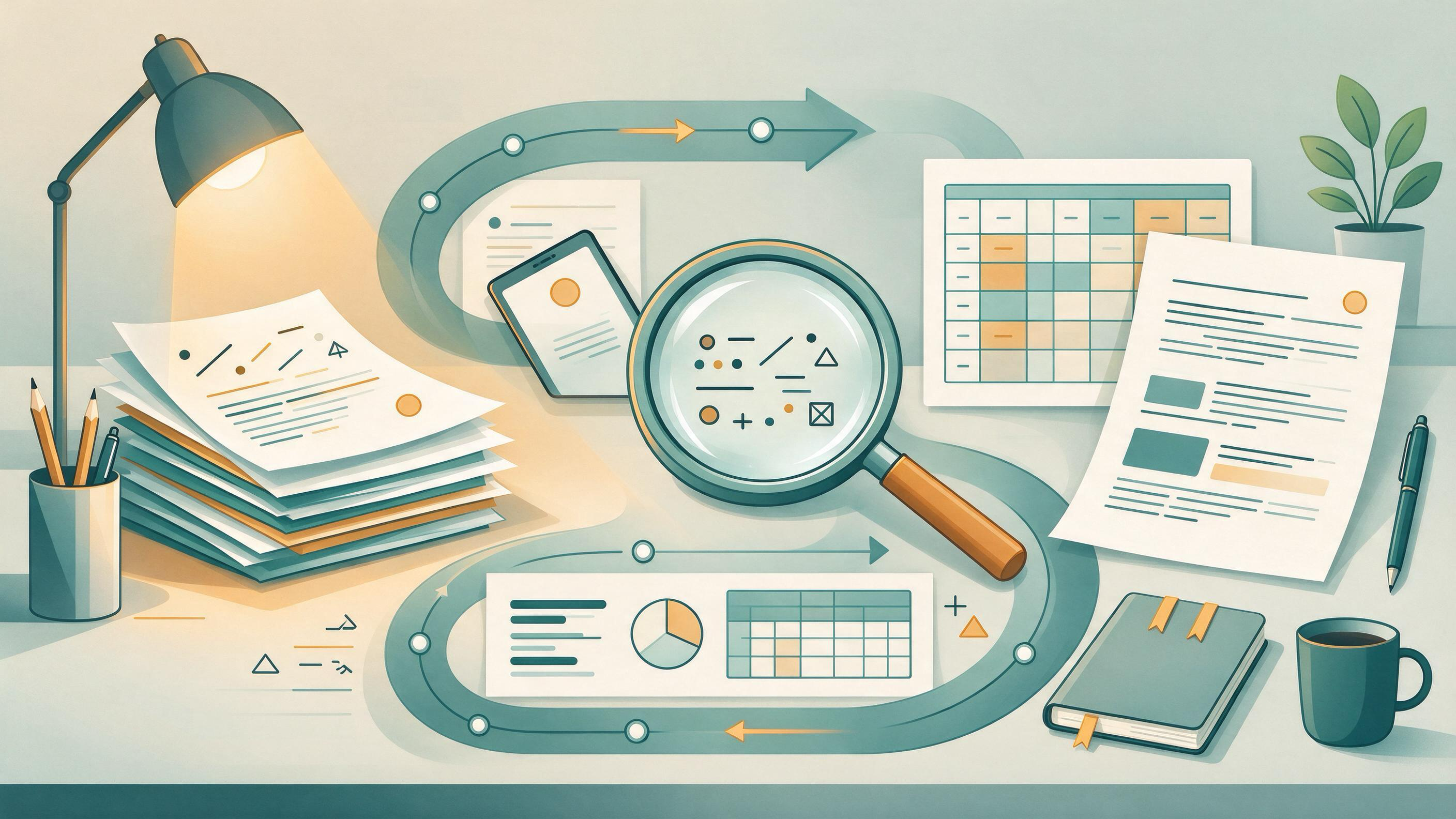
When you are finishing a course paper, a thesis chapter, or a first manuscript, the pile of papers you need to read can feel like the real bottleneck. The practical question behind "abstract-first vs. methods-first" is not which reading order is universally correct. It is which order fits the job in front of you: deciding whether a paper belongs in your project, or deciding whether its methods can support a claim you want to make.
This article compares both strategies on the same task, shows where each one breaks down, and gives you a decision table plus a combined workflow. It ends with a concrete next action you can take today, whether you are cleaning up a winter-break reading list or starting a January project.
What the two strategies actually mean
Abstract-first reading starts with the title, abstract, and keywords, then moves to the introduction and conclusion before deciding whether to read further. You use it to triage: does this paper address my question, population, or method closely enough to earn more of my time?
Methods-first reading starts with the methods and results sections. You use it when you already know the paper is relevant and you need to judge whether its design, data, and analysis can support the claim you want to build on.
The two are not rivals so much as stages. The mistake is applying one stage's logic to the other stage's job: reading methods in full for a paper that will never enter your project, or citing a paper from its abstract alone when your argument depends on how it was done.
Diagnose your starting state before you choose
Before picking an order, answer three questions about your current task.
- What decision are you making? If you are deciding whether to include a paper, you are screening. If you are deciding how to use a paper, you are appraising.
- How defined is your question? A vague topic needs broad triage. A specific claim needs targeted methods reading.
- What artifact must come out the other end? A reading list, a screening log, a methods comparison table, or a paragraph of your manuscript each demand different evidence.
A student finishing a thesis chapter usually needs both: a defensible set of included papers and a clear account of how key studies were done. A student starting a January project may only need the first for now.
Abstract-first reading: fast triage and where it fails
Abstract-first reading is efficient because abstracts are written to summarize scope, approach, and headline findings. It lets you process many records quickly and defer deep reading to the papers that survive.
It fails in predictable ways. Abstracts compress methods, so a design limitation or a small sample may not surface. Abstracts also vary in how much they report, so two papers can look equally relevant at the abstract level while differing sharply in rigor. If your manuscript's argument rests on a specific procedure or comparison, an abstract-only decision leaves you without the detail you need to describe or defend it.
Use abstract-first reading when you are building or pruning a candidate set, not when you are writing the sentence that depends on the paper.
Methods-first reading: depth and where it fails
Methods-first reading gives you the information that determines whether a study can carry the weight you want to place on it: how participants or materials were selected, what was measured, and how results were analyzed. It is the right entry point when a paper is already a strong candidate and your claim depends on its execution.
Its failure mode is cost. Reading methods in full for every record does not scale, and it can pull you into detail on papers that will not survive screening. It also assumes you already know the paper is relevant, which is often not true early in a project.
Use methods-first reading for the shortlist, and for any paper you plan to cite in a methods or comparison passage.
Compare both strategies on the same task
Imagine you are finishing a thesis chapter and have a folder of candidate papers. Here is how each strategy handles the same four criteria.
| Criterion | Abstract-first | Methods-first |
|---|---|---|
| Speed to a shortlist | Fast; suited to many records | Slow; better once the list is small |
| Fit to your research question | Good at scope-level fit | Weak as a first filter |
| Judgment of study execution | Deferred; abstracts compress methods | Strong; design and analysis visible |
| Support for a methods claim | Insufficient alone | Appropriate |
| Best moment to use | Building and pruning the candidate set | Appraising shortlisted papers you will cite |
Neither column wins outright. The table shows a division of labor: abstract-first for inclusion decisions, methods-first for appraisal decisions.
A decision table for your next reading session
Use this to choose an order for the next hour, not for the whole project.
| Your situation | Start with | Then |
|---|---|---|
| Topic still broad; many candidates | Abstract-first | Methods-first on the shortlist |
| Supervisor asked why a study is in your chapter | Methods-first | Confirm scope against the abstract |
| Writing a methods or comparison paragraph | Methods-first | Cross-check the abstract's framing |
| Cleaning up a winter-break reading list | Abstract-first | Methods-first only for papers you will cite |
| Starting a January project | Abstract-first | Methods-first once your question narrows |
Build the artifacts that make either order work
Reading order only pays off if it produces something you can reuse. Three artifacts carry most of the value.
A screening log. For each candidate, record the decision (include, exclude, maybe) and the reason. This is what lets you explain your selection later and avoid re-reading the same paper.
A methods comparison table. For shortlisted papers, capture design, sample or materials, measures, and analysis in parallel columns. This turns methods-first reading into a draftable comparison rather than scattered notes.
A citation record. Keep the reference details attached to each included paper so that writing and citation checking do not become a separate cleanup job.
If you are organizing papers across several chapters or projects, a tool that lets one item sit in multiple groupings without duplication saves you from maintaining parallel folders. Zotero collections work this way, and tags can describe topic, method, status, or workflow.
Where WisPaper fits into the workflow
WisPaper is an AI research assistant for finding, screening, organizing, and working with academic papers. It fits naturally at specific steps rather than replacing your reading decisions.
Finding candidates. When your question is defined enough to search, use WisPaper search to find academic papers through its scholarly search interface. If you want a public entry point first, the WisPaper Scholar Search page explains and opens the paper-finding flow.
Organizing the shortlist. Once papers survive abstract-first triage, save or upload them in My Library so your candidate set and your notes live together.
Asking questions across your saved papers. When you have a set of uploaded or saved papers and want to compare them, Library QA lets you ask questions based on papers in My Library or added from search results. This is a natural companion to methods-first reading: you can query the shortlist while you build your comparison table.
Checking references before submission. Before you finalize a reference list, TrueCite screens BibTeX citations against real academic databases to flag hallucinated references.
Longer synthesis tasks. If your next step is a broader literature review rather than a single chapter, Scholar Agent supports longer research tasks in its literature review, inspiration, or reproduction use cases.
Each of these connects to a specific decision: find, save, compare, verify, or synthesize. Pick the one that matches the step you are on.
A combined workflow for a thesis chapter or first manuscript
Here is a sequence that uses both reading orders in the right places.
- Define eligibility in writing. State what a paper must address to enter your project. Cochrane guidance recommends planning searches from eligibility criteria and documenting the process; even a course paper benefits from this discipline.
- Search and collect candidates. Use your search terms and sources, and keep a record of where records came from.
- Triage abstract-first. Read title, abstract, and keywords; log include, exclude, or maybe with a reason.
- Deduplicate and link reports. Multiple reports of one study should be linked rather than counted as separate studies.
- Appraise methods-first. For the shortlist, read methods and results and fill in your comparison table.
- Draft from the table. Write your methods and comparison passages from the table, not from memory.
- Verify citations. Check your BibTeX before submission.
- Rerun the search before you finalize. Cochrane recommends rerunning searches before publication; for a thesis chapter, a final check catches papers that appeared while you were writing.
If your work is a systematic review rather than a course paper, PRISMA 2020 provides a reporting checklist, an abstract checklist, and flow-diagram templates that make your search and selection transparent. The same transparency habits improve a smaller manuscript.
How to know your reading is ready
You are ready to move from reading to writing when three conditions hold.
- Every included paper has a logged reason. You can say why it is in and why others are out.
- Every paper you cite for a methods claim has been read at methods level. No citation rests on an abstract alone.
- Your comparison table is complete enough to draft from. Design, sample or materials, measures, and analysis are filled in for the papers your argument depends on.
If any of these is missing, the next action is specific: fill the gap in the log, read the methods section of one paper, or complete one row of the table.
A concrete next action
Pick the paper you are least sure about in your current chapter. Open its methods section, and in your comparison table record its design, sample or materials, measures, and analysis. Then check whether the abstract's framing matches what the methods actually show. If it does, mark the paper as included with a reason. If it does not, move it to your maybe list and note why. That single row is the smallest complete unit of methods-first reading, and it tells you immediately whether your current reading order is serving the chapter you are trying to finish.
FAQs
Keep Reading

AI-Generated Reading List vs. Curated Seed Library
You have a topic, a deadline, and a blank reference list. The question is how to fill it: let an AI tool generate a reading list from your topic description, or start from a curated seed library of papers you already tru

An AI-Written Background Section Sounds Convincing but Has No Evidence Map
A background section can read smoothly and still leave you unable to answer the one question a supervisor or examiner will ask: *which claim rests on which study, and how do you know?* That is the gap this article addres
Broad Topic Search vs. Feasibility Search for a New Project
You have a topic, a deadline, and a vague sense that the literature is either too large to enter or too thin to support a project. The practical question is not which search is "better" but which one you should run first