
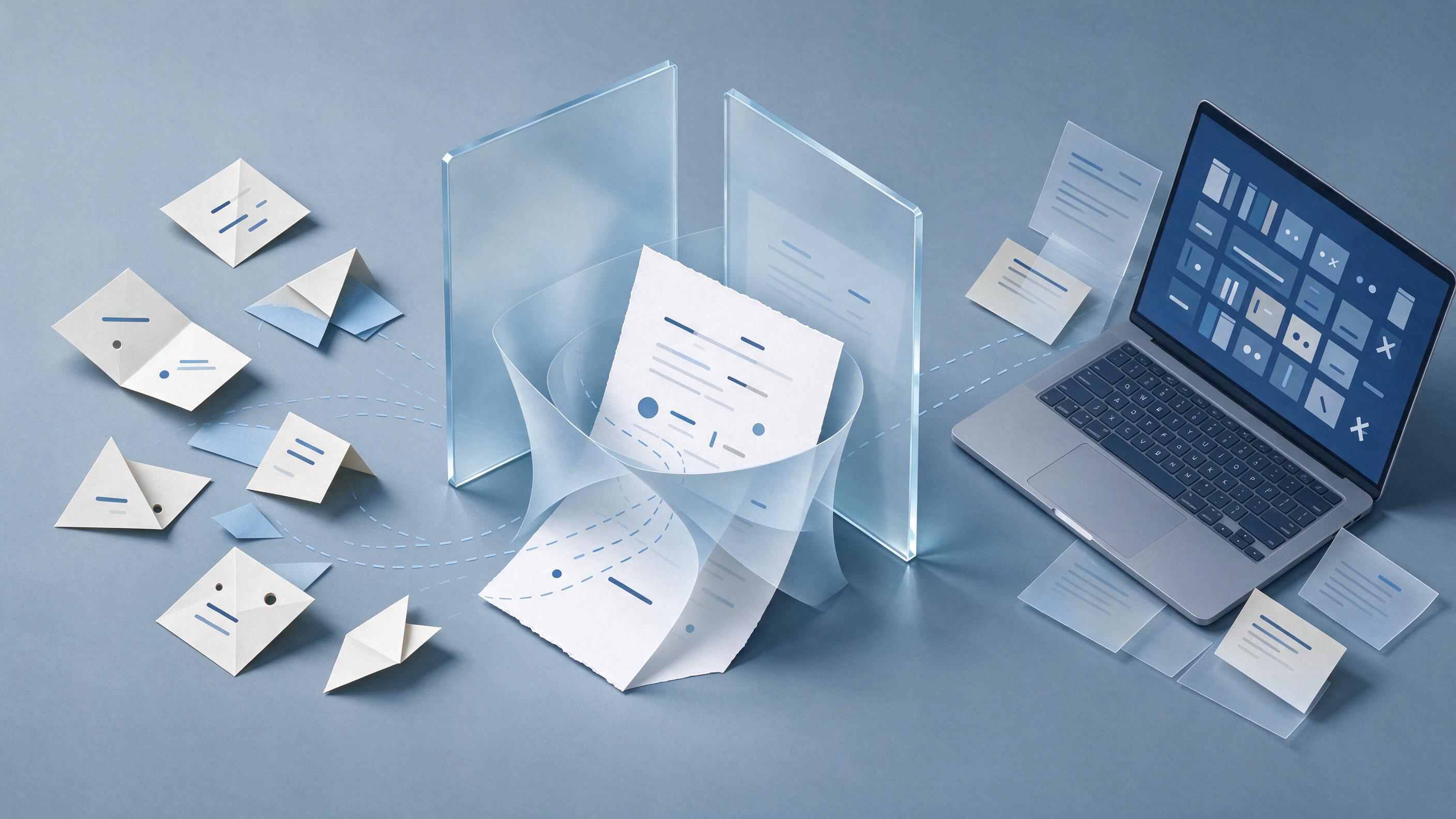
You are not really choosing between two abstractions. You are choosing how much identifying context you will expose during review, and then deciding what evidence trail you need before you send the manuscript out. Both blind and open peer review sit on a spectrum of anonymity, and both change what you should prepare, what a reviewer can see, and how you respond to the decision letter.
This article is for researchers who are revising a manuscript, closing a project, or setting up a cleaner workflow for the next submission. It treats peer review as a coordination problem: who sees what, when, and with what accountability. Along the way, it shows where a reproducible search trail and an organized evidence base become the difference between a smooth revision and a scrambled defense.
What Is the Reader's Actual Starting State?
Most researchers encounter the blind versus open question at one of three moments:
- Submission readiness. The author is reading journal instructions and must decide what to hide, disclose, or format before uploading files.
- Revision. The author holds reviewer comments and must interpret them differently depending on whether reviewers could see author names, institutions, or prior work.
- Year-end or project reset. The author is closing a project and wants to preserve the method trail before the memory of search decisions fades.
The same manuscript can need different preparation for a double-blind journal than for an open-review journal. A double-blind process asks you to remove names, affiliation lines, acknowledgments, and self-citation patterns that reveal identity. An open process asks you to make identity explicit and to treat the review record as part of the scholarly exchange. Neither is inherently more rigorous; they create different failure modes.
How Do Blind Review and Open Peer Review Actually Differ?
Blind peer review hides author identity from reviewers, and sometimes hides reviewer identity from authors. Open peer review can take several forms: open identities, published review reports, or both. The journal's implementation, not the umbrella label, determines what you must prepare.
COPE frames peer review as dependent on trust and lists ethical expectations around confidentiality, conflicts, objectivity, timeliness, and constructive assessment. That trust operates differently under each model:
- In blind review, trust flows through the editor. Reviewers trust that the editor has screened for conflicts among known authors. Authors trust that reviewers will evaluate the manuscript rather than the authors.
- In open review, trust is distributed. Both parties can see more context and are accountable for how they use it. The published record becomes evidence of the review conversation.
The practical difference for a revising author is what you can leverage. In blind review, you cannot defend your work by pointing to your lab's reputation; the manuscript must carry the argument. In open review, reviewer comments may engage your prior papers by name, and your responses can reference that shared history explicitly.
What Should You Prepare Before Choosing a Track?
Start by separating three artifacts that often get tangled during revision:
- The manuscript text that will be reviewed.
- The supporting evidence trail behind its claims, search strategy, and data decisions.
- The disclosure bundle that changes depending on blind or open expectations.
The ICMJE recommendations point authors to the selected journal's current instructions for article type, format, required statements, and submission materials. That is the decisive text. Read the journal's reviewer guidance and author instructions for the specific article type before preparing either a blinded file or an open-disclosure file.
A useful workflow is to build the evidence trail independently of the manuscript format. Save the papers that anchor each major claim, the search queries that produced them, and the selection decisions you made. WisPaper's My Library gives you a place to save or upload those papers and organize them so the trail is not scattered across downloads and browser tabs. When the journal later changes a formatting rule, you can re-export the submission bundle without rebuilding the underlying evidence.
How Does a Reproducible Search Trail Change Your Submission?
A search trail matters most when a reviewer or editor questions the scope of your references. The question is rarely "did the author find the right papers?" and more often "can I reproduce or audit how these papers were selected?"
NIH frames scientific rigor as strict application of the scientific method, including transparent design, methods, analysis, interpretation, and reporting. A search strategy is part of methods and reporting even when it sits in an appendix or a PRISMA-style flow. The catch is that a search strategy written after the fact is easy to rationalize. A search trail captured while you work is harder to fake.
When you search for academic papers through WisPaper search, keep a simple dated log: database or interface, query string, filters applied, result count, and the selection rule that moved a paper into the working set. This log becomes the audit spine whether the journal uses blind review or open review. In open review, a published reviewer may ask for exactly this log; in blind review, an editor may forward the same request without revealing the reviewer.
What Does Submission Readiness Look Like for Each Model?
A blinded submission is ready when a knowledgeable colleague scanning only the manuscript cannot infer author identity from the text itself. Check the common leaks:
- Author names and affiliations in headers, footers, or file metadata.
- First-person references to "our earlier work" or "as we showed in our 2021 paper."
- Self-citations that form an unusual cluster.
- Acknowledgments, funding lines, or ethics statements that name institutions.
- Supplementary files with author-identifying fields.
An open submission is ready differently: it should be explicit about who did the work and coherent about what prior contributions this manuscript builds on. The failure mode flips. In blind review, an accidental identity reveal can undermine trust in the process. In open review, an incomplete disclosure can look evasive.
The shared readiness test is the same: can you assemble, for each major claim, the source paper and the retrieval path? If you can, you are ready for either track. If you cannot, that gap will surface under either model, just through a different channel.
How Do You Interpret Reviewer Comments Under Each Model?
Under double-blind review, reviewer comments cannot directly reference your identity, but they can still encode assumptions about who you are. A comment like "the authors should engage the foundational work in this area" may be fair, or it may reflect a hidden guess about your field. Your response should anchor to the manuscript's internal logic rather than to external reputation.
Under open review, comments can engage your prior work by name. That is an advantage when the prior work is central, and a risk when the reviewer's engagement is with your profile rather than the current argument. In both cases, the response document should map each reviewer point to a specific manuscript change and, where relevant, to the evidence that supports the change.
When comments demand new references, do not add them from memory. Re-run the supporting search, record the new query, and add the references you can actually retrieve. WisPaper's Library QA lets you ask questions based on papers you have uploaded to My Library or added from search results, which helps you check whether a suggested source actually supports the claim a reviewer is asking you to address.
What Is the Failure Mode for a Reference List, and How Do You Catch It?
A reference list assembled during a rushed revision can contain entries that look plausible but cannot be located. This matters in both review models, but it hurts more in open review, where the reference list itself may be published alongside the review reports and become part of the citable record.
The failure is often not intentional fabrication; it is the accumulation of small formatting and memory errors. A BibTeX export can carry an incomplete field, a preprint can be mixed with its published version, or a citation manager can autocomplete a record that does not match any real database entry.
The check is mechanical and should happen before submission, not after a reviewer flags it. TrueCite screens BibTeX citation entries against real academic databases to flag references that cannot be verified. Run this pass on the final reference list, then re-check any flagged entry against the source you actually read. This is a submission-readiness step, not a post-review repair.
Can You Use the Same Workflow for Both Models?
Yes, if the workflow separates three layers:
- Evidence layer: the papers, queries, and decisions, kept independent of the journal's formatting.
- Manuscript layer: the blinded or openly attributed text that the journal will review.
- Disclosure layer: the statements, acknowledgments, and review-model disclosures that change per journal.
Researchers switching between journals often lose time because they collapse these layers. A manuscript prepared for open review needs de-identification before a double-blind submission; a blinded file needs attribution restored before an open submission. If the evidence layer is intact, both transformations are largely mechanical.
One practical move is to keep the evidence layer in a project rather than in the manuscript folder. Research Projects gives you a workspace for a named research effort, so the search log, the screened paper list, and the revision notes stay connected to the work rather than to a single file. The manuscript and disclosure layers can then be re-exported for each target journal without disturbing the audit trail.
When Does an Open Review Record Become a Research Asset?
Open peer review can produce a review record that is itself citable and useful to future readers. This changes the author's revision calculus: your response letter is not only a private negotiation with an editor, but a semi-public artifact that may explain the paper to someone encountering it later.
That is an asset if you treat it as one. The response letter should be written as an argument about the evidence, not as a defensive list of concessions. Each reviewer point should be paired with the change made, the location of the change, and the source or reasoning behind it. Where the reviewer is wrong, that disagreement should be documented with the same care as the manuscript itself.
The COPE expectations for reviewers include constructive assessment. An author who writes a clear response document makes it easier for the editor to see whether that constructiveness was present and whether the disagreement is substantive. The review record, when published, then becomes part of the paper's evidentiary context rather than a hidden negotiation artifact.
What Does a Combined Workflow Look Like?
A combined workflow takes the same researcher through blind and open tracks without rebuilding the evidence base:
- Baseline search and screening. Run the literature search, log queries and result counts, and move eligible papers into My Library.
- Evidence QA. Screen the reference list with TrueCite before the first submission, not after a reviewer flags a problem.
- Manuscript preparation per journal. Build the blinded file or the open-disclosure file from a master copy, applying only that journal's formatting rules.
- Evidence retrieval during revision. When reviewers request sources, re-run the relevant search and verify before adding.
- Decision-specific closeout. After acceptance, archive the search log, the screened set, and the final reference list together so the method trail survives the project close.
The test of readiness at every stage is the same: someone who did not do the work should be able to follow the trail from a claim in the manuscript to a retrievable source and a dated decision. If that trail exists, the blind versus open choice becomes a formatting and disclosure decision rather than a source of anxiety.
FAQs
Keep Reading
Coauthor Approval by Email vs. Shared Sign-Off Sheet: Which Keeps Your Research Submission Ready?
When a client deck, decision memo, or project closeout is waiting on coauthor sign-off, the question is rarely philosophical. It is operational: which approval method closes the loop with fewer missed replies, less versi
Confidence Interval vs. Standard Error: Which One Does Your Results Section Need?
If your supervisor has asked for clarity on your quantitative results, you are probably deciding between reporting a confidence interval, a standard error, or both. The two terms describe different things, and choosing t
Cover Letter vs. Manuscript Highlights: Which One Actually Moves Your Submission Forward?
When a course paper becomes a journal manuscript, two short documents suddenly appear on the checklist: the cover letter and the manuscript highlights. They are not interchangeable, and treating them as if they were is o