
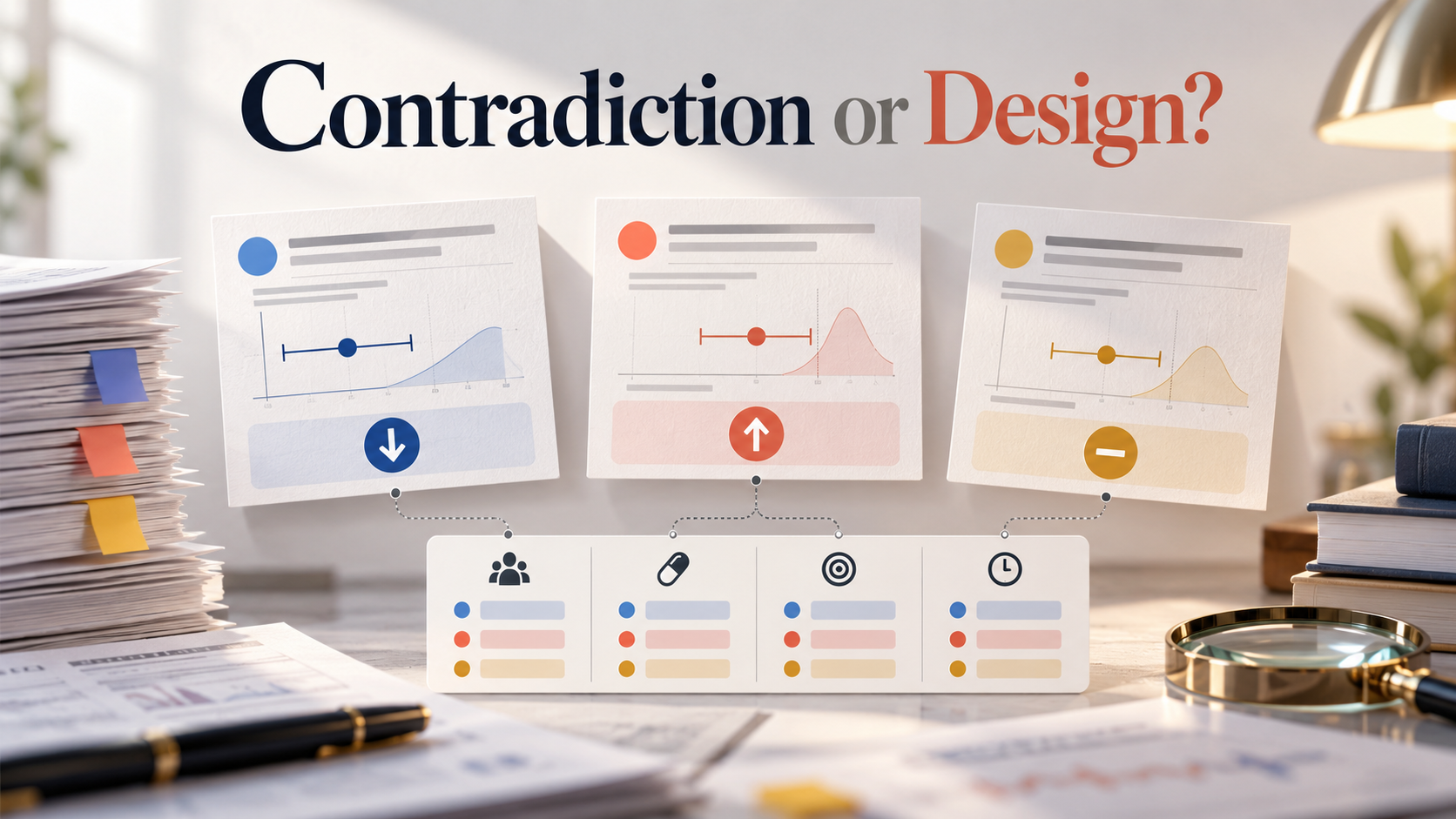
I gave an AI-assisted comparison three studies of online sleep interventions for students. Two earlier studies reported improvements. A newer randomized trial found that a guided program was not significantly better than an active digital education control on most outcomes.
At first glance, that sounds like a contradiction. After comparing the studies by population, comparator, outcome, and adherence, it looked more like a design difference.
What did the papers appear to disagree about?
A 2015 randomized study reported moderate improvements in sleep quality among students completing an internet-delivered program. A 2021 study found better sleep-related outcomes after six email-delivered CBT-I sessions than after access to a student wellness page.
The 2026 trial reported no significant advantage for its guided intervention over the control on the primary insomnia outcome. A summary tool could easily label the first two “positive” and the third “negative.”
That label loses the most important detail: the 2026 control contained sleep monitoring, sleep hygiene, stimulus control, circadian education, and chronotype feedback. It was a much more active comparison than a waitlist or basic wellness link. Engagement in the guided intervention was also low.
What should AI compare before calling papers contradictory?
Ask for a contradiction table with these columns:
- exact claim being compared
- population and eligibility
- intervention dose
- comparator content
- outcome instrument
- assessment time
- effect estimate and uncertainty
- adherence and missing data
Two papers conflict only when they make incompatible claims under sufficiently similar conditions. “One found improvement” and “one found no superiority over an active control” can both be true.
What did the small test reveal?
AI was good at locating opposite-looking conclusion sentences. It needed a narrower prompt to explain why those sentences did not answer the same comparison.
The useful prompt was:
Do not classify conclusions as support or contradiction yet. First restate each result as population + intervention + comparator + outcome + time point. Then identify which elements differ. Call the findings contradictory only if the remaining claims cannot both be true.
This moved the answer from sentiment matching to study comparison.
Compare the evidence set in WisPaper
Save the papers to My Library and ask Library QA: “Which studies report different conclusions about online sleep interventions, and do they use the same comparator and outcome?” Then open the methods and result tables for any pair labeled as a disagreement.
WisPaper can help surface the comparison. The final judgment still depends on whether the studies truly asked the same question.
FAQs
Keep Reading
Can AI Summarize a Paper from Its Abstract Alone? A Full-Text Check
See what an abstract-only AI summary gets right, what full text changes, and how to run a source-grounded correction pass.

Can AI Tell Whether a Research Idea Is Actually New?
Check whether an AI-generated research idea is actually new by testing its concepts, methods, populations, and closest prior work.

Can NotebookLM Find New Papers, or Only Read the Ones You Upload?
Can NotebookLM find new research papers? Learn how its web search works, how to separate papers from general pages, and when to switch to scholarly search.