
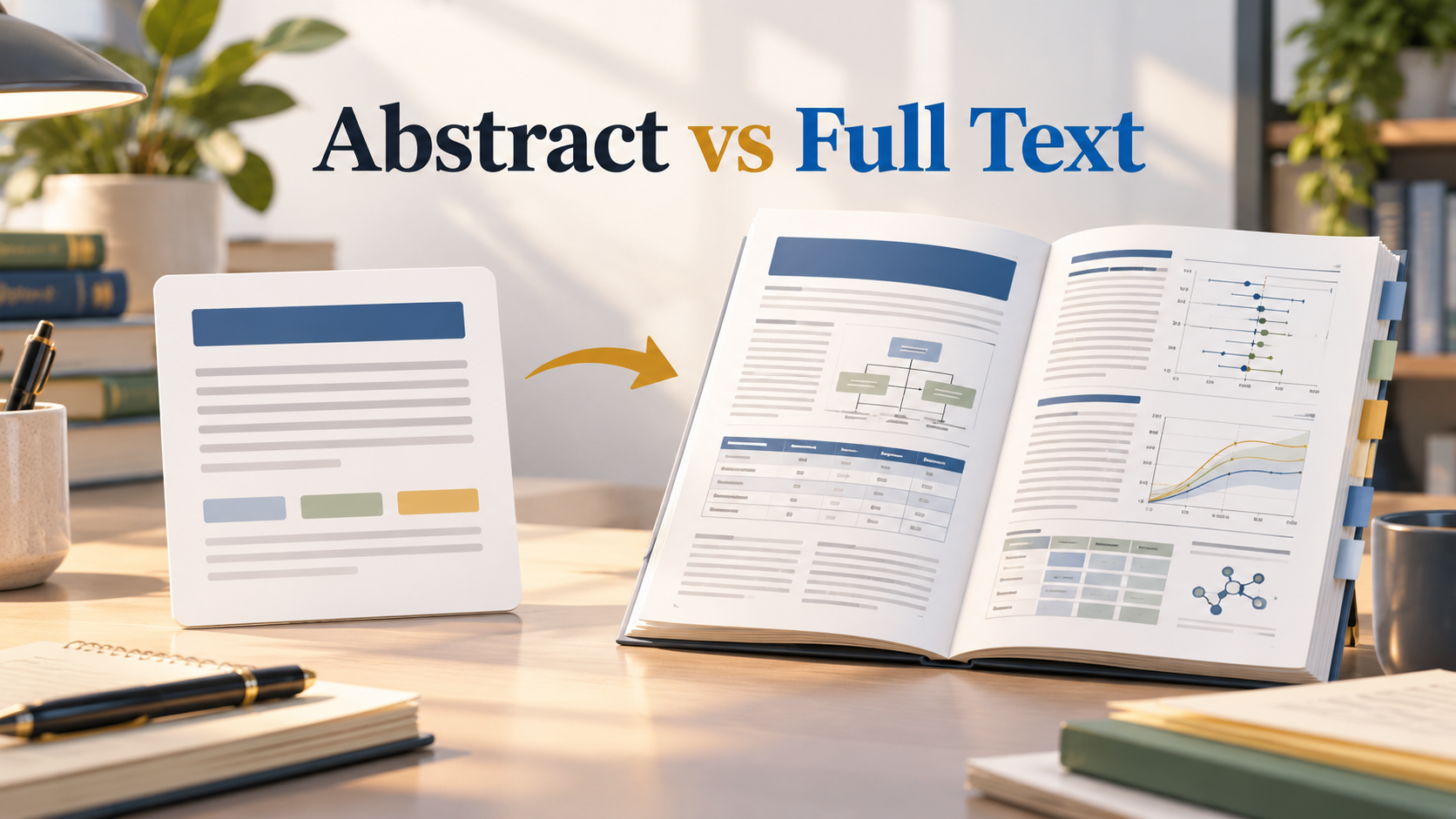
An abstract can support a useful short summary. It cannot support a reliable account of everything that matters in the paper.
I checked this with a 2026 randomized trial of a guided digital sleep intervention for university students. The abstract was unusually informative: it reported the sample, intervention, control, follow-up points, primary result, confidence interval, completion rates, and the authors' main interpretation. A summary based only on that abstract could answer, “Did the intervention outperform the control?”
It could not explain several decisions that change how a reader interprets the result.
What did the abstract get right?
The abstract clearly reported that 195 students from nine Dutch universities were randomized. The intervention lasted five weeks. The main comparison at six weeks was not statistically significant, and completion was low: 51% completed the post-treatment assessment, 30% the follow-up, and 31% completed the intervention.
That is enough for a cautious headline: the guided program was not more effective than the active online education control on most outcomes in this trial.
What appeared only after opening the full paper?
The full text showed what “active control” meant. The control group did not receive nothing. It received seven lessons covering sleep monitoring, sleep hygiene, stimulus control, circadian rhythm, chronotype feedback, and psychoeducation. That makes the small between-group difference easier to understand.
The full paper also showed:
- exactly what each intervention module contained
- how randomization and blinding were handled
- which secondary outcomes and instruments were used
- how missing observations were modeled
- module-by-module engagement
- adverse-event reporting
- baseline details such as education level, living situation, and duration of sleep problems
These are not decorative details. They affect whether the study matches your question and whether a null comparison means “the intervention did nothing” or “both groups received useful components.”
A better way to ask AI for two summaries
Start with an abstract-only summary and label it as such:
Using only this abstract, report the population, intervention, comparator, primary outcome, main result, and any limitation stated by the authors. Write “not reported in the abstract” for missing details.
Then give the full paper and ask for a correction pass:
Compare the full text with the abstract-only summary. Add details that materially change interpretation, especially control condition, adherence, missing data, outcome definitions, subgroup analyses, and adverse events. Cite the section or table for every addition.
The value is in the difference between the two versions. If the second summary is only longer, the prompt was too vague.
How can WisPaper help after the abstract?
Save or upload the paper to My Library, then ask Library QA targeted questions such as: “What did the control group receive?” or “How many participants completed each module?” Keep the PDF open and check the cited passage or table before using the answer.
Use an abstract to decide what deserves attention. Use the full text to decide what the evidence means.
FAQs
Keep Reading

Can AI Tell Whether a Research Idea Is Actually New?
Check whether an AI-generated research idea is actually new by testing its concepts, methods, populations, and closest prior work.

Can NotebookLM Find New Papers, or Only Read the Ones You Upload?
Can NotebookLM find new research papers? Learn how its web search works, how to separate papers from general pages, and when to switch to scholarly search.
Can Perplexity Find Papers That Google Scholar Misses?
See why Perplexity and Google Scholar return different papers, what each search route misses, and how to verify useful results.