
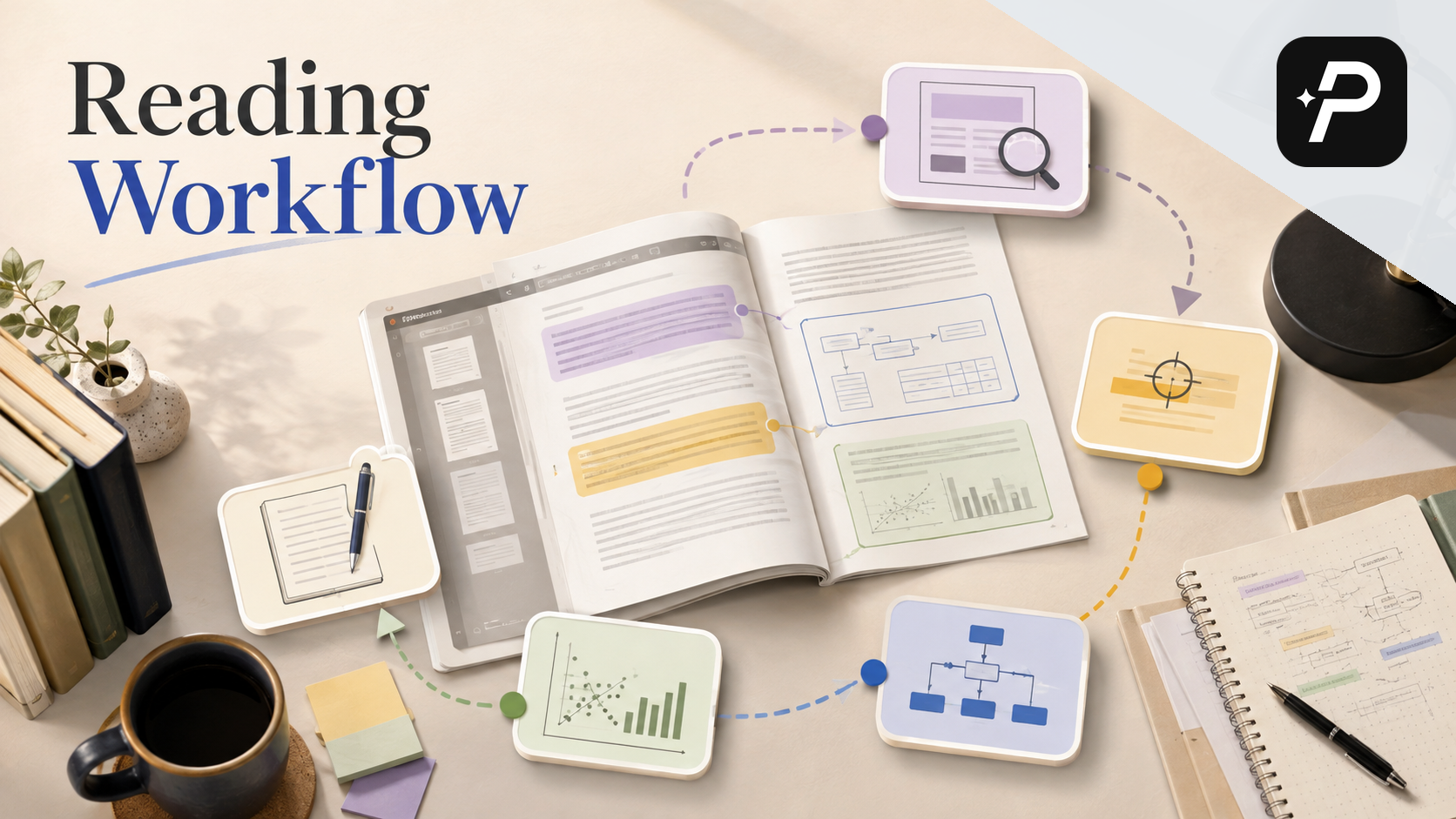
If you've opened a research paper, read the first paragraph three times, and still closed the PDF with nothing sticking, that's not a comprehension failure. It's a strategy failure. Academic papers are not written to be read the way you'd read a textbook chapter or a news article. They're written for a tiny audience of specialists who already know the field's vocabulary, debates, and history.
You're missing that shared context, so the paper feels impenetrable. The fix isn't reading more slowly. It's reading in a specific order, with specific questions at each stage.
Here's a workflow that turns an intimidating PDF into something you can actually work with.
Why Do Research Papers Feel Impossible to Read?
Three things make papers harder than they need to be.
First, the audience. Researchers write for other researchers in their sub-field. They assume you know the foundational studies, the methodological debates, and the jargon. When you don't have that context, every paragraph seems to reference a conversation you weren't part of.
Second, the structure works against casual reading. A newspaper puts the most important information first. A research paper buries it. The abstract gives you a compressed summary, but the introduction spends several paragraphs establishing the gap in the literature before stating the paper's purpose. The methods section is written for replication, not comprehension. The results are dense with statistical tests. Only in the discussion do the authors finally explain what it all means.
Third, there's the assumption that everyone else finds this easy. They don't. Experienced researchers often read a paper multiple times before it clicks. The difference is they have a system. This is yours.
What Is the Three-Pass Reading Method?
The most common mistake beginners make is reading a paper linearly, from title to conclusion, like a novel. That approach guarantees you'll drown in the methods section before you understand why it matters.
Instead, use a three-pass approach. Each pass has a different goal, and you don't complete every pass for every paper.
First pass: the skim (5–10 minutes). Read the title, abstract, and keywords. Read the final paragraph of the introduction, where authors usually state their research question or hypothesis. Scan the section headings to understand the paper's skeleton. Look at every figure and table, and read their captions. By the end of this pass, you should know whether the paper is relevant to your work and what its main claim is.
Second pass: the deep read (30–60 minutes). Read the introduction, the results (especially the figures and tables), and the discussion. Skip the methods for now. Your goal is to understand the main argument and the evidence supporting it. Write down terms you don't know and questions you want to answer later.
Third pass: the deep dive (several hours). This is only for papers central to your research. Now you read the methods in detail, trace the logic of the analysis, and check whether the results actually support the authors' claims. This pass often involves looking up cited papers and re-reading sections multiple times.
The three-pass method works because it matches your effort to the paper's importance. You don't need to understand the statistical model to grasp the main finding. You need to understand the statistical model only if you're going to build on that finding yourself.
How Do You Decode the IMRaD Structure?
Most empirical papers follow the IMRaD structure: Introduction, Methods, Results, and Discussion. Each section answers a different question, and knowing which question you're reading helps you adjust your attention.
Introduction — the "why." This section reviews relevant background literature and identifies a gap. The final paragraph almost always states the paper's purpose or hypothesis. Read this carefully.
Methods — the "how." This describes the experimental design, data collection, and analysis. For a beginner, this is the swamp. In your first two passes, you only need the general approach: "they surveyed 500 students" or "they ran a randomized controlled trial." Save the technical details for the third pass.
Results — the "what happened." This section presents the findings, usually through text, figures, and tables. Read the captions carefully. They tell you what you're looking at and often contain the key statistical results.
Discussion — the "so what." The authors interpret their results, explain their significance, and acknowledge limitations. This is often the most readable section. If you're short on time, start here.
Once you can identify which section you're in, you can adjust your reading strategy. You don't need to understand every statistical test in the results to follow the argument in the discussion.
How Do You Use AI to Build a Reading Queue Without Losing Critical Judgment?
AI tools are useful at the front end of this workflow, before you start reading. Their job is to help you find and screen papers, not to read them for you.
If you have a research question like "What is the impact of microplastics on marine life in the Arctic?" you can enter that natural-language question into WisPaper's Deep Search instead of constructing a complex Boolean query for Google Scholar. The search returns papers relevant to your question. The Scholar Agent can also help you explore different angles of your research question and suggest directions you might not have considered.
The key is to treat AI as a research assistant that brings you raw materials. Your job is still to evaluate those materials critically.
Once you have a list of candidate papers, use the paper cards to screen them. These cards show the source label, a summary, publication details, and authors. That lets you triage quickly: which papers are directly relevant, which are tangentially related, and which can be skipped. This screening step is part of building an effective reading queue for a new research topic. If you want a more detailed walkthrough of that process, see our guide on how to build a reading queue for a new research topic.
How Do You Take Notes That Actually Help You Later?
Reading a paper and taking notes that merely summarize its abstract won't help you build a coherent understanding of a field. You'll end up with a pile of paraphrases and no idea how the papers relate to each other.
Instead, take connective notes. For each paper you read, ask yourself:
- How does this paper relate to my research question?
- Does it support or contradict other papers I've read?
- What is the key takeaway I can use in my own writing or thesis?
- What are the limitations, and how might they affect my interpretation?
These notes become the raw material for your literature review. They help you organize papers into themes and see the bigger picture. If you're saving papers as you go, you can keep them in WisPaper's My Library and use Library QA to ask questions across your saved sources. For example, you could ask, "According to the papers in my library, what are the main limitations of using self-reported data?" The tool answers based on the papers you've actually saved, which keeps the synthesis grounded in your own sources.
For a more structured approach to note-taking, you might find our guide on creating an annotated bibliography with AI helpful. It shows a safer workflow for tracking your sources without losing your own critical voice.
When Should You Walk Away From a Paper?
Not every paper deserves the same level of attention. Strategic triage is part of the workflow.
Walk away if the paper is only tangentially related to your topic. You've read the abstract and the conclusion, and you have a general sense of what it's about. That's enough. You can come back later if needed.
Dig in if the paper is central to your research. This is when you do the third pass, read the methods in detail, and take comprehensive connective notes.
It's better to deeply understand five core papers than to have a superficial familiarity with fifty. Learning to prioritize is also something you can discuss with your supervisor to make sure you're focusing on the right sources. Preparing for a supervisor meeting with a clear understanding of your reading queue can make those conversations far more productive. Our guide on how to prepare for a supervisor meeting with an AI literature review workflow covers this in more detail.
How Do You Handle Papers That Cite Work You Haven't Read?
A common frustration: you're reading a paper, and it references a study that seems central to the argument. You don't have time to read everything, but you also don't want to misunderstand the point.
Start by checking the reference list. If the cited work appears multiple times across different papers you're reading, it's probably foundational. That's worth a deeper look. If it appears once, it's likely a supporting detail you can set aside.
For foundational papers, use backward citation chasing: find the original study and read at least its abstract and conclusion. For newer work that builds on the paper you're reading, use forward citation chasing to see how later researchers have interpreted or critiqued it. Our practical guide to backward and forward citation chasing walks through both techniques step by step.
You can also use WisPaper's Library QA to ask questions about papers you've saved. If you've uploaded a paper that cites a study you haven't read, you can ask what the paper says about that study's findings. The answer will be grounded in the source you actually have, which helps you avoid relying on a secondhand interpretation you can't verify.
What Should You Do When You Find Too Many Papers?
Source overload is a real problem, especially when you're starting a new topic. You search for one thing, find twenty relevant papers, and then panic about reading them all.
The first step is to build a reading queue. This means deciding which papers you'll read in full, which you'll skim, and which you'll set aside. A queue prevents the feeling of being buried under an avalanche of PDFs. Our guide on how to build a reading queue for a new research topic walks through the process in detail.
The second step is to use screening tools. WisPaper's paper cards show source labels, summaries, publication details, and authors. That lets you triage quickly: which papers are directly relevant, which are tangentially related, and which can be skipped. This screening step is part of building an effective reading queue for a new research topic.
The third step is to set a limit. Decide how many papers you can realistically read in a week, and stick to that number. If you find more, add them to the queue for later. You can always expand your reading later, but you can't un-read a paper you skimmed too quickly to understand.
If you're still feeling overwhelmed, our guide on how to avoid source overload in a literature review offers practical strategies for keeping your scope manageable.
FAQs
Keep Reading
How to Understand the Methods Section of a Research Paper
The methods section is often the most intimidating part of a research paper. It is dense, technical, and packed with jargon that seems to assume you already know the experiment by heart. If you are a student, thesis writ
How to Understand the Results Section of a Research Paper
The results section is where a study shows what it actually found. For many students and early-stage researchers, it is also the most intimidating part of a paper. Statistical tests, dense tables, and figures can feel li
How to Summarize a Research Paper Without Missing the Important Parts
When you sit down to summarize a research paper, the goal sounds simple: condense the main points into a shorter version. But in practice, it is easy to lose the thread. You might capture the method but forget the limita