
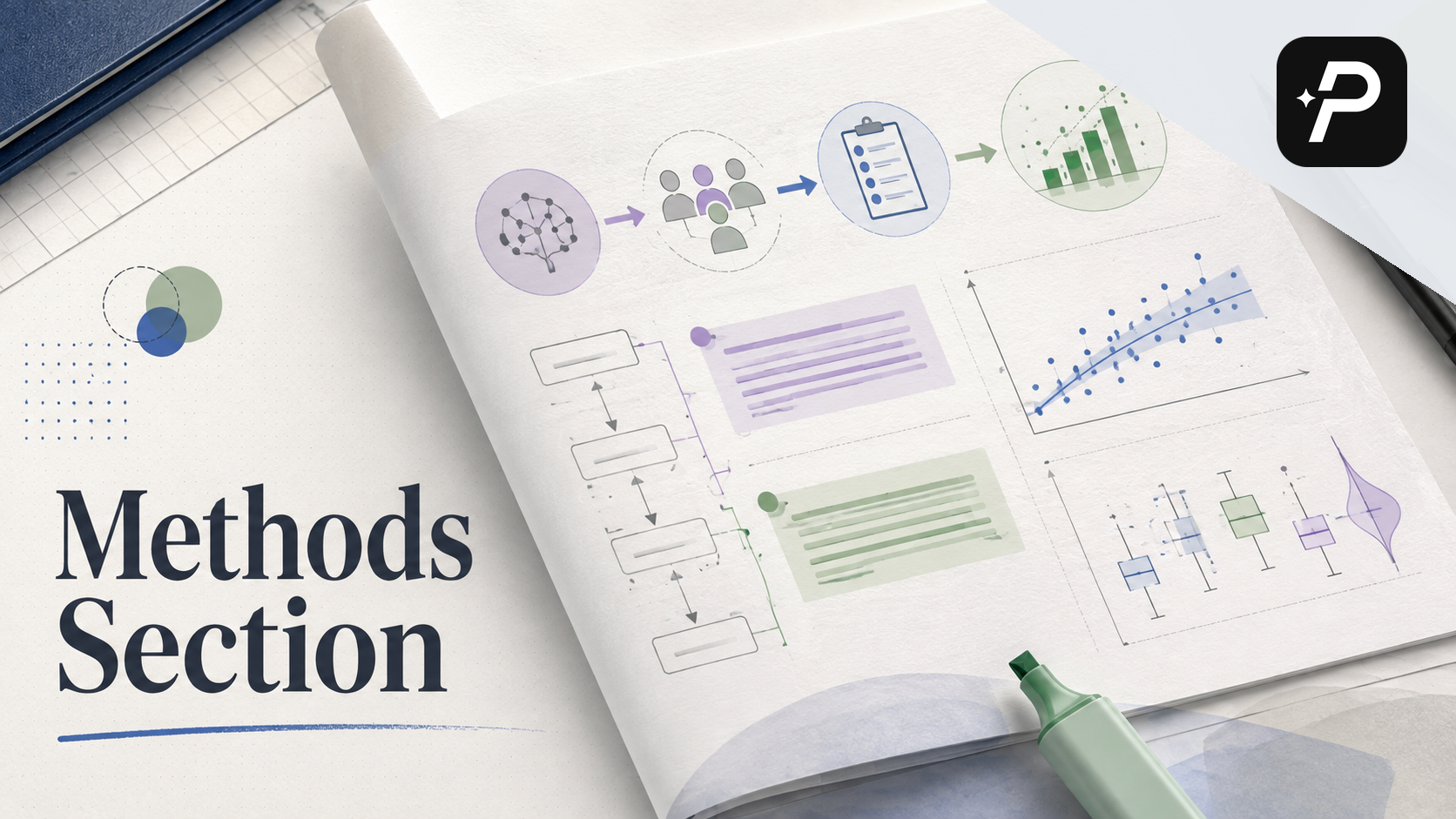
The methods section is often the most intimidating part of a research paper. It is dense, technical, and packed with jargon that seems to assume you already know the experiment by heart. If you are a student, thesis writer, or early-stage researcher, you have probably found yourself staring at a paragraph about "Likert scales" or "confounding variables" and wondering if you skipped a prerequisite class.
Here is the good news: you do not need to be a statistician to understand the methods section. You need a reading strategy. While most online guides focus on how to write a methodology, this guide is different. It is a reader's manual. We will break down the methods section into five core components—sample, design, measures, procedure, and limitations—and show you exactly what to extract from each.
By the end of this article, you will be able to read a methods section critically, evaluate whether the study is sound, and decide if the findings are worth citing in your own work.
Why the Methods Section Feels Harder Than It Is
The primary reason the methods section feels difficult is that it is written backward. Authors write it after the experiment is finished, and they write it in past tense to describe what was done. But as a reader, you are trying to figure out what this means for your own research. This mismatch creates cognitive friction.
Another reason is that the methods section is not written to be read linearly. It is written to be verified. Journals often require enough detail for another researcher to replicate the study. This means the text is loaded with specific instrument names, software versions, and statistical tests that are irrelevant to your immediate understanding of the paper's contribution.
To understand the methods section, you must shift your goal. You are not trying to memorize every reagent or code snippet. You are trying to answer five specific questions:
- Who or what was studied?
- How was the study structured?
- What was measured?
- What steps were taken?
- What are the limitations?
Once you have these answers, you can evaluate the paper's credibility and move on to the results and discussion with confidence.
The Five Core Components of Any Methods Section
Most methods sections, regardless of whether they are in psychology, biology, economics, or computer science, contain the same underlying structure. If you can identify these five components, you can understand 90% of any methodology you encounter.
1. Sample (Who or What Was Studied)
The sample describes the participants, subjects, or data points used in the study. Look for:
- Sample size (N): How many participants or observations?
- Recruitment: How were they chosen? Randomly, by convenience, or via a specific database?
- Inclusion/Exclusion criteria: Who was allowed in, and who was left out?
- Demographics: Age, gender, location, or other relevant characteristics.
Consider a study on study habits among university students. If the sample consists of 200 psychology undergraduates recruited from a single introductory course, the findings may not generalize to engineering students or to learners in online programs. The sample section tells you how far you can stretch the conclusions.
2. Design (How the Study Was Structured)
The design tells you whether the study is experimental, correlational, longitudinal, or qualitative. Look for:
- Control groups: Was there a comparison group?
- Randomization: Were participants randomly assigned to conditions?
- Independent vs. dependent variables: What was manipulated, and what was measured?
- Timeframe: Was it a one-time survey or a multi-year study?
A correlational design can show that two variables move together, but it cannot prove that one causes the other. If a paper claims a causal relationship but used a cross-sectional survey, that is a mismatch worth flagging.
3. Measures (What Was Measured)
Measures are the tools used to collect data. Look for:
- Instruments: Questionnaires, sensors, interviews, or software.
- Validity and reliability: Did the authors cite prior validation of their tools?
- Primary outcomes: What was the main thing they wanted to capture?
If a study measures anxiety using a self-report questionnaire, the authors should reference where that questionnaire came from and whether it has been validated in a similar population. A measure that was developed for clinical patients may not work well with college students.
4. Procedure (What Steps Were Taken)
The procedure is the chronological sequence of events. Look for:
- Intervention: What did the participants actually do?
- Data collection: How was the data recorded?
- Timing: When were measurements taken (pre-test, post-test)?
The procedure matters because small changes in timing or instructions can alter results. A memory study that tests participants immediately after learning will produce different results than one that tests them a week later. The procedure section tells you which version you are dealing with.
5. Limitations (What Could Be Wrong)
Limitations are often in the discussion, but good methods sections acknowledge them upfront. Look for:
- Bias: Could the sample be unrepresentative?
- Confounds: Are there alternative explanations for the results?
- Generalizability: Can these findings apply to other populations?
If the authors recruited volunteers through a social media post, the sample is self-selected. People who volunteer for research may differ from the general population in motivation, availability, or interest in the topic. That limitation shapes how much weight you should give the findings.
How to Read the Methods Section in Three Passes
Do not read the methods section once. Read it three times, each time with a different goal. This technique will save you hours of confusion.
Pass 1: The 30-Second Scan (The Abstract View)
Skim the entire section in under a minute. Do not read every word. Instead, look for the bolded subheadings (e.g., "Participants," "Measures," "Statistical Analysis"). Highlight the sample size and the main outcome measure. Your goal here is to get a gist of what the study did.
Pass 2: The 10-Minute Deep Dive (The Skeptic View)
Now, read the section carefully. For each paragraph, ask yourself: Which of the five components does this belong to? If you are reading about a Likert scale, it belongs to Measures. If you are reading about random assignment, it belongs to Design. Take notes in the margins or in a separate document.
Pass 3: The 5-Minute Synthesis (The Reviewer View)
Close the paper and try to explain the methods to a friend in three sentences. If you cannot do this, you have missed something. Go back and find the missing piece. This active recall step is crucial for moving the information into your long-term memory.
Common Jargon in Methods Sections (And What It Really Means)
Even with a three-pass strategy, you will hit words that look like a foreign language. Here is a quick cheat sheet for the most common terms that confuse early-stage researchers.
- "Statistical significance" (p < 0.05): This means the results are unlikely to be due to chance. It does not mean the results are practically important.
- "Confounding variable": An outside factor that affects both the independent and dependent variable, making it hard to tell what caused what.
- "Blinding" (single or double): Single-blind means participants do not know which group they are in. Double-blind means neither the participants nor the researchers know.
- "Longitudinal vs. cross-sectional": Longitudinal follows the same group over time. Cross-sectional takes a snapshot at one point in time.
- "Qualitative vs. quantitative": Qualitative uses words and themes (interviews, observations). Quantitative uses numbers and statistics (surveys, experiments).
If you see a term you do not recognize, do not panic. Write it down and look it up after your first pass. Often, the term is explained later in the paper or in the footnotes.
How to Evaluate the Quality of a Methods Section
Understanding the methods is about evaluation. A paper can have a beautiful introduction and a compelling conclusion, but if the methods are flawed, the entire study is compromised. Here is a checklist to help you judge the quality.
Is the sample size justified?
A good methods section will explain why they chose that many participants. If they just say "we used 30 participants" without a power analysis or justification, be skeptical.
Is there a clear control group?
For experimental studies, a control group is essential. Without it, you cannot attribute changes to the intervention.
Are the measures validated?
If they used a questionnaire, did they cite a paper that created it? If they used a sensor, did they calibrate it?
Is the procedure replicable?
Could you, with the same resources, repeat the study? If there are missing steps or vague descriptions, the methods are weak.
Are limitations acknowledged?
No study is perfect. If the authors do not mention any limitations, they are either naive or dishonest.
For a more detailed comparison of how different papers handle their methodology, you can use a structured approach to compare methods across research papers. This will help you spot patterns and best practices.
The Difference Between Reading Methods and Reading Results
Many students make the mistake of reading the methods and results as separate entities. In reality, they are deeply intertwined. The methods tell you how the data was collected; the results tell you what was found. To truly understand the methods section, you must read it with the results in mind.
Look for the connection:
- Does the statistical test in the results match the design in the methods?
- Did they measure what they said they would measure in the methods?
- Are the participants described in the methods the same ones reported in the results?
If there is a mismatch, it is a red flag. For example, if the methods say they recruited 100 participants, but the results only report data from 80, you need to find out what happened to the other 20. This is called "attrition," and it can introduce bias.
Using AI Tools to Help You Understand Methods
You do not have to do this alone. Modern research tools, including AI-powered literature platforms, can help you parse complex methods sections. Instead of getting stuck on a single paragraph, you can use a tool to ask specific questions about the study design.
For example, if you are using a research platform with a Scholar Agent, you can ask it to explain the difference between the mixed-methods design in one paper and the quasi-experimental design in another. This can save you hours of manual comparison.
Similarly, if you are working with a paper that you have uploaded to your personal library, you can use Library QA to ask questions like, "What was the sample size in this study?" or "What statistical test was used?" This is especially helpful when you are dealing with a 40-page paper and you only need the methodology details.
If you are building a reading list for a new topic, you can use Deep Search to find papers based on a natural-language research question. Instead of constructing a complex Boolean query, you can type a question like "What interventions reduce procrastination in graduate students?" and review the papers that come back.
How to Take Notes on the Methods Section
Taking notes creates a personal map of the paper. Here is a template you can use for every paper you read.
Paper Citation:
Research Question (from intro):
Sample (N, demographics):
Design (Experimental/Correlational/Qualitative):
Main Measures (What was used):
Procedure (3-5 bullet points):
Key Limitations:
Your Evaluation (Is it sound? Why or why not?):
This template forces you to extract the five core components we discussed earlier. It also creates a quick reference sheet that you can consult when writing your literature review. If you are building a larger project, you can use this information to build a literature review evidence map to visualize how different studies relate to each other.
What to Do When the Methods Section Is Still Confusing
Sometimes, even after three passes and a cheat sheet, you will still be lost. This is normal. The methods section of a specialized paper can be as complex as a foreign language. Here is what to do next.
1. Read the Discussion section first.
The discussion often summarizes the main findings in plain English. If you know what they found, it is easier to understand how they found it.
2. Look for the "Limitations" subsection.
Authors often explain their own methodological weaknesses here. This can give you clues about what the methods were trying to achieve.
3. Find a review article or a blog post about the paper.
Sometimes, a third-party source will explain the methodology in simpler terms.
4. Ask a colleague or a mentor.
Do not be afraid to ask for help. Explaining a confusing paragraph to someone else is a great way to clarify your own understanding.
5. Use a research assistant tool.
If you are using a platform like WisPaper, you can use the Inspiration Discovery feature to find related papers that use simpler methods to answer the same question. This can help you build a foundational understanding before tackling the complex paper.
Conclusion: From Confusion to Confidence
Understanding the methods section of a research paper is a skill, not a talent. It requires a systematic approach, a willingness to skim, and the ability to focus on the big picture rather than the technical details. By breaking the section down into the five core components—sample, design, measures, procedure, and limitations—you can transform a dense, jargon-filled text into a clear, logical narrative.
You are reading the methods to answer the question: Can I trust these findings? Once you have that answer, you can confidently move forward with your own research, whether you are writing a thesis, a literature review, or a grant proposal.
As you continue to practice, you will get faster and more intuitive. You will start to recognize common designs and statistical tests at a glance. And when you encounter a truly novel method, you will have the tools to dissect it and understand it. So, the next time you open a paper and see a wall of text under the "Methods" heading, take a deep breath. You now have the map to navigate it.
FAQs
Keep Reading
How to Understand the Results Section of a Research Paper
The results section is where a study shows what it actually found. For many students and early-stage researchers, it is also the most intimidating part of a paper. Statistical tests, dense tables, and figures can feel li
How to Summarize a Research Paper Without Missing the Important Parts
When you sit down to summarize a research paper, the goal sounds simple: condense the main points into a shorter version. But in practice, it is easy to lose the thread. You might capture the method but forget the limita
How to Take Useful Notes From Research Papers
Most note-taking fails because it happens too late, captures the wrong details, or produces files you never open again. You read a paper, highlight a few sentences, and close the PDF. A week later, you cannot remember wh