
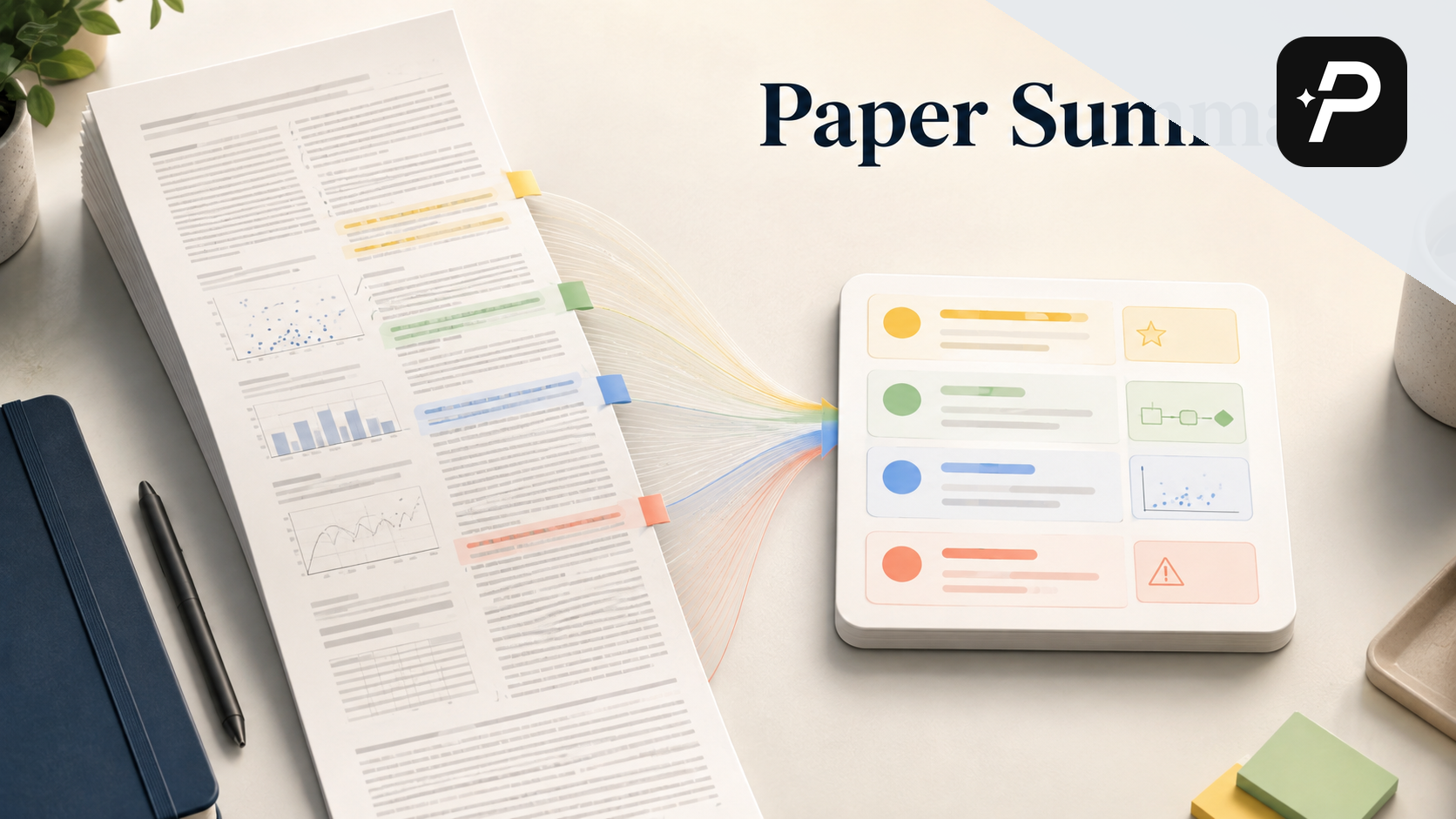
When you sit down to summarize a research paper, the goal sounds simple: condense the main points into a shorter version. But in practice, it is easy to lose the thread. You might capture the method but forget the limitation, or note the finding but miss why the authors chose that particular approach. The result is a summary that looks complete but would not survive a follow-up question from your supervisor.
This guide gives you a concrete system for how to summarize a research paper without missing the important parts. You will learn the five elements every summary must preserve, how to read strategically, and how to use AI tools like WisPaper's Deep Search and Scholar Agent without losing your own judgment. By the end, you will have a checklist you can reuse for every paper you read.
Why Most Summaries Miss the Important Parts
The most common reason a summary fails is not a lack of effort. It is a mismatch between what you think matters and what the paper actually contributes. When you are new to a field, every detail feels important. When you are deep into your own thesis, you might skim past a limitation that directly affects your research question.
Another issue is that many people summarize in the order the paper is written. They start with the abstract, then the introduction, then the method. This linear approach often produces a summary that mirrors the paper's structure but not its logic. A good summary should be organized around the research question and the evidence, not the section headings.
Finally, there is the problem of verification. If you use an AI tool to summarize a research paper, you might not know which parts were emphasized or omitted. Without a framework for checking the output, you can end up with a summary that is fluent but wrong in subtle ways. This is why the paper summary prompts: what to ask before trusting an AI summary guide is a useful companion to this article.
The Five Non-Negotiable Elements of a Paper Summary
Before you write a single sentence, you need to know what you are looking for. Every research paper, regardless of discipline, can be summarized around five core elements. If your summary does not address all five, it is incomplete.
1. The research question. What problem does the paper address? This is not the same as the topic. The topic is "machine learning in healthcare." The research question is "Can a specific neural network architecture predict patient readmission within 30 days using only structured EHR data?"
2. The method. How did the authors try to answer the question? This includes the data source, sample size, experimental design, and analysis technique. You do not need every parameter, but you need enough to understand what was actually done.
3. The central finding. What did the authors observe? This should be stated as a result, not an interpretation. For example, "the model achieved an AUC of 0.82" is a finding. "The model is clinically useful" is an interpretation.
4. The limitation. What could not be concluded? Every paper has limits, whether in the sample, the method, or the scope. Missing this element is the fastest way to overstate a paper's contribution.
5. The citation fit. How does this paper relate to your own work or to the broader literature? This is the element that turns a summary from a school exercise into a research tool. It answers the question: "Why does this paper matter for what I am doing?"
If you use WisPaper's paper cards, you will see many of these elements surfaced automatically, including source labels, summaries, publication details, and author information. But the citation fit is something you have to determine yourself.
Step 1: Skim for the Skeleton Before You Read
Do not start reading from the first page. Instead, spend five minutes extracting the skeleton of the paper. This is a deliberate pre-reading step that primes your brain for the five elements above.
Open the paper and go straight to the abstract. Read it once, then close it. Write down the research question in your own words. If you cannot do this, read the abstract again. The abstract should contain the question, the method, and the finding in compressed form.
Next, look at the figures and tables. In most empirical papers, the key results are visible in the visuals. You do not need to understand every detail, but you should be able to identify the main outcome variable and the comparison being made.
Finally, read the conclusion section. This is where the authors restate their contribution and often acknowledge limitations. By the end of this five-minute skim, you should have a rough draft of all five elements in your head. This draft will guide your full reading.
Step 2: Read the Introduction for the Gap, Not the Background
The introduction of a research paper is usually the longest section, and it is tempting to read it as a mini textbook. Resist this. For the purpose of summarizing, you only need one thing from the introduction: the gap.
The gap is the sentence or paragraph where the authors explain what is missing in the existing literature. It often appears near the end of the introduction, right before the research question is stated. Look for phrases like "however," "remains unclear," "has not been examined," or "little is known."
Once you find the gap, you can articulate the research question more precisely. The question is essentially the gap plus a proposed solution. For example, if the gap is "no study has compared transformer-based models to CNNs for histopathology image classification," the research question is "how do transformer-based models compare to CNNs on this task?"
This step is also where you start thinking about citation fit. Does this gap overlap with your own research area? If so, you may want to note how the authors position their work relative to specific prior studies. This is different from simply listing references.
Step 3: Extract the Method Without Getting Lost in Details
The method section is where summaries often go wrong. Novice summarizers either copy too much detail or skip the method entirely because it feels technical. The right approach is to extract the logic of the method, not the mechanics.
Ask yourself four questions about the method:
- What data was used? This includes the source, the time period, and the sample size.
- What was the intervention or exposure? For experimental studies, this is the treatment. For observational studies, this is the variable of interest.
- What was the comparison? Who or what was the control group? If there is no comparison, note that.
- What was the outcome? How did the authors measure the effect?
You do not need to include the statistical test names unless they are central to the finding. You do not need to include every preprocessing step. If you find yourself copying sentences from the method section, stop and rewrite them in your own words.
A useful trick is to write the method as if you were explaining it to a peer who has not read the paper. If you can explain the design in two or three sentences, you have the right level of detail.
Step 4: Identify the Finding and Separate It From Interpretation
The results section is the heart of the paper, but it is also where summaries become unreliable. The issue is that authors often mix results with interpretation, and you need to separate them.
A finding is a factual observation. It answers the question "what happened?" An interpretation is a claim about what the finding means. For example:
- Finding: "The intervention group showed a 15% reduction in symptom scores compared to control."
- Interpretation: "This suggests the intervention is effective for treating the condition."
Both are important, but a summary should present the finding first and the interpretation second, clearly labeled. If you only include the interpretation, you are relying on the authors' framing without giving your reader the raw evidence.
This is also where you should check whether the finding actually answers the research question. Sometimes the results are partial, or the authors report secondary analyses that were not part of the original question. Note these discrepancies in your summary.
If you are using WisPaper's Library QA to ask questions about papers you have saved, you can test your own summary by asking the tool to retrieve the exact result statement. This is a quick way to verify that you did not misremember the finding.
Step 5: Look for Limitations in Unlikely Places
Most papers have a limitations paragraph, usually near the end of the discussion. But some limitations are only visible in the method section or in what the authors did not do.
When you summarize a research paper, you should actively hunt for limitations in three places:
- The explicit limitations paragraph. Read this carefully and note each limitation mentioned.
- The method section. Look for convenience samples, short follow-up periods, self-reported outcomes, or missing control groups.
- The discussion. Sometimes authors acknowledge limitations indirectly by saying "future work should..." or "our findings may not generalize to..."
Do not assume that the absence of a limitations paragraph means there are no limitations. Every study has them. If the authors did not list any, that is itself a signal that the paper may be overclaiming.
For your summary, you do not need to list every limitation. Pick the one or two that matter most for your purposes. If you are citing the paper to support a claim in your thesis, the most important limitation is the one that affects whether the evidence actually supports your claim.
Step 6: Write the Summary in Your Own Words
Now you have all the raw material. The next step is to write the summary. The structure should follow the five elements, but you can order them in a way that makes sense for your reader.
A strong one-paragraph summary might look like this:
This paper investigates whether [research question]. Using [method], the authors analyzed [data] and compared [comparison]. They found that [finding]. However, the study is limited by [limitation], which means the results may not apply to [scope]. This is relevant to my work because [citation fit].
You can expand this into multiple paragraphs if needed, but the logic should stay the same. Start with the question, explain how it was answered, state what was found, acknowledge the limits, and connect it to your own context.
Writing in your own words is non-negotiable. Copying sentences from the abstract is not summarizing; it is quoting. If you find yourself using the authors' phrasing, close the paper and write from memory. Then check your version against the original to make sure you have not changed the meaning.
Step 7: Use AI Tools as a Drafting Partner, Not a Replacement
AI tools can help you summarize a research paper faster, but they should not replace your own reading. The right workflow is to use AI as a drafting partner that produces a first version you then verify and edit.
WisPaper's Deep Search is designed to search academic literature using a natural-language research question. Instead of constructing a long Boolean query, you can ask something like "What is the effect of sleep deprivation on cognitive performance in medical residents?" Deep Search will return relevant papers, and you can then use the paper cards to get quick summaries, source labels, and publication details.
The Scholar Agent can help you explore research questions and paper directions inside the search workflow. If you are not sure whether a paper is worth reading in full, you can ask the Scholar Agent to explain how it relates to your topic. This is useful for building a reading queue without committing to a full read of every paper.
However, you should treat AI-generated summaries with the same skepticism you would apply to a peer's summary. Check the five elements. Did the AI include the limitation? Did it accurately state the finding? Use the paper summary prompts: what to ask before trusting an AI summary guide to build a verification checklist.
How to Use Paper Cards and My Library for Faster Summaries
WisPaper's paper cards are designed to support quick screening. Each card shows source labels, a summary, publication details, authors, and preview information. When you are working through a large reading list, these cards let you decide which papers deserve a full read and which can be summarized from the card alone.
The key is to use paper cards as a triage tool, not as the final summary. A card can tell you whether a paper is relevant, but it cannot tell you how the paper fits into your argument. That requires your own analysis.
My Library lets you save papers and upload your own PDFs. Once papers are in your library, you can use Library QA to ask questions based on the content of your saved papers. For example, you might ask "What methods did the authors use to control for confounding?" and get an answer drawn from the paper itself. This is a fast way to verify details before you finalize your summary.
The combination of Deep Search for discovery, paper cards for screening, and Library QA for verification gives you a workflow that is faster than reading every paper in full, but still grounded in the actual text.
A Summary Checklist You Can Use Tomorrow
To make this practical, here is a checklist you can copy into your notes and use for every paper you summarize. If you can answer all of these questions, your summary will not miss the important parts.
- What is the research question in one sentence?
- What gap in the literature does the paper address?
- What data and method were used?
- What was the primary finding?
- What is the main limitation?
- How does this paper relate to my own work or thesis?
- Did I write the summary in my own words?
- Did I verify the finding against the original text or a reliable tool?
If you are summarizing many papers for a literature review, this checklist will also help you avoid source overload. You can compare papers side by side by looking at their answers to the same five questions. This is much more efficient than trying to remember the details of each paper separately. For more on managing a large reading workload, see How to Keep Up With Research Literature Without Burnout.
Common Mistakes to Avoid When Summarizing
Even with a checklist, certain mistakes recur. Here are the ones to watch for.
Mistake 1: Summarizing the abstract instead of the paper. The abstract is a summary written by the authors, but it often omits limitations and assumes you know the context. Your summary should be based on the full paper.
Mistake 2: Including too many details from the method. Unless you are replicating the study, you do not need to know the exact temperature settings or the version of the software used. Focus on the design logic.
Mistake 3: Ignoring the citation fit. A summary that does not explain why the paper matters to you is just a book report. The citation fit is what makes the summary useful for your research.
Mistake 4: Trusting an AI summary without verification. AI tools are getting better, but they still make mistakes. Always check the finding and the limitation against the original text.
Mistake 5: Writing the summary before you understand the gap. If you do not know what the paper is responding to, you will misjudge the contribution.
When to Summarize Versus When to Read in Full
Not every paper deserves a full summary. Part of being an efficient researcher is knowing when to use a lighter touch. If a paper is only tangentially related to your topic, a paper card summary might be enough. If a paper is central to your thesis, you should read it in full and write a detailed summary.
A useful rule of thumb is to ask: "Will I cite this paper?" If the answer is yes, read it in full. If the answer is maybe, skim it and save it to My Library for later. If the answer is no, move on.
This triage approach is especially important when you are building a reading queue for a new research topic. You do not want to spend an hour summarizing a paper that turns out to be irrelevant. For guidance on building an efficient reading queue, see How to build a reading queue for a new research topic.
FAQs
Keep Reading
How to Take Useful Notes From Research Papers
Most note-taking fails because it happens too late, captures the wrong details, or produces files you never open again. You read a paper, highlight a few sentences, and close the PDF. A week later, you cannot remember wh
How to Find the Main Finding of a Research Paper Quickly
You have a stack of papers for your literature review, a seminar discussion tomorrow, and no time to read every word of every study. The main finding of a research paper is usually buried under methodology, jargon, and b
Is This Paper Relevant to Your Topic? How to Decide
You have a PDF open, a highlighter ready, and a creeping doubt. The paper is well-written and the title looks promising, but you cannot tell if it actually belongs in your literature review or annotated bibliography. The