
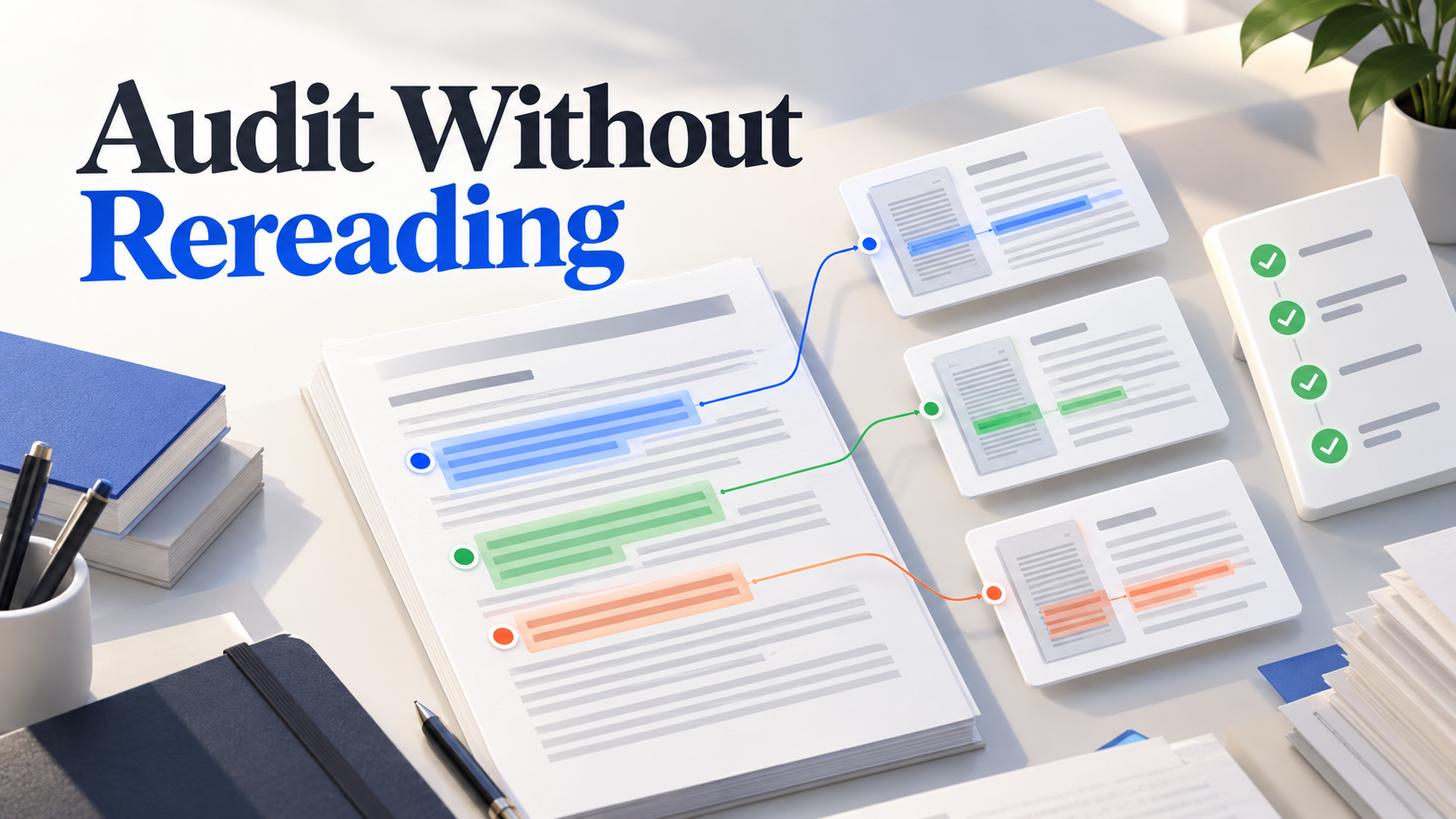
An AI research report cites 42 sources. Reading all 42 before deciding whether the report is usable defeats the reason you generated it. Reading none of them leaves you trusting the hardest parts of the work.
Use risk-based checking: verify the claims that carry the argument and the sources most likely to expose a broken process.
Start with the report’s claim map
Write the report's three to five main conclusions in one column. In the next column, list the sources cited for each conclusion. If a major conclusion has no source—or every conclusion relies on the same two papers—you have found a structural weakness before opening a PDF.
Mark claims that are numerical, causal, surprising, current, or central to a recommendation. Those deserve priority.
Choose a revealing source sample
Do not sample only the first references. Include:
- the source supporting the main conclusion
- a numerical claim
- the newest source
- an unfamiliar or surprising citation
- a source used repeatedly
- one paper that reportedly disagrees
For each, verify the publication record, then check the exact passage. Record whether the report preserved the population, design, outcome, direction, size, and uncertainty.
Check the search process without repeating it
Read the search log. Look for queries, dates, source systems, filters, languages, and exclusions. Then run two spot searches yourself:
- one query likely to reproduce the report's central sources
- one adversarial query for contradictory or null evidence
You are not rebuilding the review. You are checking whether the process can recover its own foundation and whether it searched beyond confirming evidence.
Inspect the joins between sources
AI reports often fail where several papers are combined. Watch for sentences such as “Taken together, these studies demonstrate…” Open the cited papers and ask whether they use comparable populations, definitions, and outcomes.
Three studies can all mention “engagement” while measuring attendance, clicks, and self-reported interest. The synthesis may be fluent and still combine unlike things.
Decide what level of trust the audit supports
Use three labels:
- briefing only: useful for orientation; search or citations are incomplete
- working evidence map: core claims and source trail are usable, but important papers still require reading
- formal-review input: documented methods and extensive checks; still not automatically a completed systematic review
This avoids a false pass/fail decision. A report can be helpful without being ready to cite.
Use WisPaper to organize the audit
Save the sampled papers to WisPaper My Library. Ask Library QA for the population, design, measured outcome, main result, and limitation from each paper, then compare that table with the report. Search missing or contradictory evidence in WisPaper Search.
The audit should end with a reading queue: papers that can change your interpretation first, background papers later.
FAQs
Keep Reading
AI Can Generate a Research Hypothesis. How Do You Check the Evidence?
Turn an AI-generated hypothesis into a testable claim, then check its mechanism, boundary conditions, and supporting evidence.
How to Check What’s New Since Your Last Literature Search
Update a literature search without starting over: use dates, saved queries, deduplication, citation alerts, and consistent screening.
How to Compare Papers That Use Different Names for the Same Idea
Compare papers that use different names for similar ideas without erasing meaningful differences in definitions and measures.