
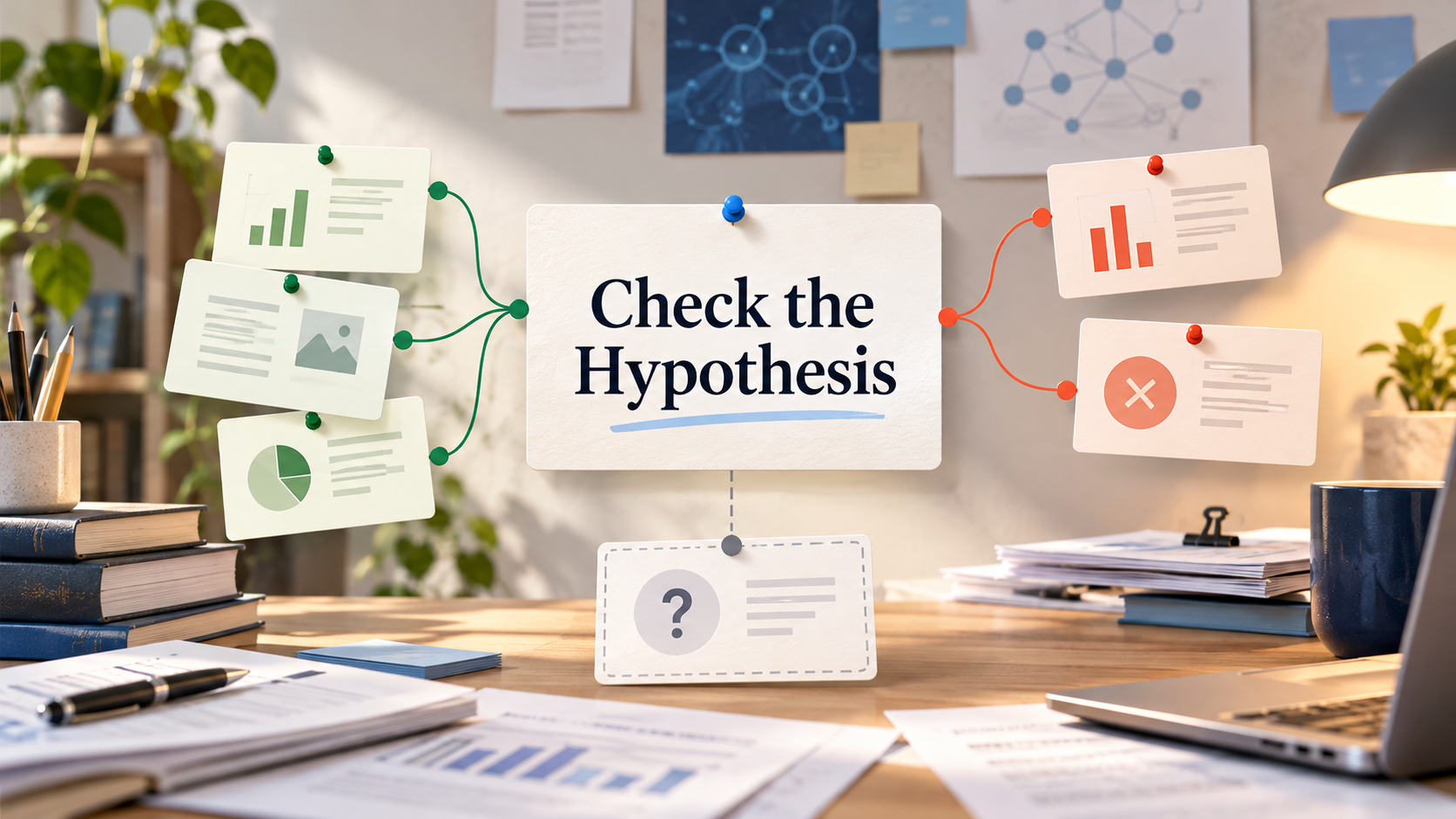
An AI-generated hypothesis can sound scientific before it is testable: “Adaptive AI feedback improves learning by increasing metacognitive engagement.” It contains a cause, an effect, and a mechanism—but each part may rest on different evidence.
Treat the hypothesis as a bundle of claims that must survive separate checks.
Turn the hypothesis into a causal chain
Write the proposed sequence:
adaptive AI feedback → more metacognitive engagement → better learning
Then ask what evidence is needed for each arrow. Does adaptive feedback actually change metacognitive behavior? Does that behavior predict or cause learning gains? Could another factor explain both?
The hypothesis becomes useful when it produces observable predictions, not when it uses impressive terms.
Find evidence for and against each link
Search separately for:
- direct studies of the full hypothesis
- evidence for each mechanism link
- studies in comparable populations and settings
- null or opposite findings
- alternative explanations
Ask the agent to return the closest contradictory study, not just a “limitations” paragraph. A hypothesis supported only by papers selected to agree with it is not being tested.
Check whether the variables can be measured
“Engagement,” “trust,” and “critical thinking” can mean many things. Require an operational definition. What behavior, scale, score, or observation would count as a change?
Then define a result that would make you reject or revise the hypothesis. If every possible outcome can be explained as support, the hypothesis is not doing useful scientific work.
Compare competing hypotheses
For the same observation, generate at least two alternatives:
- adaptive feedback improves learning through metacognition
- adaptive feedback merely increases time on task
- students who already self-regulate are more likely to use adaptive feedback well
Now design evidence that separates them. This step is often more valuable than generating ten versions of the original hypothesis.
Check feasibility, ethics, and contribution
A plausible hypothesis may require unavailable data, an unvalidated measure, or an unethical manipulation. Estimate sample, access, time, skills, and risk before investing in novelty language.
Also ask what changes if the hypothesis is supported or rejected. A testable statement with no meaningful consequence may not be the best research question.
Use WisPaper to build the evidence chain
Search each arrow and each competing explanation separately in WisPaper Search. Save the closest studies to My Library, then ask Library QA which variables, populations, designs, and results each paper actually contains.
Scholar Agent can help generate hypotheses and counterarguments. Keep the final evidence map outside the brainstorming loop so attractive wording does not replace support.
FAQs
Keep Reading

How to Check What’s New Since Your Last Literature Search
Update a literature search without starting over: use dates, saved queries, deduplication, citation alerts, and consistent screening.
How to Compare Papers That Use Different Names for the Same Idea
Compare papers that use different names for similar ideas without erasing meaningful differences in definitions and measures.

Does Adding More PDFs Make an AI Research Answer Better?
See when adding more PDFs improves an AI research answer, when it adds noise, and how to organize sources by evidence role.