
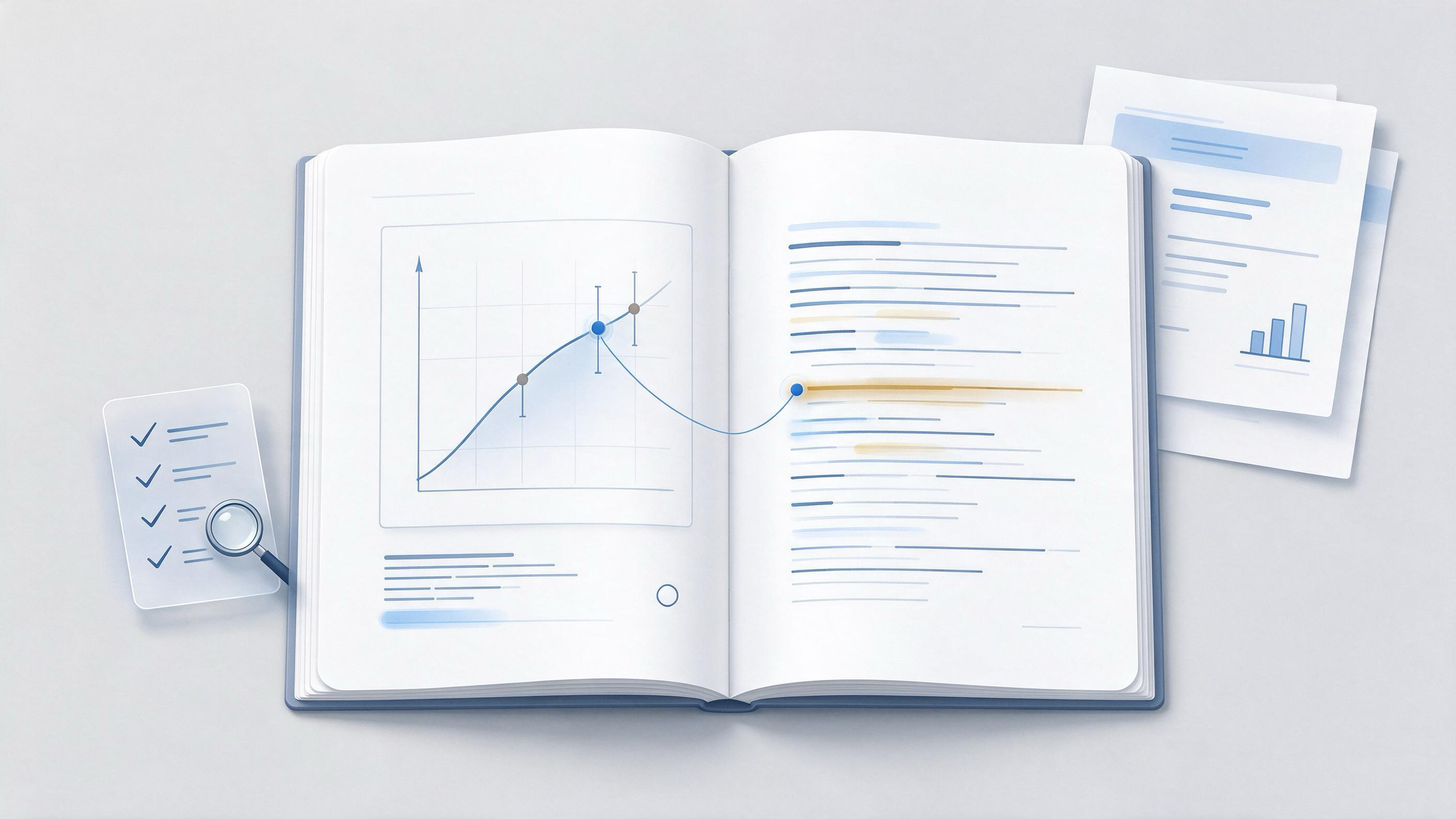
You are deep in revision, and the editor's or coauthor's comment says nearly the same thing in two places: “This figure is not explained in the text” and “The results paragraph just repeats the caption.” Both comments point to a single underlying problem—the figure caption and the results paragraph are being asked to do the same job, so neither does its own job well. This article lays out what each component must accomplish in a manuscript prepared for submission, where authors typically go wrong, and how to check whether the two are working as a pair rather than as duplicates.
What is the actual job of a results paragraph?
A results paragraph reports an observation from the study in a form the reader can evaluate. It names the comparison or measurement, gives the numeric or qualitative result, and states the outcome of the statistical or analytical test. The paragraph exists so a reader can follow the logic from method to finding without having to decode the figure first.
The paragraph is not the place to interpret why the result matters. Its job is to establish what was observed and how strongly the evidence supports that observation. When the paragraph does this well, it gives the reader enough to understand the claim even if the figure were removed, while still pointing the reader to the figure for the full pattern.
A common failure is compression: a paragraph that says only “Figure 3 shows the comparison” and then moves on. That leaves the figure to carry the entire evidentiary burden. The paragraph should state the direction, size, and uncertainty of the finding in words, then direct the reader to the figure as the visual record of the same result.
What is the actual job of a figure caption?
A figure caption makes the figure legible on its own. It identifies what is plotted or displayed, defines the symbols, units, and groups, and gives the minimal context needed to read the image without flipping back to the methods. It should be long enough to make the image interpretable and short enough that it does not become a mini-results section.
The caption's job is identification and orientation, not narration. A caption that says “Results over time” fails because it does not tell the reader what the axes are, what the error bars represent, or which group is which. A caption that recounts the full finding, including the p-value and the direction of every comparison, also fails, because it duplicates the paragraph and invites inconsistency between the two.
A useful test is the detached-reader test: if someone opened only the figure and its caption, could they state what was measured, in whom, under what conditions, and what each marker means? If yes, the caption is doing its job. Whether the finding was significant and what it means is the paragraph's and discussion's work.
Where the two collide in a real revision
Consider a manuscript reporting a longitudinal measurement across three groups. In the first draft, the results paragraph reads, “As shown in Figure 2, Group A declined over time while Group B remained stable.” The caption reads, “Figure 2. Decline in Group A over time compared with stable Group B.” On the surface, both are true. But the manuscript is not ready for submission because the paragraph and caption are now two versions of the same sentence.
The risk is not redundancy alone. When the paragraph and caption duplicate each other, any later edit to one becomes a divergence from the other. A coauthor changes the caption to use “non-significant trend” while the paragraph still says “declined,” and the manuscript now contains two contradictory descriptions of the same figure. Reviewers notice that kind of drift immediately.
The fix separates the two functions. The paragraph carries the claim: “Group A decreased from baseline to week 12 by 14.2 points (95% CI, 8.1–20.3), whereas Group B changed by 0.8 points (95% CI, −3.2 to 4.8; Figure 2).” The caption carries the legibility: “Figure 2. Mean score by group and visit. Points represent group means; error bars represent 95% confidence intervals. A, Group A; B, Group B; C, Group C.” The reader now gets the finding in words and the map of the visual in the caption, with no duplicated claim.
Does the order between text and caption matter?
Yes, because the two have different readers at different moments. The paragraph is read in flow, as part of the argument. The figure and caption are often read out of flow, by a reviewer scanning the figures first or by a reader checking one result before reading the whole section. The caption therefore needs to be self-sufficient, while the paragraph needs to connect the figure to the surrounding logic.
This means the paragraph should not assume the reader has just looked at the figure. It states the result first, then references the figure as the supporting display. The caption does the inverse: it assumes the reader is looking at the figure and supplies the decoding key. Neither component should require the other to be understood.
Tradeoffs when you compress the caption into the paragraph
Authors under word limits sometimes push everything into the paragraph and write a bare caption such as “Figure 4. Results.” This saves words but creates a submission-readiness problem: the figure becomes undecipherable to a reader who encounters it before the paragraph. It also makes the manuscript harder to audit, because the visual evidence and the written claim can no longer be checked against each other without reconstructing the codebook from the methods.
The opposite compression—pushing the full result into the caption and writing a thin paragraph—creates a different failure. It makes the figures readable in isolation, but it leaves the prose argument without evidentiary substance. A reviewer reading only the results text cannot tell what the study found. The tradeoff is not symmetrical; losing the paragraph's substance damages the argument more than losing the caption's detail, because the paragraph is the claim and the caption is the legend.
How to preserve an auditable method trail across both
The caption and paragraph together form part of the method trail a reviewer and a future collaborator will follow. To keep that trail auditable, every number in the paragraph should correspond to a definable element in the figure, and every element in the figure should be named in the caption. If the paragraph reports a confidence interval, the caption should say what the error bars represent. If the paragraph reports a model-adjusted estimate, the caption should say whether the plotted values are adjusted or unadjusted.
This kind of consistency becomes harder to maintain as projects grow. One practical workflow is to keep the figure specification, the analysis output, and the source paper together in a single project space rather than scattered across local folders and email threads. WisPaper's Research Projects area gives researchers a place to hold that material as a project, so the paper behind a figure, the caption draft, and the paragraph draft can be reviewed side by side rather than reconstructed from memory. When you are revising a figure against its source analysis, keeping the project artifacts together makes the check faster and more reliable.
Why the search and source trail changes what you can claim
A results paragraph is only as submission-ready as the sources behind its methods and comparisons. If a reporting guideline or a published comparison was found through an ad hoc search, the trail may not survive a revision query asking where a number came from. This is especially true when a coauthor revises the paragraph months later and needs to confirm which version of a dataset or guideline the claim rests on.
A reproducible-search workflow helps here. Instead of reconstructing a search from browser history, you can run the search through a scholarly interface that returns the papers you relied on, then save those papers into My Library so the evidence set is visible to the whole writing team. When a figure's source paper or a reporting standard needs to be checked again during revision, the trail is already in place.
Submission readiness: comparing the two on the same manuscript
The table below compares a bare caption, a duplicated caption, a bare paragraph, and a separated pair on a single example: a two-group comparison with a 95% confidence interval reported in the text and shown in a figure.
| Component decision | What the reader gets | Main failure mode | Ready for submission? |
|---|---|---|---|
| Paragraph states full result; caption says only “Results” | Strong claim in prose, illegible standalone figure | Figure cannot be read out of flow | Not ready |
| Caption states full result; paragraph says “see Figure” | Legible figure, empty prose argument | Results section has no evidentiary substance | Not ready |
| Both state the full result in similar words | Redundant pair with no clear division of labor | Edits create contradictions over time | Not ready |
| Paragraph states direction, magnitude, CI; caption decodes symbols, units, groups | Claim in text plus self-sufficient figure legend | Needs only a consistency check | Ready, after verification |
The decision rule is simple: the paragraph owns the claim, and the caption owns the legend. Any sentence that would fit equally well in both places is a sentence that has not yet been assigned to its correct component.
A combined workflow for revision and year-end reset
A workable revision workflow for the two components looks like this:
- Extract every figure into a separate view with its caption and the surrounding results paragraph.
- Check each caption with the detached-reader test: can a new reader decode the figure without the methods section?
- Check each paragraph for the claim test: does it state direction, magnitude, and uncertainty in words, or does it defer to the figure?
- Find every number that appears in both places and verify the wording matches exactly.
- Record which source paper or reporting guideline supports each figure's design, and attach that source to the figure in the project space.
This same sequence works when you are closing a project at the end of a grant year and handing a manuscript to a new coauthor. The handoff document should list, for each figure, where the source paper lives, which analysis produced the plotted numbers, and which version of the caption and paragraph is current. Keeping those items in a shared project area means the handoff is a matter of pointing to the project rather than emailing archives.
For the step where a cited source must be verified before submission, TrueCite checks BibTeX entries against real academic databases, which helps catch a reference that drifted out of sync during a long revision. Run that check after the final figure-to-source reconciliation, not before, so it validates the state you are actually submitting.
When a figure needs a source paper you no longer have
During revision, a coauthor may ask where a plotted comparison came from, and the original PDF has disappeared from local storage. Rather than pausing the revision to hunt through email, you can search for the paper through WisPaper search and add the matching record back to the project's library. The goal is not merely to recover the file but to restore the missing link between the figure and the evidence it displays.
Once the relevant papers are back in the library, Library QA lets you ask questions over the papers you have saved, which is useful when the figure's source contains a methodological detail the caption needs to state precisely, such as the definition of a group or the version of an instrument. This keeps the caption's definitions tied to the source text rather than to memory.
How to know the result is ready
The pair is ready when three checks pass. First, the paragraph would still make sense if the figure were deleted, and the figure and caption would still be decodable if the paragraph were deleted. Second, every number in the paragraph maps to a visible element in the figure, and every visible element is named in the caption. Third, the source behind the figure is attached in the project space, and any citation supporting the comparison has been validated.
Before final submission, authors should also follow the selected journal's current instructions for article type and format, and choose a reporting guideline that matches the study design being reported. The ICMJE recommendations describe the standard parts of a manuscript and direct authors to follow the target journal's instructions for required statements and materials. The EQUATOR Network database lets you select a reporting checklist by study type, and the APA Journal Article Reporting Standards provide design-specific modules for quantitative, qualitative, and mixed-methods work. These external checks belong in your submission workflow even though they are separate from the caption-versus-paragraph check itself.
FAQs
Keep Reading
How to Add New Evidence During Manuscript Revision
Revision starts the moment a draft leaves your desk and returns with notes in the margin. For students and early-career researchers, the most difficult revision request is rarely "shorten this paragraph" or "fix the p-va
How to Anonymize a Manuscript for Double-Blind Review
Double-blind review fails quietly. A manuscript can pass a journal's technical check yet still expose the author team through a project name in the methods section, a grant number in the acknowledgments, file metadata, o

How to Archive Decision Letters and Revision Files for Your Next Paper
Your folder of decision letters, reviewer comments, and revision files is not a graveyard of past submissions. It is the raw material for the next project: evidence of what reviewers in your field actually ask for, a rec