
You have a new research topic, and everyone around you seems to know something you do not. They reference the same few studies in passing, assuming you have read them. You have not. Nobody handed you a reading list, and the papers are not labeled "important" in any database.
Seminal papers in a field are the works that shaped how researchers think, talk, and work. They are the studies that introduced the core concepts, settled a major debate, or opened a line of inquiry that dozens of later papers built on. Finding them is a research skill in itself—and one that does not require you to trust citation counts blindly.
This guide walks through a practical workflow for identifying foundational work when you are starting from zero.
What is a seminal paper?
A seminal paper changes how a field approaches a problem. It might introduce a new theory, present a method that becomes standard practice, or organize scattered observations into a framework that other researchers can use.
Think of it this way: when you read a modern paper in the field, the seminal works are the ones cited in the introduction to establish context. They are the papers that gave the field its vocabulary, its key questions, and its standard tools. Later work builds on them, refines them, or argues against them—but rarely ignores them.
Not every highly cited paper qualifies. Some papers accumulate citations because they contain a useful dataset or a specific formula that everyone needs to reference. Those papers are important, but they are not necessarily seminal. Seminal papers are conceptually foundational. They changed how people think, rather than simply giving later authors something to cite.
Why are seminal papers hard to find in a new field?
When you are new to a field, you lack the context that tells you which papers matter. You do not know which authors are considered pioneers, which debates shaped the discipline, or which methods are standard. Everything looks equally important—or equally obscure.
The jargon makes it worse. Seminal papers often introduced the terminology that defines a field, but if you do not know that terminology yet, you cannot search for it effectively. A keyword search for "neural networks" returns thousands of recent results, but the 1986 paper that established the modern approach may not appear on the first page.
The volume of literature compounds the problem. Modern databases index millions of papers, and the count grows daily. Without a strategy, you can spend hours reading abstracts without finding anything foundational. The signal-to-noise ratio is poor, and you need a systematic way to cut through it.
Finally, seminal papers are often old. In fast-moving fields, a paper from 1990 can seem ancient, even if it laid the groundwork for everything that followed. New researchers sometimes skip older work because it feels outdated, not realizing that the modern papers they are reading are just building on those older ideas.
How can review papers point to foundational work?
A good review paper is a map of the field. It summarizes the state of the art, identifies the key debates, and cites the foundational work that shaped the area. When you are new to a field, a recent review is the most efficient starting point you have.
Read the introduction and the historical background sections carefully. These sections often name the classic studies explicitly. Look for phrases like "pioneering work by X," "the foundational study by Y," or "this field was established by Z." Those are direct pointers to seminal papers.
You can also use review papers to build a preliminary list of key authors. If the same researcher's name appears repeatedly across sections, that person has likely made significant contributions. Search for their other papers to find more foundational work.
Start with a review paper published within the last five years. This ensures the review covers recent developments while still referencing the older classics. If you are unsure where to find one, the OpenAlex literature review guide explains how to use that open-source database to locate review articles in your area.
How do citation networks reveal key papers?
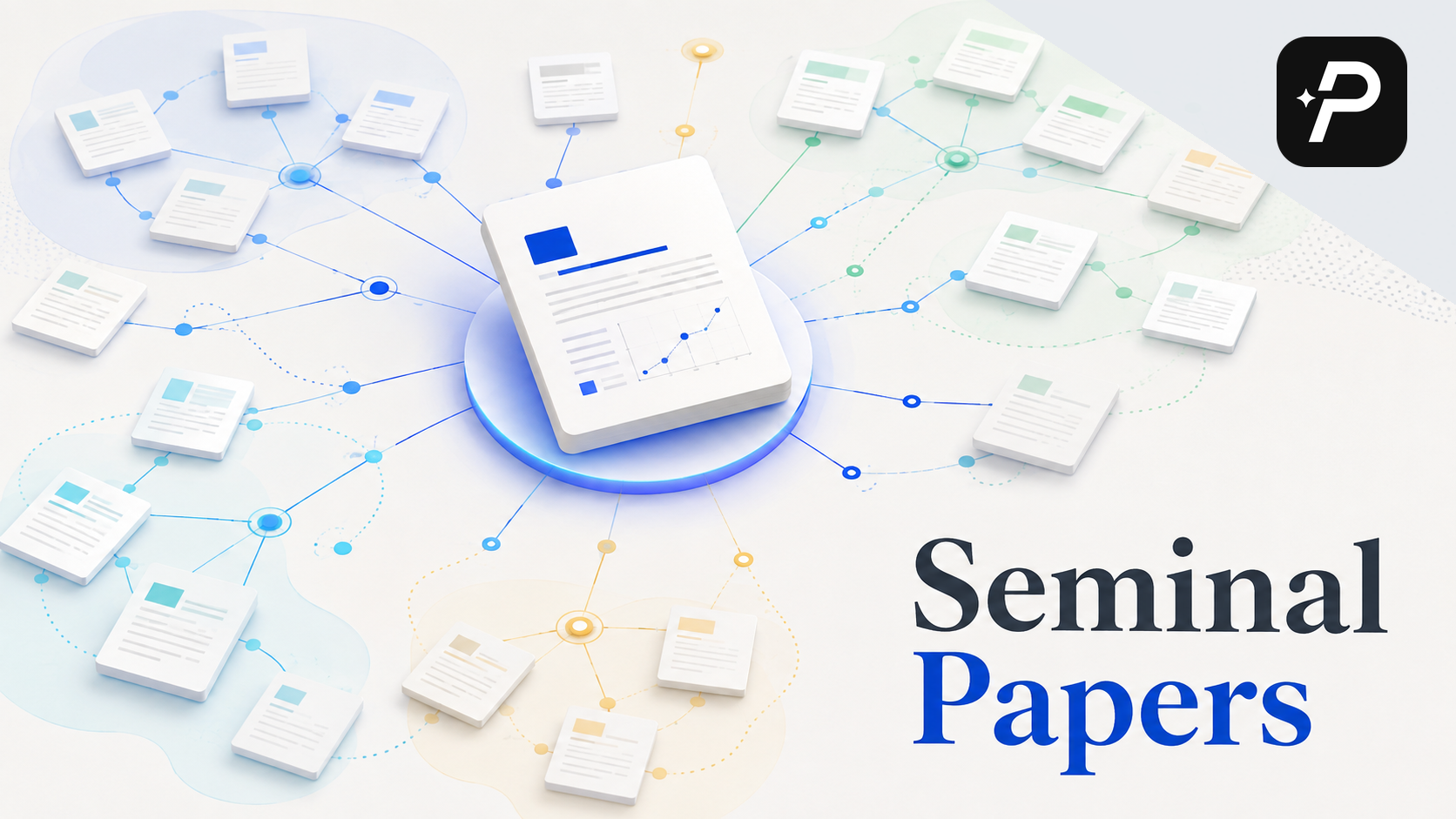
Citation networks show relationships between publications. If paper B cites paper A, then paper B is building on paper A's work. Map enough of these connections, and you can identify the papers that anchor the network—the ones cited by many others across different lines of research.
Two techniques matter here: backward citation chasing and forward citation chasing.
Backward chasing means looking at the references of a paper you are reading. If a modern paper cites an older work, that older work might be foundational. Forward chasing means finding papers that cite a particular work, which shows you how the field developed after that paper appeared.
The backward forward citation chasing guide walks through both techniques step by step. The key is to start with a few seed papers—recent, highly relevant articles in your area—and trace their citation networks outward. This approach is often more effective than keyword search because it relies on the collective judgment of researchers rather than your own search terms.
Citation mapping tools can visualize these networks, making it easier to spot the most connected papers. Tools like Connected Papers, Litmaps, and OpenAlex's citation features all serve this purpose. To understand the strengths and limitations of each, the citation mapping tools compared guide breaks down what each tool does well. The visual representation helps you see which papers are central to the network and which are peripheral.
What signals matter besides citation count?
Citation count is a starting point, but it is not the most reliable signal. A paper can be highly cited because it contains a widely used dataset, a standard method, or a controversial claim that everyone feels compelled to address. None of those make it seminal.
Look at the citation pattern instead. Seminal papers are often cited in the introduction sections of later works, where authors establish background rather than justify a method. When a paper is cited to set the context for a field, that is a sign it is conceptually foundational.
Consider the diversity of citing papers. A seminal paper is cited by researchers from many subfields and often from multiple disciplines. If a paper is only cited by a narrow group of researchers, it may be important to that niche but not foundational to the broader field.
Pay attention to who cites the paper. If leading researchers in the field consistently reference a particular work, that is a strong signal of its importance. If a paper appears in the reference lists of multiple review articles, it has likely earned a permanent place in the field's canon.
Finally, check the paper's longevity. Seminal papers continue to be cited decades after publication. A paper still being cited 20 or 30 years later has demonstrated lasting influence. This is more reliable than a paper that received a burst of citations shortly after publication and then faded.
How do you avoid outdated or over-cited sources?
Not every old paper is seminal, and not every highly cited paper is worth reading. You need to be selective to avoid wasting time on sources that are outdated, superseded, or simply not relevant to your specific question.
First, check whether a paper's findings are still valid. Fields evolve, and what was considered true in 1980 may have been refined or overturned by later research. Look for recent papers that cite the older work. If newer papers confirm the findings, the older paper is likely still relevant. If they correct or extend it, read both to understand the current state of knowledge.
Be wary of citation inflation. Some papers are cited because they are part of standard citation practice, not because they are deeply relevant. A methodological paper might be cited in every study that uses a particular technique, even if the technique is only a small part of the research. These papers are important, but they are not necessarily seminal in the conceptual sense.
The citation network vs keyword search comparison helps clarify when each approach is most useful. Citation networks show you the structure of a field; keyword searches help you find specific topics. Combining both gives you a more balanced view.
Remember that seminal papers are not always the oldest or the most cited. Sometimes a field is defined by a more recent breakthrough that changed the direction of research. Evaluate each paper on its merits, rather than age or citation count alone.
How should you build a first reading queue from seminal papers?
Once you have a set of candidate seminal papers, organize them into a reading plan. The goal is not to read everything at once—that would be overwhelming. You want a focused queue that gives you the context you need to understand the field.
Start by selecting 5 to 10 papers that appear to be the most foundational. These should be the papers cited most frequently in review articles and the ones with the broadest influence. If you are unsure which to choose, look for the papers cited in the introduction sections of multiple recent papers.
Arrange these papers in chronological order. Reading the oldest first helps you understand how the field developed. You will see how early ideas were refined, challenged, and extended over time. That historical perspective is invaluable for understanding why certain concepts matter.
As you read each paper, take notes on the key concepts, methods, and findings. Also note the papers it cites—these might be additional seminal works you missed. This is where the seed papers literature search approach becomes useful. A seed paper is any paper that serves as a starting point for exploration. By following the citation trail from your initial seeds, you can discover more foundational work.
Set a goal for your first reading session. Aim to read at least two or three seminal papers in full. This gives you a solid foundation without overwhelming you. You can add more papers later as you identify gaps in your understanding. For a detailed approach to organizing your reading, the build reading queue research topic guide offers practical steps.
How can WisPaper help explore papers around a new field?
WisPaper is designed for the discovery phase of research—the part where you are trying to figure out what exists and what matters. Several features are directly useful when you are hunting for seminal papers.
Deep Search lets you enter a natural-language research question instead of building a complex Boolean query. If you are starting from a broad question like "What are the foundational theories in behavioral economics?" Deep Search scans the academic literature and returns relevant results, including many of the key papers you need.
Scholar Agent can help refine your research question and suggest directions you might not have considered. If you are unsure how to frame your search, the agent can guide you toward more specific angles—useful when you are entering a field with no clear starting point.
Inspiration Discovery is valuable when your topic is too broad, too narrow, or underdeveloped. If you search for "seminal papers in AI" and get thousands of results, Inspiration Discovery can surface related angles you might not have thought of. It helps you narrow your focus or expand it, depending on what you need.
Once you have identified candidate papers, paper cards provide a quick way to screen them. Each card shows the source, a summary, publication details, authors, and preview information. This lets you assess whether a paper is worth reading in full without opening the PDF.
My Library lets you save papers you want to read later. You can upload PDFs or save papers from your searches. Library QA then answers questions based on the papers in your own library—useful when you want to check what a specific paper says without re-reading the entire text.
WisPaper helps you discover and inspect candidates. It does not rank papers by authority. The final judgment about whether a paper is seminal still requires your own evaluation and understanding of the field.
FAQs
Keep Reading
How to Read a Research Paper for the First Time
Opening a research paper for the first time can feel overwhelming. The dense paragraphs, unfamiliar jargon, and complex data visualizations make many students wonder if they are missing some secret skill. The truth is, r
How to Read Research Papers Faster Without Missing the Point
Reading research papers is a core part of academic life, but the sheer volume of literature can quickly become overwhelming. Whether you are building a thesis bibliography, preparing for a seminar, or scoping out a new f
Can't Understand Research Papers? Start With This Reading Workflow
If you've opened a research paper, read the first paragraph three times, and still closed the PDF with nothing sticking, that's not a comprehension failure. It's a strategy failure. Academic papers are not written to be