
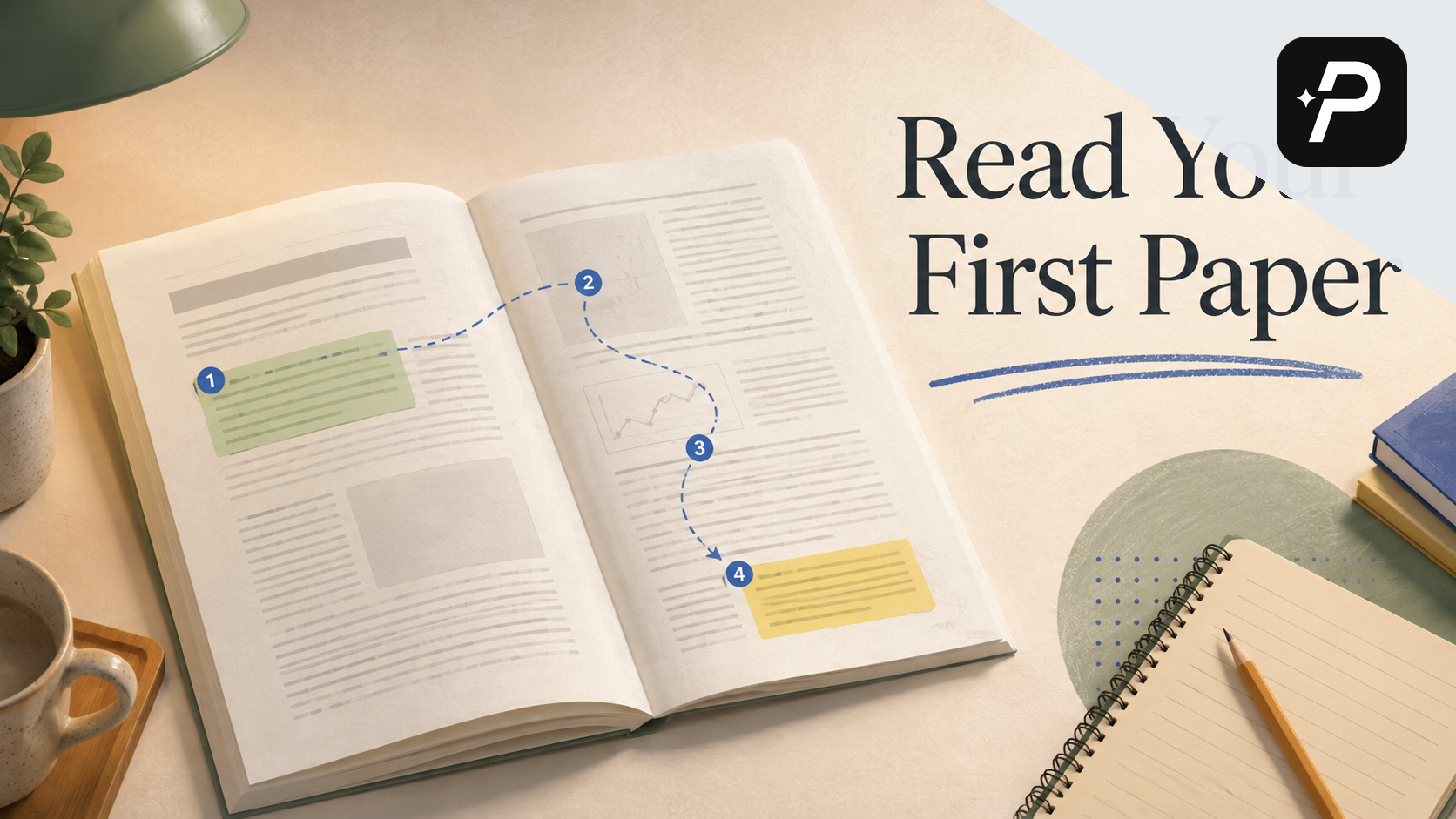
Opening a research paper for the first time can feel overwhelming. The dense paragraphs, unfamiliar jargon, and complex data visualizations make many students wonder if they are missing some secret skill. The truth is, reading a research paper is not about decoding every word in order. It is about learning a strategic reading order that helps you quickly understand what the authors did, why they did it, and what it means for your own work.
This guide is for students facing their first academic paper for coursework, a thesis, or an initial literature review. You will learn a practical, step-by-step approach to reading a research paper for the first time without getting lost in the details. By the end, you will have a clear method for extracting the core contribution of any paper and a system for organizing what you learn.
How should you read a research paper for the first time?
The biggest mistake beginners make is treating a research paper like a novel. They start at page one and read linearly, hoping the meaning will reveal itself by the final paragraph. This approach rarely works because academic writing is not designed to be read front-to-back. Instead, approach the paper as a detective would approach a case: gather clues, form a hypothesis, and verify it against the evidence.
For your first read, follow a three-pass strategy. The first pass is a quick scan to get the big picture. The second pass is a focused read of the key sections. The third pass is a deep dive into the details you need for your specific purpose. For a first-time reader, the goal is simply to complete the first pass and a partial second pass. You want to be able to answer three questions: What is the paper about? What did the authors find? And why does it matter?
A practical reading order for this initial pass is: title and abstract, then figures and tables, then the conclusion, and finally the introduction. Notice that the methods section comes much later. This order allows you to build a mental framework of the paper's contribution before you get bogged down in the technical details. It is a way to read a research paper for the first time that prioritizes understanding over completion.
What should you read before the introduction?
Before you even look at the introduction, read the title, the abstract, and the keywords. These three elements are your first filter. The title tells you the general topic. The abstract provides a condensed version of the entire study, including the main result. The keywords tell you the core concepts and methods used.
After the abstract, your next stop should be the conclusion or discussion section. This might seem counterintuitive, but reading the conclusion early gives you the "answer" before you see the "problem." When you know what the authors concluded, you can read the introduction with a clearer sense of purpose. You are no longer passively absorbing information; you are actively looking for how the authors set up their argument to reach that conclusion.
This pre-introduction reading also helps you decide whether the paper is worth your time. If the conclusion does not seem relevant to your research question, you can set the paper aside and move on to the next source. This is a critical skill for building an efficient reading queue for your research topic. Reading the conclusion early is not about spoiling the ending; it is about giving yourself a roadmap for the journey.
How do you use the abstract without trusting it too much?
The abstract is the most important paragraph in the paper, but it is also a sales pitch. The authors are trying to convince you that their work is novel, significant, and correct. As a first-time reader, you should use the abstract to orient yourself, but you should not accept its claims at face value.
When you read the abstract, you are looking for four pieces of information: the research problem, the methods used, the key results, and the stated significance. Write these down in your own words. This forces you to process the information rather than just skim it. For example, if the abstract says "we show that X causes Y," your note should say "the authors claim X causes Y." The word "claim" is important because it reminds you that this is an assertion that needs to be verified in the body of the paper.
The abstract is also your first test of whether the paper is readable. If you cannot understand the abstract at all, it may be a sign that you need to read some background material first. However, do not give up immediately. Sometimes an abstract is dense because it is packed with information, and a quick look at the figures will clarify everything.
What should you look for in figures and tables?
Figures and tables are the heart of a research paper. They contain the raw evidence that supports the authors' claims. For a first-time reader, the figures are often more accessible than the text because they present data visually. Your goal is to understand the "story" each figure is telling without getting lost in the statistical details.
Start by reading the figure captions. The caption should tell you what the figure shows and what the axes represent. Then, look at the visual elements: Is there a trend? Are there distinct groups? Are there error bars or confidence intervals? For a first-time reader, you are looking for the main takeaway of each figure, not the statistical methodology.
A useful technique is to cover up the figure and try to predict what it will show based on the caption alone. Then, uncover the figure and see if your prediction was correct. This active engagement helps you understand the relationship between the text and the data. If a figure is confusing, do not dwell on it. Mark it with a sticky note or a comment in your PDF reader and move on. You can return to it during your second pass. Remember, the goal of this first read is to understand the paper's contribution, not to master every statistical test.
When should you read the methods section?
The methods section is the most technical part of a research paper, and first-time readers should approach it with caution. Do not read it in detail during your first pass. Read it after you understand the main finding and the paper's argument.
The purpose of the methods section is to answer the question: "How did the authors do what they did?" This is crucial for evaluating the validity of the research, but it requires a certain level of background knowledge. For a first-time reader, read the methods section with a specific question in mind. For example, you might ask: "What kind of data did they use?" or "What was their sample size?" or "What was the main experimental setup?"
If the methods section is too technical, do not panic. You can often get the gist from the abstract and the figure captions. The key is to understand the type of study (e.g., experimental, observational, qualitative) and the scope of the data. You can always return to the methods later if you need to evaluate the paper's rigor for your own research. The goal of your first read is to understand the "what" and the "why," not the "how" in exhaustive detail.
How do you identify the main finding?
The main finding is the single most important contribution of the paper. It is the answer to the research question posed in the introduction. To identify it, look for the "so what?" statement. This is often found in the discussion section, where the authors interpret their results and explain their significance.
A common mistake is to confuse the main finding with the main topic. The topic is what the paper is about (e.g., "the effect of sleep on memory"). The finding is what the authors discovered (e.g., "sleep deprivation impairs memory consolidation"). The finding is a specific, evidence-based claim that the paper supports.
To articulate the main finding in your own words, try the "elevator pitch" test. Imagine you have thirty seconds to explain this paper to a classmate. What would you say? Your pitch should include the topic, the method (in one sentence), and the main result. If you can do this, you have successfully identified the main finding. If you cannot, you may need to re-read the abstract and the conclusion. This is the core skill of learning how to read a research paper for the first time: moving from a vague sense of the topic to a precise statement of the contribution.
What notes should you take after the first read?
Taking notes is not an optional extra; it is an essential part of the reading process. Your notes are your external memory. They allow you to remember what you read, compare papers, and build your own arguments. After your first read, you should take a specific type of note: a summary note.
Your summary note should contain the following elements:
- Citation: Full citation of the paper.
- Research problem: What question were the authors trying to answer?
- Methodology: What did they do? (Keep this to one or two sentences.)
- Main finding: What was the key result?
- Limitations: What did the authors say were the limitations of their study? (This is often in the discussion section.)
- Your thoughts: What do you think about the paper? Is it relevant to your work? What questions do you have?
This note is not meant to be a comprehensive review. It is a quick-reference card that you can use later when you are writing your literature review or preparing for a discussion. A well-organized note-taking system is the foundation of a strong annotated bibliography workflow. By taking structured notes, you are building a personal database of knowledge that will save you hours of re-reading later.
How can WisPaper help with paper reading and source organization?
Reading a research paper for the first time is a skill you build with practice, but the right tools can make the process smoother. WisPaper is designed to support your reading workflow without replacing your own critical thinking.
When you find a paper that looks relevant, you can save it to My Library. This is your personal repository for all the sources you are reading. You can upload PDFs or save papers you find online. Having everything in one place helps you avoid the chaos of scattered bookmarks and downloads.
Once a paper is in your library, you can use Library QA to ask specific questions about the papers you have saved. For example, if you are reading a paper and forget what the authors concluded about a specific variable, you can ask Library QA to find that information for you. This is a powerful way to quickly locate details across multiple papers. However, it is crucial to remember that Library QA is a tool for retrieval and clarification, not a substitute for your own reading. The tool can point you to the relevant text, but you must make the final judgment about what the paper means and how it fits into your research.
WisPaper also offers features like Deep Search, which can help you find academic literature using a natural-language research question. This is useful when you are just starting and do not know the correct Boolean search terms. Scholar Agent can help you explore research questions and paper directions inside the search workflow. And Inspiration Discovery can surface related angles when your topic is too broad, too narrow, or underdeveloped. These features are designed to help you find the right papers to read in the first place.
The paper cards in WisPaper show source labels, summaries, publication details, authors, and preview information. This is perfect for quick screening during your first pass. You can use the summary to decide if a paper is worth a full read, and the source labels to assess its credibility. For more tips on managing your sources, see this guide on how to manage your PDF library for a literature review and how to avoid source overload in your literature review.
FAQs
Keep Reading
How to Read Research Papers Faster Without Missing the Point
Reading research papers is a core part of academic life, but the sheer volume of literature can quickly become overwhelming. Whether you are building a thesis bibliography, preparing for a seminar, or scoping out a new f
Can't Understand Research Papers? Start With This Reading Workflow
If you've opened a research paper, read the first paragraph three times, and still closed the PDF with nothing sticking, that's not a comprehension failure. It's a strategy failure. Academic papers are not written to be
How to Understand the Methods Section of a Research Paper
The methods section is often the most intimidating part of a research paper. It is dense, technical, and packed with jargon that seems to assume you already know the experiment by heart. If you are a student, thesis writ