
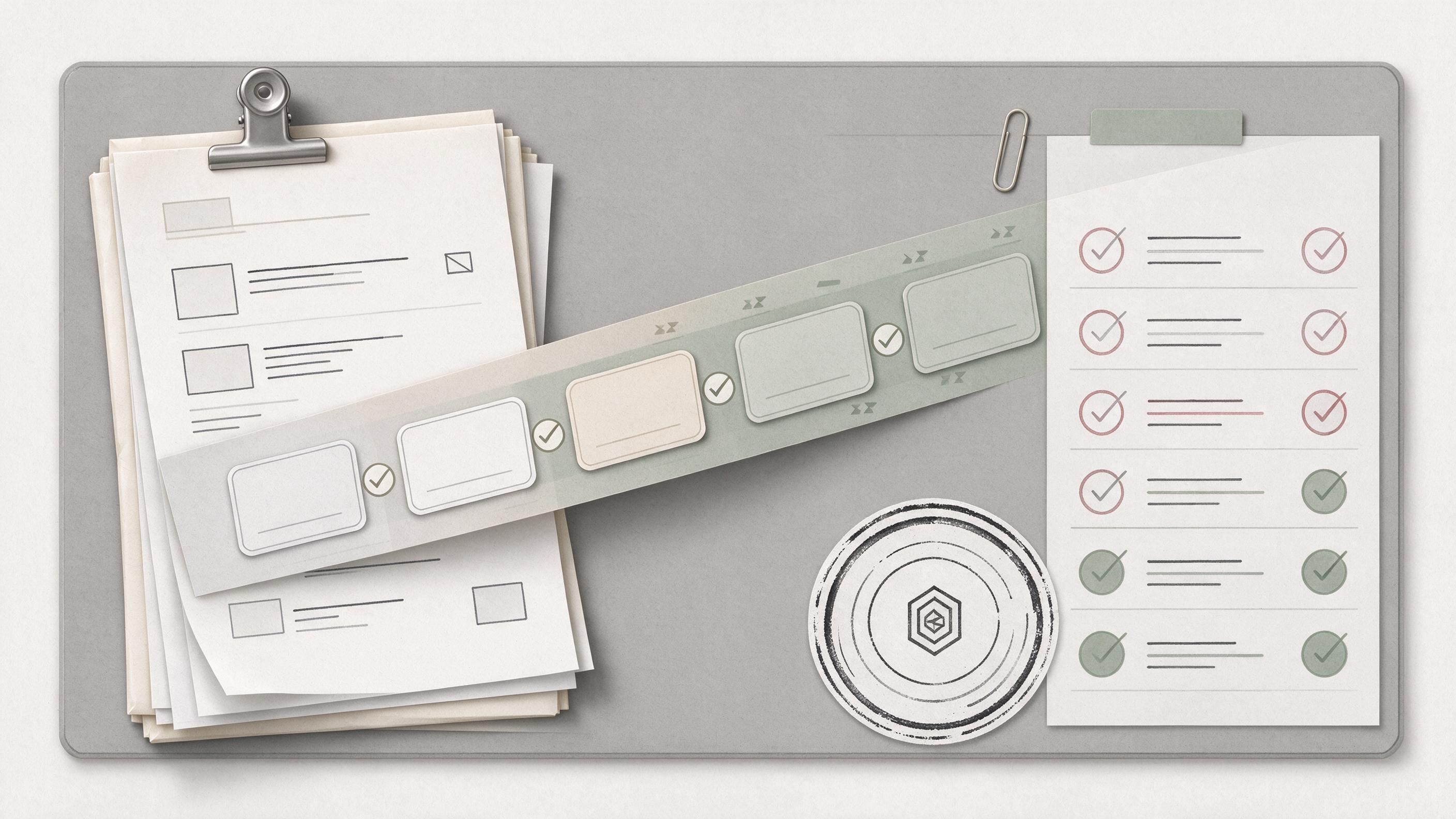
Final approval from every coauthor is the last gate before submission, and it is usually the step where manuscripts stall. The practical question is not whether coauthors agree in principle. It is whether you can produce a documented, auditable record that each listed author has reviewed the exact version you intend to submit and confirmed their accountability for it. This article gives a repeatable sequence for collecting that confirmation, with checkpoints, a worked clinical example, and explicit completion criteria.
Who must approve before the manuscript is final?
The approval list should match the final author list, not the working group. The ICMJE defines authorship through four criteria, and one of them is approving the final version of the work and agreeing to be accountable for all aspects of the work. That means the approval task applies to every person whose name appears in the byline. Contributors who do not meet all four authorship criteria should instead be acknowledged as contributors rather than moved into the approval loop under a weaker standard.
The ICMJE framework also makes the accountability condition explicit: each author should be able to identify which coauthors are responsible for specific parts of the work, and each author should have confidence in the integrity of the contributions of their coauthors. In practice, this means approval is not a one-line email. It is a confirmation tied to a specific manuscript version and a defensible record of who contributed what.
A controlled vocabulary can make that record easier to assemble and audit. The CRediT taxonomy provides 14 standardized contributor roles, such as conceptualization, methodology, formal analysis, and writing. CRediT roles describe contributions and do not by themselves determine authorship, but they give the team a shared vocabulary for naming each person's contribution in the approval package.
What goes into the final approval package?
The approval package has three components: the exact manuscript file under review, the contributor record, and the confirmation instrument. Sending only a link to an editable document creates version ambiguity. The package should instead fix the version and let every coauthor approve against that fixed artifact.
Start by storing the manuscript and its supporting files in one place where the version is unambiguous. In WisPaper, you can save and organize uploaded papers in My Library, which is useful when several reviewers need to work from the same source files rather than from email attachments with conflicting filenames.
Attach a contributor table built from CRediT roles where each row names a coauthor, their role or roles, and the manuscript sections where their responsibility is most direct. The table does not decide authorship. It makes each author's specific stake in the version visible before approval is requested, which reduces the common delay where a coauthor does not respond because they are unsure what exactly they are being asked to confirm.
Finally, attach a short approval instrument that records the version identifier, the date, and the explicit statement that the author approves the final version and agrees to be accountable for the work. A checklist item is not enough. The instrument should capture a per-author yes or no with a timestamp.
How do you set a realistic approval sequence?
Sequence matters because approvals are dependent. The corresponding author should not chase all coauthors simultaneously against a draft that senior authors have not yet seen. A workable order is:
- Freeze the scientific content with the authors responsible for the core analysis and interpretation.
- Circulate the frozen version to all coauthors with a fixed response window.
- Track confirmed, requested changes, and no response separately.
- Re-circulate only if a change alters the scientific content; otherwise log the change request as acknowledged without reopening approval.
- Close the loop only when every listed author has a recorded approval of the final version.
The checkpoint after step two is the most important. If the manuscript version changes after some coauthors have approved, their approvals are no longer attached to the submitted file. The completion criterion is therefore not "all authors responded" but "all authors approved the exact submitted version."
What questions should you ask before requesting approval?
A question-led review shortens the response loop because it gives each coauthor a defined task. The approval email can ask three questions:
- Does this version accurately represent your contribution?
- Do you identify any error in the data, analysis, or interpretation that would prevent submission?
- Do you approve this exact version for submission and accept accountability for the work?
Question one replaces the open-ended invitation to edit. Question two catches blocking issues. Question three creates the formal record. For teams that need to make the underlying evidence traceable during review, you can pull the papers behind each cited claim into a searchable workspace and run targeted questions against them. WisPaper's Library QA supports asking questions based on papers uploaded to My Library or added from search results, which is useful when a coauthor challenges a specific claim and you need to verify the source before re-opening approval.
What does a tracked approval workflow look like in WisPaper?
A research group can run the approval sequence inside a shared project space rather than across email threads. Use Research Projects to create a project for the submission, then treat the approval record as a project artifact: the contributor table, the versioned manuscript, and the confirmation log live in one place.
The evidence review that feeds the manuscript can stay in the same workspace. When a coauthor asks whether a cited reference supports a claim, the team can search for the original paper and add it to the library for verification. This keeps the approval discussion anchored to sources rather than to memory.
For a deeper literature-checking task, TrueCite checks BibTeX entries against real academic databases to flag hallucinated references. Running a citation screening pass before final circulation reduces the chance that a coauthor's approval is delayed by a reference problem discovered at the last minute.
Worked example: a focused clinical research submission
Consider a team preparing a retrospective cohort manuscript on time to antibiotic administration in adult emergency department patients with suspected sepsis. The byline has six authors: two clinical investigators, one biostatistician, one data manager, a pharmacist co-investigator, and a junior clinician who performed chart review.
The population and outcome are narrow enough that every author can review against a concrete question. The fixed outcome is time from ED arrival to first antibiotic dose in minutes. The fixed population is adults aged 18 or older with suspected sepsis and a documented antibiotic order during the index visit.
The corresponding author freezes the manuscript after the biostatistician confirms the regression tables. The contributor table assigns CRediT roles: conceptualization to the two clinical investigators, methodology to the biostatistician, data curation to the data manager, formal analysis to the biostatistician and junior clinician, writing to the first author, and review and editing to the pharmacist.
Approval requests go out in two waves. The clinical investigators and biostatistician approve the scientific content first. Then all six authors receive the frozen file and the three approval questions. The pharmacist flags that one paragraph describes vancomycin timing in a way the local protocol does not support, so the corresponding author corrects the sentence, increments the version, and re-circulates only the affected page. All six authors then record approval against version 2.1.
Completion is reached only when the approval log shows six recorded approvals, each referencing version 2.1, and no open blocking question.
Reusable approval tracking table
Use this table as a status board. The columns are the minimum viable audit trail.
| Author | CRediT role(s) | Version approved | Approval date | Blocking issues | Status |
|---|---|---|---|---|---|
| First/Corresponding author | Conceptualization, Writing – original draft | 2.1 | 2025-11-03 | None | Approved |
| Senior investigator | Conceptualization, Supervision | 2.1 | 2025-11-04 | None | Approved |
| Biostatistician | Methodology, Formal analysis | 1.0 | 2025-10-28 | None | Re-confirmed for 2.1 |
| Data manager | Data curation | 2.1 | 2025-11-05 | None | Approved |
| Pharmacist | Writing – review & editing | 2.0 | 2025-11-04 | Protocol wording | Resolved then approved 2.1 |
| Junior clinician | Formal analysis, Investigation | 2.1 | 2025-11-06 | None | Approved |
Note that the biostatistician approved version 1.0 and later re-confirmed after the pharmacist's wording change, even though the change did not touch the analysis. The rule is strict: approval attaches to a version, so any content change triggers a targeted re-confirmation.
How do you know the approval task is complete?
Define completion as a closed checklist, not a feeling of consensus. Completion requires all of the following:
- The final author list is agreed and every author meets the ICMJE authorship criteria.
- The frozen manuscript has a unique version identifier.
- Every listed author has returned a recorded yes to the question about approving the exact final version and accepting accountability.
- Any change made after an earlier approval has been re-confirmed by every affected author.
- The contributor record is complete and uses a consistent vocabulary, such as CRediT roles.
- No author has an open blocking question.
If any of these is false, the submission is not ready. The most common failure is a silent gap between an earlier approval and a later edit, so make the version check an explicit step in the pre-submission runbook.
What are the limits of a standardized approval workflow?
A workflow cannot manufacture agreement. It can only make the absence of agreement visible sooner. The ICMJE criteria define accountability as part of authorship, but no system can verify how carefully an author reviewed the manuscript. A recorded approval is evidence that an author accepted the final version, not direct evidence of the depth of their review.
The CRediT taxonomy has a practical limit as well. It standardizes contribution labels, but teams may map the same label to different levels of effort across projects. Treat the contributor table as a communication aid for the approval package, not as a measure of contribution weight.
For the clinical example above, the evidence direction is direct for the outcome of interest because the manuscript is the team's own work. Indirectness and limitations arise mainly from the review process itself: the approval record shows timestamps and version numbers, not reviewer comprehension. A workflow that makes the review questions specific and the version fixed reduces that gap, but does not eliminate it.
FAQs
Keep Reading
How to Compare Manuscript Versions Without Missing Changes
Before a manuscript is ready to submit, revise, or share with a study team, the practical question is rarely “which file is newest.” The real question is: which changes matter, what evidence supports them, and are any de

How to Conduct a Year-End Research Project Inventory
A year-end research project inventory is a structured review that turns a scattered collection of half-finished analyses, saved PDFs, and conference notes into a clear picture of what is ready to submit, what needs revis

How to Consolidate Research Notes at the End of a Project
You have spent months collecting sources, highlighting PDFs, typing marginal comments, and pasting snippets into documents. Now the project is finishing, and the raw material has become its own problem: the same study ap