

You have read twenty papers, highlighted dozens of passages, and collected enough notes to fill a small notebook. Now comes the hard part: turning that pile into a single, coherent argument. The task is to connect multiple sources into one argument that moves your own thinking forward, not to summarize each source one after another.
This guide is for students, thesis writers, and early-stage researchers stuck in the "summary sandwich" phase. You know the one: source A says X, source B says Y, source C says Z, and then the paragraph ends. Instead, you will learn a claim-first workflow that treats every source as a player with a specific role in your argument. You will also see how tools like Deep Search, Scholar Agent, and My Library can help you manage the process without doing the thinking for you.
Why "One Argument" Is Different from "Many Summaries"
When you connect multiple sources into one argument, you are building a chain of reasoning, not a list. Each source should either support a claim, challenge it, refine it, or provide context for it. If a source does none of those things, it probably does not belong in that paragraph.
The biggest mistake early-stage researchers make is treating sources as isolated islands. They write a paragraph on Smith (2020), then a paragraph on Jones (2021), then a paragraph on Lee (2022). The reader finishes the section wondering what the point was. The writer has summarized three papers but has not made an argument.
A single argument starts with a claim that you believe is true or worth exploring. Then you bring in sources to do specific work. One source provides the definition you are building on. Another offers evidence that supports your claim. A third presents a counterexample that forces you to qualify your position. A fourth suggests a method you can borrow. Together, these sources create a conversation, and your argument is the thread that ties that conversation together.
This is the core skill of synthesis. It is about deciding what role each source plays in the story you are telling, not about finding more sources.
Start with a Claim, Not a Source
The most practical way to connect multiple sources into one argument is to start with a claim. Write the claim in one or two sentences before you look at your notes. This claim is your anchor. It tells you which sources matter and which ones are just interesting.
For example, suppose you are writing about remote work and productivity. A weak approach is to say, "Many studies have looked at remote work." That is a topic, not a claim. A stronger claim might be, "Remote work increases productivity only when teams have clear communication protocols." Now you have something to argue. You can bring in a study that supports the communication-protocol point, a study that found no productivity boost in teams without protocols, and a study that suggests the effect fades over time. Each source now has a job.
If you are not sure how to turn your notes into a claim, try the reverse approach. Look at your notes and ask, "What do these sources together suggest?" Write down three or four possible claims. Then pick the one that feels most defensible and most interesting. That claim becomes the topic sentence of your paragraph or the thesis of your section.
This claim-first method also helps you avoid source overload. When you know what you are arguing, you can quickly decide whether a new paper is relevant. If it does not speak to your claim, it goes into a "maybe later" pile. You can learn more about managing that pile in our guide on how to avoid source overload in a literature review.
Give Each Source a Job in the Paragraph
Once you have a claim, the next step is to assign roles to your sources. Think of a paragraph as a small team. Not everyone can be the leader. Some sources will provide the foundation, others will add nuance, and one might play the role of the skeptic.
Here are five common jobs a source can do in an argument:
The Foundation Source establishes the key concept or definition you are working with. You cite it early to show the reader where your thinking starts.
The Evidence Source provides data, case studies, or empirical findings that support your claim. This is the source that makes your argument credible.
The Counterpoint Source disagrees with your claim or presents a finding that complicates it. You bring this source in to show that you have considered the other side, not to undermine yourself.
The Refinement Source offers a nuance or a condition that sharpens your claim. For example, it might show that your claim holds only under certain conditions or for certain populations.
The Method Source supplies a technique, framework, or approach that you plan to use in your own research. This source is less about content and more about process.
When you write a paragraph, you do not need all five roles. You might only need two or three. But naming the role in your head—or in a note—helps you decide what to say about the source. Instead of writing "Smith (2020) found that...," you write "Smith (2020) provides the definition of X that this argument builds on." That small shift changes how you frame the citation.
Use Signposting to Show the Relationship Between Sources
The words you choose to introduce a source tell the reader what kind of relationship exists between that source and your argument. This is called signposting, and it is one of the most underused tools in academic writing.
If you are connecting two sources that agree, use phrases like "Similarly," "Building on this," or "Extending this line of reasoning." If you are introducing a counterpoint, use "In contrast," "However," or "This view is challenged by." If you are showing refinement, use "More precisely," "A more nuanced view comes from," or "This claim holds under certain conditions."
These phrases do more than make your writing flow. They tell the reader how to interpret the sources. Without them, the reader has to guess whether you think Smith and Jones agree or disagree. With them, the argument becomes visible on the page.
Signposting also helps you stay honest as a writer. If you find yourself writing "Similarly" but the source actually contradicts your claim, you have to fix either the signpost or the argument. This is a good kind of friction. It forces you to think carefully about what each source is really saying.
Build a Synthesis Matrix to See the Conversation
A synthesis matrix is a simple table that helps you compare sources across key dimensions. You do not need fancy software. A spreadsheet or even a piece of paper works. The goal is to see, at a glance, where your sources agree, disagree, and complement each other.
To build one, list your sources in the first column. Then create columns for the main themes or questions your argument addresses. For each source, write a short note about what it says on that theme. You might also add a column for "Role in my argument" and "Key quote or finding."
The matrix is especially useful when you are working with many sources and starting to lose track of who said what. It turns a messy pile of PDFs into a structured overview. If you want a step-by-step guide to creating one, see our article on how to build a synthesis matrix for a literature review.
Once the matrix is filled in, you can look for patterns. Which sources cluster around the same idea? Which ones stand alone? Where is the disagreement? These patterns become the building blocks of your argument. You might discover that your sources split into two camps, and your argument is about reconciling them. Or you might find that most sources support your claim, but one important study does not, and that study becomes the pivot point of your paragraph.
Move from Notes to an Argument Outline
A synthesis matrix shows you the landscape. An argument outline shows you the path. The outline is where you decide the order in which your claims will appear and which sources will support each claim.
Start by listing your main claims in a logical order. For each claim, write down the sources that will do the work. You do not need full sentences yet. A rough structure like "Claim 1: Remote work boosts productivity with clear protocols (support: Smith, Jones; counterpoint: Lee)" is enough.
This outline is a working document. You will revise it as you write. But having it in place before you start drafting saves you from the "blank page" problem. You are not staring at a cursor. You are staring at a plan.
If you have already collected a lot of notes, you might find it helpful to convert those notes directly into an outline. Our guide on how to turn paper notes into an argument outline walks through a method for doing exactly that. The key is to stop thinking of notes as summaries and start thinking of them as raw material for claims.
Use Deep Search to Find Sources That Fill Gaps
Sometimes the problem is too few sources, or the wrong ones. You have a claim, but you lack a source that plays a specific role. Maybe you need a counterpoint, or a study from a different discipline, or a more recent paper.
This is where AI-powered academic search can help. Tools like Deep Search allow you to search using a natural-language research question instead of a long Boolean string. Instead of typing ("remote work" OR "telework") AND "productivity" AND "communication", you can type "Does remote work increase productivity when teams have clear communication protocols?" The tool returns relevant papers, and you can quickly scan the results.
The advantage of this approach is that it helps you think in terms of questions, not keywords. You are looking for sources that answer a specific need in your argument, not collecting papers for their own sake. If your claim lacks a counterpoint, search for "evidence against remote work productivity." If you need a methodological model, search for "how to measure communication protocols in remote teams."
Deep Search also helps you audit the sources you find. You can check whether a paper is peer-reviewed, who the authors are, and whether the findings are recent. For more on how to evaluate AI-generated search results, see our guide on auditing academic sources from AI research tools.
Let Scholar Agent Help You Explore the Direction
When you are early in the writing process, you might not know exactly what your argument is. You have a topic, but the claim is fuzzy. This is a good time to use a Scholar Agent, which can help you explore research questions and paper directions.
A Scholar Agent is not a search engine. It is more like a thinking partner. You can ask it to suggest related angles, point out debates in the literature, or help you narrow a topic that feels too broad. For example, if you are interested in "remote work and productivity," the agent might suggest you focus on "the role of asynchronous communication" or "productivity in creative versus routine tasks." These suggestions can help you find a claim that is specific enough to argue.
The key is to treat the agent as a starting point, not an oracle. Use its suggestions to generate hypotheses. Then go to the literature and test those hypotheses. The agent can also help you when your topic is too narrow. If you are stuck on a tiny sub-question with almost no literature, the agent can surface adjacent fields or related concepts that give you more room to work.
For more on how to use AI tools to broaden or narrow your search, see our article on AI academic search beyond Google Scholar.
Use Inspiration Discovery When Your Topic Is Underdeveloped
Sometimes the problem is that your topic is underdeveloped. You have a general interest, but you cannot find a clear angle. This is where Inspiration Discovery comes in.
Inspiration Discovery surfaces related angles and connections that you might not have considered. If your topic is too broad, it can help you find a specific slice. If your topic is too narrow, it can show you adjacent fields where similar questions are being asked. If your topic is just underdeveloped, it can point you to debates, methods, or case studies that give your argument more substance.
For example, if you are writing about "social media and mental health," Inspiration Discovery might surface a paper on "digital detox interventions" or "the role of passive versus active use." These are not random suggestions. They are angles that other researchers have explored, which means they are likely to have enough literature to support an argument.
The point of Inspiration Discovery is to expand the set of possibilities, not to replace your own thinking. Once you have a few new angles, you can go back to your claim-first method and decide which angle gives you the strongest argument.
Use Paper Cards and My Library to Keep Track of What Matters
As you gather sources, you need a system for keeping track of them. Paper cards are a lightweight way to do this. Each card shows the source label, a summary, publication details, authors, and preview information. This is enough to help you decide whether a paper is worth reading in full.
The advantage of paper cards is that they force you to summarize. When you save a paper, you write a one- or two-sentence summary in your own words. This is the first step toward synthesis, not busywork. If you cannot summarize a paper in one or two sentences, you probably do not understand it well enough to use it in your argument.
Once you have saved papers, you can organize them in My Library. This is where you keep the sources you plan to use. You can upload PDFs, save papers from search results, and group them by theme or by the role they play in your argument.
My Library also supports Library QA, which lets you ask questions based on the papers in your own library. This is useful when you are trying to remember what a specific paper said or when you want to compare findings across several papers. Instead of reopening five PDFs, you can ask a question like "What did the papers in my library say about communication protocols and productivity?" and get an answer grounded in your saved sources.
This is not a substitute for reading. You still need to read the papers carefully. But Library QA can help you retrieve information quickly when you are in the middle of writing and need to check a detail.
FAQs
Keep Reading
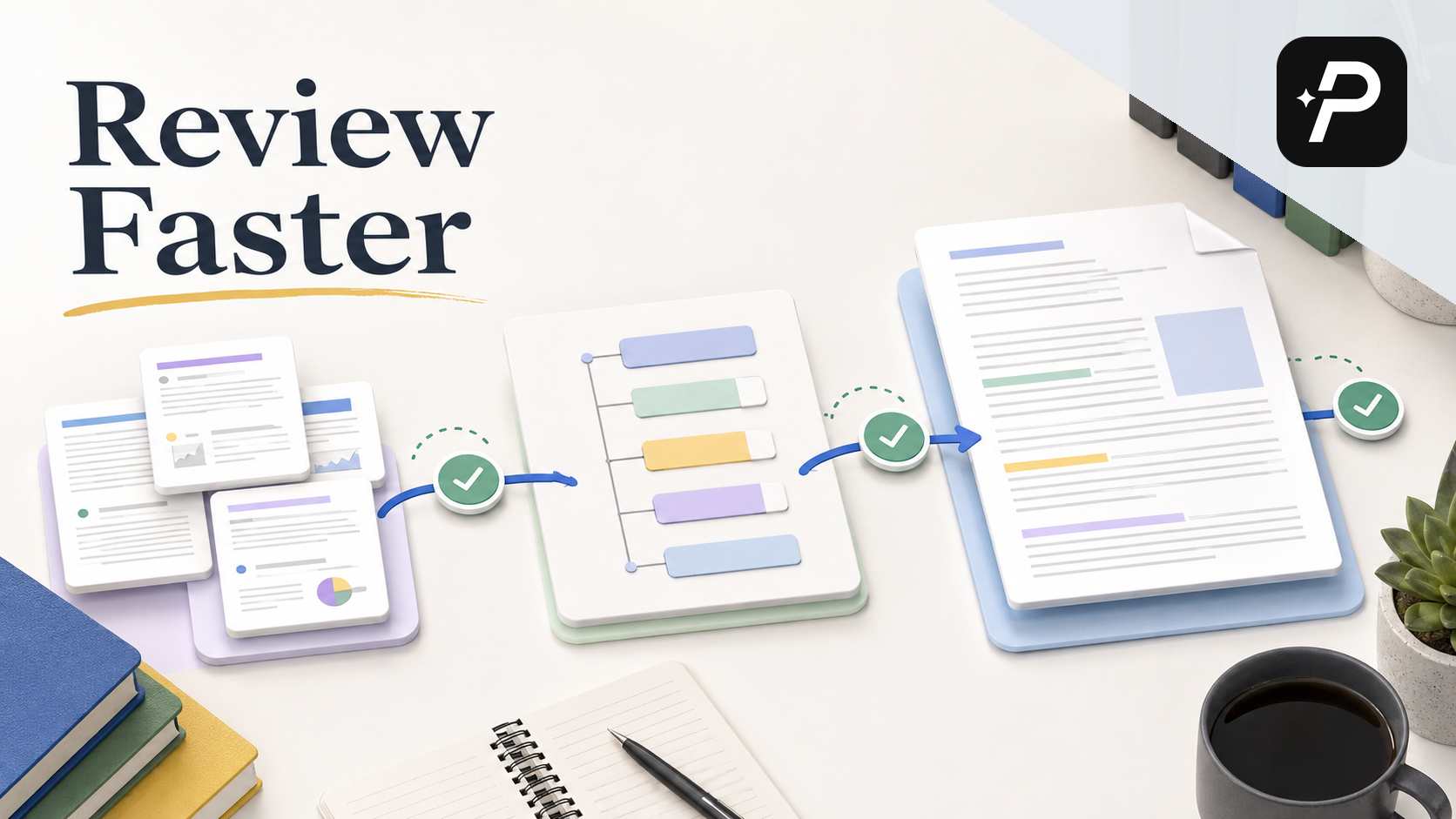
How to Write a Literature Review Faster Without Cutting Corners
A literature review can consume weeks of your research timeline. You collect dozens of PDFs, read them, take notes, and then realize you cannot remember which paper said what. The writing itself becomes a second research

Can AI Find Academic Sources You Can Actually Cite?
You have a thesis due in eight weeks. You type a research question into ChatGPT or Perplexity, and within seconds the chatbot hands you a list of references with authors, journals, and years attached. It feels like a sup

Can ChatGPT Reliably Find Peer-Reviewed Articles?
You have a research question, a blank document, and a deadline. Asking ChatGPT for a list of peer-reviewed articles feels faster than navigating databases, and the results look polished. But can ChatGPT find peer reviewe