
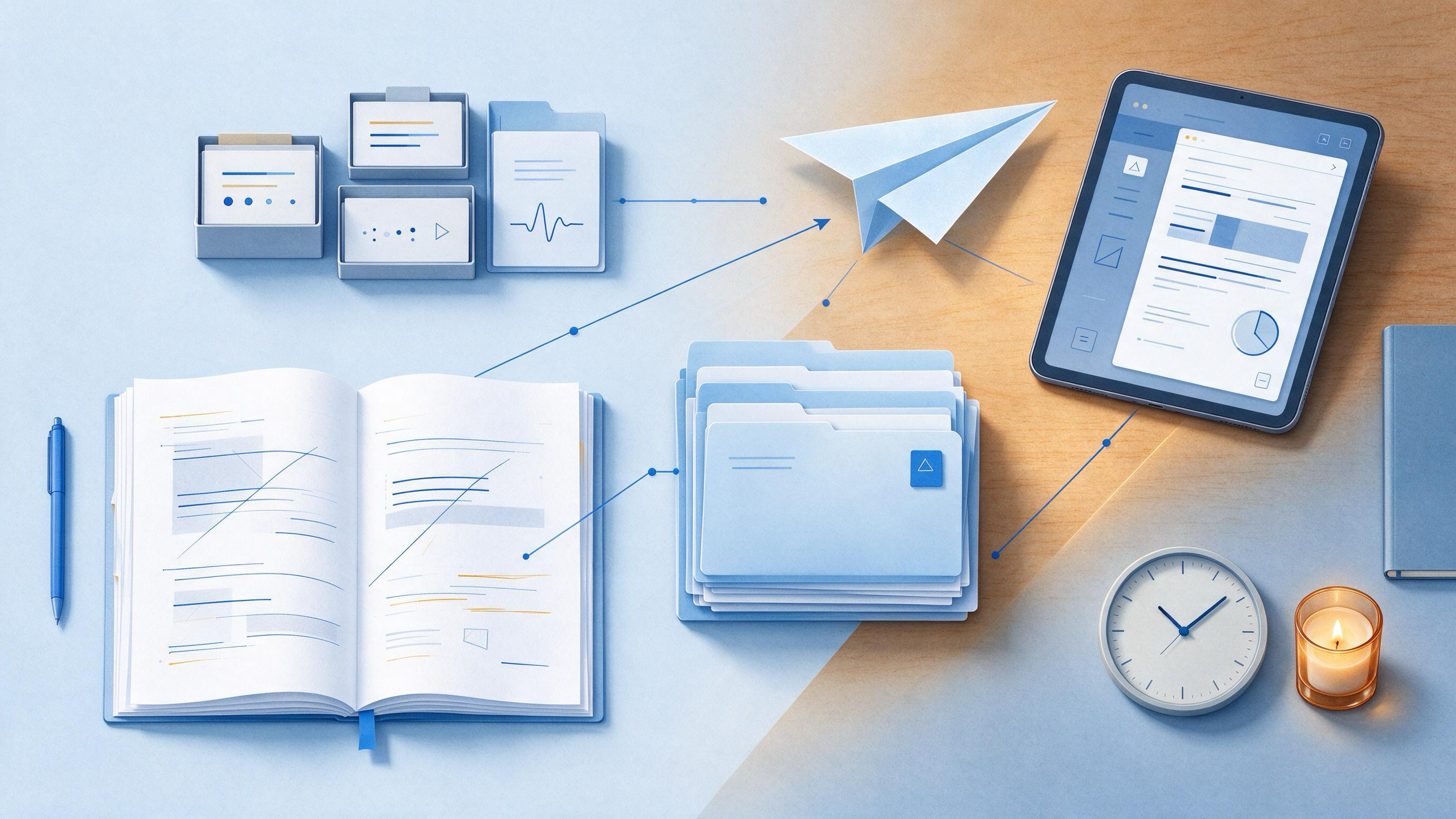
Most restart notes fail before January ends because they list intentions without a handoff. A useful restart note tells your future self what was finished, what is uncertain, where everything lives, and what the first working hour should be. It is not a journal entry; it is an operating document for resuming interrupted research.
The article below walks through a complete process for students and early-career researchers wrapping up a course paper, thesis chapter, or first manuscript. It uses a supervisor-feedback scenario, shows how to assemble the note, and gives explicit checks for knowing the note is ready.
What Problem Is the Restart Note Solving?
After a semester ends, a project often stops in the middle of a thought. The argument may be half-revised, the dataset partially cleaned, and the reference list half-checked. When January arrives, the researcher spends the first days reconstructing context instead of working.
A restart note closes that gap. It records the exact state of submission readiness, the agreed next revision, and the location of every artifact the future self needs. The note should answer one question in its opening section: if I had only 30 minutes to resume this project, what would I do first?
Before writing anything, diagnose the starting state. The evidence brief describes three useful elements for organizing research objects: organized files, documented versions, and metadata that makes items findable and reusable. A restart note applies those same ideas to the project as a whole.
What Does a Submission-Ready Restart Note Contain?
A restart note should be short enough to read in one sitting and specific enough to act on. Keep these five blocks:
- Project state — what is finished, what is in progress, what is blocked.
- Feedback received — the supervisor's or reviewer's main requested changes, in the order they should be addressed.
- Artifact map — the filename and location of the manuscript, data, analysis scripts, notes, and submission checklist.
- Open risks — the claims or results that still need verification.
- First action — a single task that can begin immediately without new decisions.
The artifact map is often the part that saves the most time. Meaningful filenames and documented versions, as the data-preparation evidence suggests, allow someone to understand and reuse the material without the original author present. The January self is effectively a new collaborator who needs that same documentation.
Where Should the Note Live?
Store the note where you will look first in January, not where it is most convenient today. For a thesis or manuscript, keep it alongside the manuscript file. For broader project management, a WisPaper Research Projects area can hold the project context and link the note to the papers and documents that support it.
If the project involves many saved sources, put the reading context in one place. Papers uploaded or organized in My Library become the working set referenced by the note. The note itself should then point to specific library items, so the January self does not re-search for a source that was already found and screened.
The key is to choose one location and state it explicitly in the note. A restart note that says "see my files" without a path fails its purpose.
How Do You Capture Supervisor Feedback Correctly?
Supervisor feedback arrives as margin comments, meeting notes, and verbal suggestions, and it is easy to lose the difference between a mandatory correction and a stylistic preference. The restart note should separate them.
Create a small table with three columns: location, requested change, and decision. For location, record the section, page, or claim. For the requested change, quote or summarize the supervisor's statement. For the decision, write what you will do and, if the request is ambiguous, what you need to clarify before editing.
This prevents a common January mistake: rereading a comment such as "expand the discussion" without remembering what was actually agreed. The note records the decision already made, so the future self can execute rather than renegotiate.
How Do You Map Your Sources and Data?
A manuscript cannot restart cleanly if the supporting material is scattered. The note should list every input the next revision will touch, including the dataset, code, bibliography file, and key published sources.
The evidence briefs describe several useful practices. Organized files, meaningful names, and documented versions help material remain understandable and reusable. The FAIR framing adds findability, accessibility, interoperability, and reusability through rich metadata and provenance. Citation-management practice supports the same goal: collections and tags can record an item's topic, method, or workflow status without duplicating it.
Translate these into concrete entries in the note:
- Data file: exact name, version, and briefly what changed in the latest version.
- Analysis: which script produced which figure or table in the current draft.
- Bibliography: where the citation file lives and which entries still need checking.
- Sources: which saved papers support which section, using collection labels or tags where available.
Where a bibliography file needs verification before submission, WisPaper's TrueCite can screen BibTeX entries against academic databases to flag references that do not correspond to a real indexed source. That check belongs in the note's open-risks block if the reference list has not yet been verified.
What Should You Ask the Library Before You Stop?
After the manuscript and data are mapped, ask focused questions against the saved literature so the note can record settled answers. For papers already uploaded to My Library or added from search results, WisPaper's Library QA supports asking questions based on those stored papers.
Before winter break, use this step to answer two or three questions that would otherwise stall the January restart, such as whether a source actually reports the effect size cited in the discussion. Record the answer and which paper supports it directly in the note. This turns a vague "check the Smith citation" into a settled decision or a clearly identified correction.
Do not use this step to generate new claims. Use it to turn stored evidence into a short status line the future self can trust.
How Do You Structure a Worked Example?
Here is a restart note for a student revising a first manuscript after supervisor feedback. The example is condensed but includes every block described above.
Project state — Full draft complete through Section 4. Sections 5 and 6 are drafted but not yet revised against the second round of feedback. Tables 2 and 3 are current; Table 4 contains a calculation the supervisor questioned.
Feedback to address, in order — 1) Rework the introduction framing per the meeting notes. 2) Re-run the Table 4 regression with the alternative control variable. 3) Add one paragraph connecting the findings to the literature saved in the library folder titled "comparison papers."
Artifact map — Final manuscript: manuscript_v7_june.docx. Data: survey_clean_v3.csv. Analysis: table4_analysis_v2.R produces Table 4. Bibliography: references_v6.bib, verification not yet complete.
Open risks — The bibliography has not been screened, and two discussion claims need a source check before submission.
First action — Re-run table4_analysis_v2.R with the alternative control and compare it with Table 4. If the result changes, mark the discussion text for revision.
This note is usable because each item points to a named artifact and a decision, not an intention.
What Checklist Shows the Note Is Ready?
Use this checklist before closing the project for the term.
- The first paragraph states one concrete first action for January.
- Every artifact mentioned has a filename and location.
- Data and analysis files indicate which draft output they produced.
- Supervisor feedback is separated into required changes and preferences, with a decision for each.
- Open risks list exactly what still needs checking, not vague worries.
- The note points to the stored papers, data, and project location.
- The bibliography verification status is recorded if relevant.
- The note can be read and understood without opening any other file first.
The final bullet is the decisive test. If the note requires the January self to open the manuscript before knowing what to do, the note is not complete. It should contain enough artifact context to stand on its own.
What Is the Difference Between a Restart Note and a Project Plan?
The restart note records where work stopped; a project plan records where work is going. Both are useful, but they answer different questions.
A restart note is retrospective and narrowly scoped to the current draft, dataset, and feedback. It should be short and file-focused. A project plan is prospective and may cover the next paper, the next data collection, or a new research direction. Waiting to write a full plan before recording the restart note usually means the restart note never gets written.
If a January project start is the real goal, the restart note for the old project can end with a short forward section. It names the next project, lists the first information need, and points to the tool or workflow that will support it. For generating research directions from a topic and existing references, WisPaper's Idea Discovery workflow is designed around exactly that input set.
FAQs
Keep Reading
How to Cut a Research Paper to the Journal Word Limit Without Losing Your Argument
Most word-limit problems are not writing problems. They are selection problems. You have more material than the journal wants, and the real task is deciding which 20–30% of the paper carries the argument and which materi

How to Decide Which Research Project to Pause
Deciding which research project to pause is not a single binary choice. It is a portfolio decision made under constrained time, attention, submission deadlines, and funding. The goal is to stop work on the project that c
How to Hand Off an Unfinished Research Project
Handing off an unfinished research project fails most often because the person receiving the work cannot reconstruct what the original researcher knew. A clean handoff is not a polished document; it is a decision-ready p